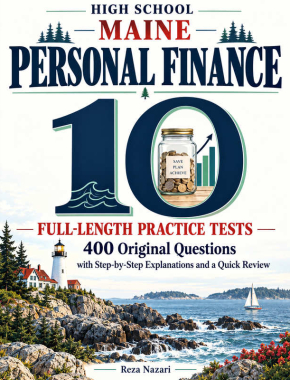
10 Full-Length Maine Personal Finance Practice Tests
10 Full-Length Maine Personal Finance Practice Tests gives high school learners 10 complete forms and 400 original questions in one instant downloadable PDF. The Maine edition pairs topic-tagged answer keys with step-by-step explanations, a Quick Review, Reference Sheet, five-week study plan, and score tracker. Use the first form to see what needs attention, then return to new questions after focused review. The file is ready for screen reading or selected-page printing under the purchase terms.
Know What Earnings Really Include
Income can be described as a salary, commission, gig receipt, or freelance payment. Those figures do not all mean the same thing in a budget. Maine students practice finding what has been earned, what remains after the relevant costs, and what still must be set aside. Ten full-length tests make that careful reading a habit rather than a one-time calculation.
10 Full-Length Maine Personal Finance Practice Tests contains ten complete 40-question forms, 400 original four-choice items in all. Each suggests 60 minutes. Earning, spending, saving, investing, credit, and risk recur in the book’s mix. Students practice recognizing whether a problem is about pay, a purchase, an account, a loan, or protection before they choose the figures and method.
This is an instant downloadable PDF: start with a complete Maine form, then use the worked answers to understand each decision before moving to the next one.
A clear view of what is included
10 complete tests
40 original questions per form.
400 original questions
Four answer choices with a worked explanation for each question.
133-page PDF
One downloadable file with the tests and study support together.
60 minutes
Suggested time for each full practice sitting.
What You Get Inside
Full-length practice
Ten fresh forms provide repeated mixed-topic work.
Answers that teach
Topic-tagged keys and step-by-step explanations show the reasoning.
Quick Review
A concise return to important ideas between test sittings.
Planning tools
A Reference Sheet, five-week study plan, and score tracker support focused review.
Companion pages
Clickable and scannable test QR codes lead to the online companion pages.
What students will practice
Income questions reward students who ask what each figure represents. Maine learners practice distinguishing receipts from money available to spend and checking whether an expense or rate has already been accounted for. The answer choices make those distinctions visible; a number can be correctly copied from a statement yet still be the wrong measure for a budget or comparison.
This matters because income supports other choices. A spending plan cannot rely on a gross amount that is not fully available, while a credit or saving decision needs a realistic estimate of what remains. The mixed forms move between those decisions so learners see how one mistaken income assumption can affect several later answers. Irregular work adds a further challenge: a strong week of receipts may need to cover a weaker one, so planning from the average alone can mislead.
A practical study rhythm
The Maine introduction offers a reading routine that works across the mixed form: define the task, identify what each source figure measures, set up the comparison, and check the result. Some questions use a shared record, so students must return to it with a new purpose. Other items are brief enough for a quick decision. A basic calculator is permitted for the suggested sitting, and the varied format helps learners practice distributing their time between short questions and sources that need a second look.
A five-week plan lets Maine students alternate full tests with topic review. The score tracker makes recurring weaknesses visible, while Quick Review and Reference Sheet pages offer a concise return to the idea that needs attention. Each printed form begins with a QR code for its online companion. On paper, learners can label a figure as gross receipts, cost, or available income and compare that label with the solution.
The answer key tags each question so a learner can tell whether income, spending, or risk is the weak area. Worked explanations expose a rate applied to the wrong base or a cost left outside a take-home estimate. Students may mark uncertain answers before scoring and use those explanations even when they guessed correctly. A later form asks them to recognize the same kind of condition with a fresh occupation or account.
Why Choose the Instant PDF?
Start when you are ready
Download the book after purchase and keep the ten tests in one file.
Choose your working format
Read on a tablet or computer, or print the pages you need for permitted personal or instructional use.
Is This the Right Book for You?
A good fit if
You want mixed-topic high school finance practice, worked answers, and a way to track results across Maine forms.
May not be the best fit if
You need a lesson-by-lesson introductory course before attempting full practice tests.
Your digital copy
This purchase delivers the complete 133-page PDF. It includes the practice tests, answer support, Quick Review, Reference Sheet, study plan, and score tracker. The PDF works for screen reading and for printing selected pages. The linked QR codes can be clicked in the digital file.
Frequently Asked Questions
Is this a digital product?
Yes. The purchase is an instant downloadable PDF, not a mailed print book.
Can I print the practice tests?
Yes. You can print selected pages for use within the terms of your purchase.
Can teachers or tutors use it?
Yes, for guided review, tutoring, homeschool study, and classroom discussion within the purchase terms.
Where should a student begin?
Try one complete form. Read the explanations for missed or guessed answers, then use a later form to check what changed.
Ready for the first form?
By the end, Maine learners can look at an income figure and ask what stands behind it before using it in a plan. The answer explanations make the distinctions visible, and later forms test whether the habit survives a different kind of work.
Download the PDF and begin with the first full form.
Students also viewed
A companion personal finance course for students who want lessons alongside these practice tests.

You must be logged in to post a review.




There are no reviews yet.