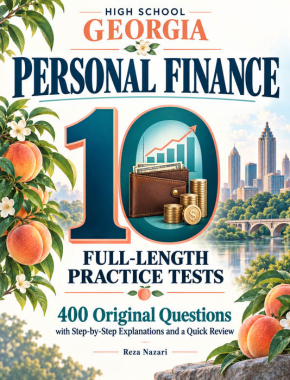
10 Full-Length Georgia Personal Finance Practice Tests
10 Full-Length Georgia Personal Finance Practice Tests gives high school learners 10 complete forms and 400 original questions in one instant downloadable PDF. The Georgia edition pairs topic-tagged answer keys with step-by-step explanations, a Quick Review, Reference Sheet, five-week study plan, and score tracker. Use the first form to see what needs attention, then return to new questions after focused review. The file is ready for screen reading or selected-page printing under the purchase terms.
Compare What You Pay With What You Keep
A low starting price does not always mean a low final cost. Georgia students practice following money through a purchase, including what is paid now, what may come back later, and which fees remain. The same care applies to credit, housing, accounts, and insurance throughout ten complete tests.
10 Full-Length Georgia Personal Finance Practice Tests contains ten 40-question forms, 400 original four-choice items in all. The suggested sitting is 60 minutes per test. Economic decision making, earnings and taxes, budgeting and major purchases, the financial system and interest, credit, and insurance and consumer protection all appear in the mix. Students must decide which figures matter before they calculate.
This is an instant downloadable PDF: start with a complete Georgia form, then use the worked answers to understand each decision before moving to the next one.
A clear view of what is included
10 complete tests
40 original questions per form.
400 original questions
Four answer choices with a worked explanation for each question.
136-page PDF
One downloadable file with the tests and study support together.
60 minutes
Suggested time for each full practice sitting.
What You Get Inside
Full-length practice
Ten fresh forms provide repeated mixed-topic work.
Answers that teach
Topic-tagged keys and step-by-step explanations show the reasoning.
Quick Review
A concise return to important ideas between test sittings.
Planning tools
A Reference Sheet, five-week study plan, and score tracker support focused review.
Companion pages
Clickable and scannable test QR codes lead to the online companion pages.
What students will practice
Georgia’s spending questions ask what value remains after the first transaction. A return, later sale, or financing term can change the net result, so students must follow the decision beyond the moment of purchase. The answer choices make it possible to see how a plausible shortcut goes wrong and to learn which amounts belong together before choosing a result.
The same thinking helps with larger commitments. A loan has a schedule, an account has conditions, and a policy has limits. A reader who can trace what goes out and what comes back is better equipped to judge those terms. Georgia’s forms keep the contexts varied so learners have to select the right comparison for the choice at hand. A rental, purchase, or financing plan can each be sensible for a different purpose. The book asks students to explain which condition makes one fit instead of assuming ownership or the lowest payment is always best.
A practical study rhythm
Georgia’s practice alternates brief decisions with questions that ask readers to work from an offer, statement, or budget. The introduction gives a way to handle both: name the task, find the source details that apply, set up the comparison, and check the answer in plain language. When several items share a source, each still deserves a fresh reading. A basic calculator is permitted for the suggested sitting, while pacing guidance helps students reserve time for the more involved documents.
Each answer has a topic label and worked reasoning. When a choice looks inexpensive only because a later value was ignored, the explanation shows where the comparison changed. A borrowing error may instead call for attention to the payment schedule. Students can check uncertain correct answers as well as wrong ones, then use another form to see whether the same kind of thinking works with a new product.
Georgia learners can use the score tracker to separate spending from credit and other areas rather than judge progress by one total. The five-week plan makes space for Quick Review and Reference Sheet work between full forms. A QR code opens every test to its companion online page. The paper edition leaves room to note both the initial cost and what remains after the transaction, then compare that note with the explanation.
Why Choose the Instant PDF?
Start when you are ready
Download the book after purchase and keep the ten tests in one file.
Choose your working format
Read on a tablet or computer, or print the pages you need for permitted personal or instructional use.
Is This the Right Book for You?
A good fit if
You want mixed-topic high school finance practice, worked answers, and a way to track results across Georgia forms.
May not be the best fit if
You need a lesson-by-lesson introductory course before attempting full practice tests.
Your digital copy
This purchase delivers the complete 136-page PDF. It includes the practice tests, answer support, Quick Review, Reference Sheet, study plan, and score tracker. The PDF works for screen reading and for printing selected pages. The linked QR codes can be clicked in the digital file.
Frequently Asked Questions
Is this a digital product?
Yes. The purchase is an instant downloadable PDF, not a mailed print book.
Can I print the practice tests?
Yes. You can print selected pages for use within the terms of your purchase.
Can teachers or tutors use it?
Yes, for guided review, tutoring, homeschool study, and classroom discussion within the purchase terms.
Where should a student begin?
Try one complete form. Read the explanations for missed or guessed answers, then use a later form to check what changed.
Ready for the first form?
The practice is complete when a student can explain the net result, not merely point to the first price. Georgia’s fresh forms make that explanation earn its place across purchases, accounts, credit, and protection.
Download the PDF and begin with the first full form.
Students also viewed
A companion personal finance course for students who want lessons alongside these practice tests.

You must be logged in to post a review.




There are no reviews yet.