Ordering and Comparing Decimals for 4th Grade
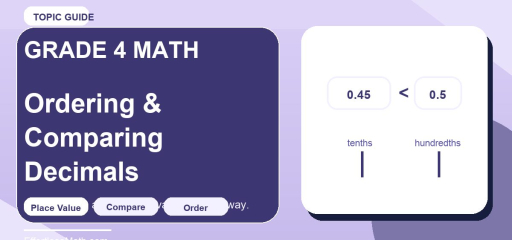
Ordering and Comparing Decimals for 4th Grade: this Effortless Math guide explains the topic in plain language, shows how it works through solved examples, and gives you free practice to try immediately, so the idea sticks instead of staying abstract.
Ordering and comparing decimals helps students read place value carefully and decide which decimal is greater or smaller.
This lesson covers comparing and ordering decimals for fourth-grade math. Use the examples and practice below to build confidence and skill.
Key Ideas to Remember
- Keep place value lined up so dollars stay with dollars and tenths stay with tenths.
- Regroup carefully whenever a column totals more than ten or needs borrowing.
- Estimate first so you can tell whether the final decimal answer makes sense.
Detailed Explanation
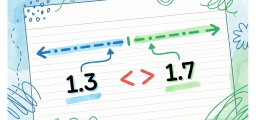
Compare decimals by comparing digits from left to right (tenths, then hundredths). 0.4 is greater than 0.39 because 4 tenths > 3 tenths.
Worked Example
Problem: Which is greater: 0.56 or 0.6?
- Step 1: Apply the concept from the lesson above.
- Step 2: Carry out the operation or reasoning.
Answer: 0.6 = 0.60. Compare tenths: 6 > 5. So 0.6 > 0.56.
Common Mistakes
Students usually improve faster in ordering and comparing decimals when they slow down and watch for a few repeated mistakes. These are the ones worth checking first:
- Not lining up decimal points before adding or subtracting.
- Forgetting that 100 cents equals 1 dollar when regrouping money amounts.
- Dropping zeros that help hold the correct place value.
Pre-Algebra for Beginners 2026 The Ultimate Step by Step Guide to Preparing for the Pre-Algebra Test
Practice Strategy
A short but consistent review routine helps students build confidence with ordering and comparing decimals without getting overwhelmed.
- Solve one vertical-form problem and one word problem involving money or decimals.
- Say the answer aloud in place-value language so each digit keeps its meaning.
- Estimate the result before solving and compare the estimate to the exact answer.
Watch Another Example
Use a second example video to hear the steps explained in a different way and reinforce the same skill from another angle.
Frequently Asked Questions
What is the most important rule in ordering and comparing decimals?
Place value has to stay lined up. When decimal points are aligned, each digit keeps its meaning and regrouping becomes much easier to manage.
Why is estimation useful here?
A quick estimate tells you whether the decimal answer is in the right range before you trust the exact calculation.
What is a fast way to check the work?
Add the difference back, or round the numbers and compare the exact answer to the estimate. Both checks help confirm the result.
Keep Practicing
After finishing this lesson on ordering and comparing decimals, spend a few minutes on mixed review so the skill stays connected to the rest of Grade 4 math.
Need more Grade 4 review? Explore the Grade 4 Mathematics Worksheets hub for extra guided practice, review sets, and printable support.

Related to This Article
More math articles
- Website Speed: How to Build Better Word Games
- The Best Grade 8 Math Book for Oregon Students
- Waves, Tides, Currents, and Ocean Resources
- Capitalism, Socialism, Mixed Economies, and Postindustrial Change
- District of Columbia DC CAPE Grade 3 Math at Home — 49 Free Single-Skill PDF Worksheets
- 6th Grade MAP Math FREE Sample Practice Questions
- Free Grade 8 English Worksheets for Tennessee Students
- The Ultimate ParaPro Math Formula Cheat Sheet
- The Ultimate Precalculus Course
- Multiplication Models: Area Models and Partial Products


What people say about "Ordering and Comparing Decimals for 4th Grade"?
No one replied yet.