How to Find Composite Numbers?
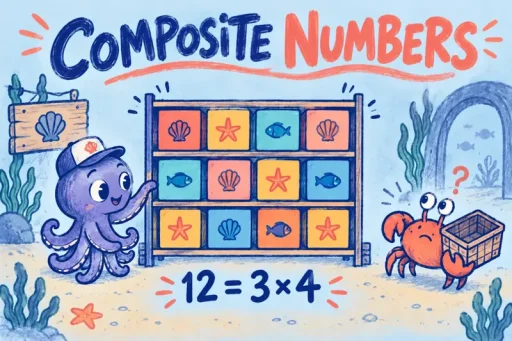
A composite number has more than two factors, which is what separates it from a prime. Every whole number above 1 is one or the other, and 1 is neither. Below: how to test a number by trial division up to its square root, the properties composites share, and worked examples.
In Mathematics, composite numbers are numbers that have more than two factors. Among positive integers greater than 1, a number is either prime or composite. A prime number has exactly two positive factors, i.e. \(1\) and the number itself.
A step-by-step guide to composite numbers
Composite numbers can be defined as natural numbers that have more than two factors. In other words, a number that is divisible by a number other than \(1\) and the number itself is called a composite number.
Properties of composite numbers
A composite number is a positive integer that is obtained by multiplying two smaller positive integers. Characteristics of a composite number are listed below:
- All composite numbers are evenly divisible by smaller numbers that can be prime or composite.
- Every composite number can be written as a product of at least two prime factors, counting repeated factors. For example, 4 = 2 × 2.
For example, \(72=8\times9\), so it is composite. Its prime factorization is \(72=2^3\times3^2\); repeated factors count.
How to find composite numbers?
To find a composite number, we find the factors of the given number. The best way to determine a composite number is to do a divisibility test. The divisibility test helps us determine if the number is prime or composite. Divisibility means that one number is divided completely (without remainder) by another number.
For an integer \(n>1\), try dividing by prime numbers up to and including \(\sqrt{n}\). One exact divisor greater than 1 proves the number composite. If no prime in that complete range divides it, the number is prime. For example, \(42=2\times21\), so no further test is needed.
Do not stop at a fixed list of small primes. The number \(289\) is not divisible by \(2,3,5,7,11\), or \(13\), but \(289=17\times17\), so it is composite. The square-root endpoint must be included.
Why the square-root limit works: if \(n=a\times b\) and both positive factors exceeded \(\sqrt{n}\), their product would exceed \(n\). A composite number therefore has a factor at or below its square root. That factor has a prime divisor in the same range.
Types of composite numbers
The two main types of composite numbers in mathematics are odd composite numbers and even composite numbers.
Even composite numbers
All the even numbers that are not prime are even composite. For example, \(4, 6, 8, 10, 12, 14,\) and \(16\), are even composite numbers.
Odd composite numbers
Every odd positive integer greater than 1 that is not prime is composite. The number 1 is neither prime nor composite. For example, \(9, 15, 21, 25\), and \(27\) are odd composite numbers.
Composite Numbers, Example 1:
Is \(486\) a composite number or not?
Solution:
Its factors are \(1, 2, 3, 6, 9, 18, 27, 54, 81, 162, 243,\) and \(486\). This shows that it has factors other than \(1\) and itself. Therefore, \(486\) is a composite number.
Exercises for Composite Numbers
Which of the numbers is a composite number?
- \(\color{blue}{73}\)
- \(\color{blue}{51}\)
- \(\color{blue}{42,059}\)
- \(\color{blue}{991}\)
Answers
- \(\color{blue}{Not}\)
- \(\color{blue}{Yes}\)
- \(\color{blue}{Yes}\)
- \(\color{blue}{Not}\)
Check the exercise answers
- 73 is prime. Its square root lies between 8 and 9. None of 2, 3, 5 or 7 divides 73.
- 51 is composite: 51 = 3 × 17.
- 42,059 is composite: 42,059 = 137 × 307. Multiplying the factors checks the result.
- 991 is prime. Its square root lies between 31 and 32. Test 2, 3, 5, 7, 11, 13, 17, 19, 23, 29 and 31; none divides 991 exactly.
Start with small numbers and factor pairs before using larger trial-division examples. The Common Core Grade 4 factors and multiples standard introduces prime and composite classification for whole numbers from 1 to 100.

Related to This Article
More math articles
- Dominant Culture, Subcultures, and Countercultures
- How to Use a Venn Diagram to Classify Rational Numbers?
- Ocean Water Changes with Depth
- Sequence Calculator (Arithmetic & Geometric — nth Term & Sum)
- Wisconsin Algebra 1 Free Worksheets: Free Printable PDFs Covering Every Algebra 1 Skill
- How Smart Bettors Use Math to Beat the Books
- 5th Grade North Carolina End-of-Grade Math Worksheets: FREE & Printable
- PSAT 10 Math Practice: Answers to 48 Legacy Questions
- Dividing Dollars: How to Navigate Money Division in Word Problems
- Cattle, Mining, Water, and the Frontier Thesis



What people say about "How to Find Composite Numbers"?
No one replied yet.