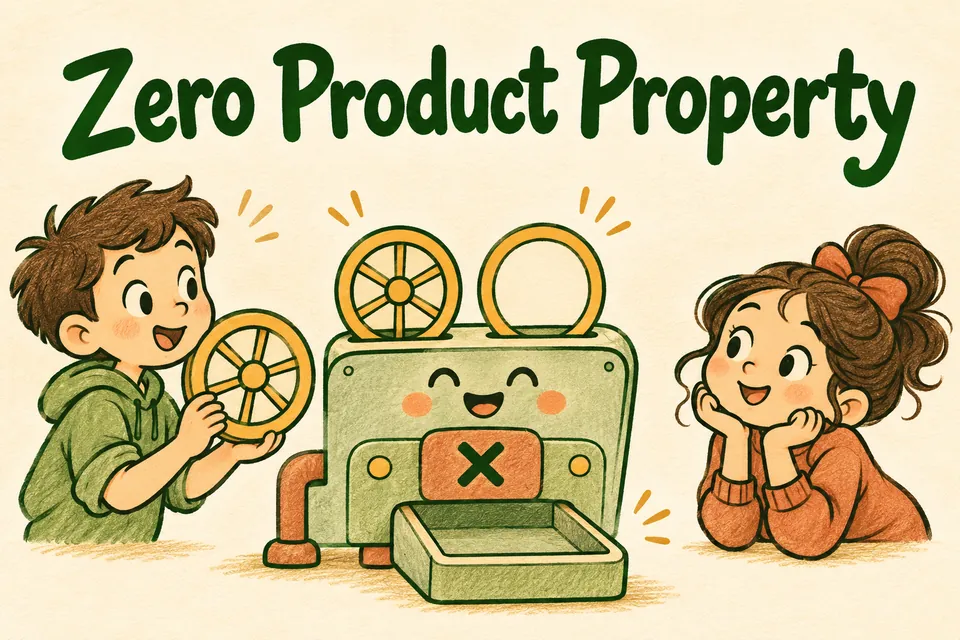
Zero Product Property definition
The zero product property says that if a product of real numbers equals zero, at least one factor equals zero.
Zero Product Property in a picture
How it works
If ab = 0 and a is nonzero, dividing both sides by a gives b = 0. If a is already zero, the property is satisfied. The same idea applies to any finite product of real numbers. To solve by factoring, move all terms to one side, factor, and solve each resulting equation.
Worked examples
Solve x(x − 6) = 0.
The factors give x = 0 or x = 6.
Solve x² = 25 by factoring.
Subtract 25 and factor to get (x − 5)(x + 5) = 0. Thus x = 5 or x = −5.
Solve (2x + 1)(x − 7) = 0.
Solve 2x + 1 = 0 or x − 7 = 0 to get −1/2 and 7.
Common mistake
Use the property after getting zero on one side. From (x − 1)(x + 2) = 4, you cannot set either factor equal to zero.
Quick check
Can both factors be zero?
Show answer
Yes.
Solve x(x + 9) = 0.
Show answer
x = 0 or x = −9.
Does a + b = 0 guarantee that one addend is zero?
Show answer
No. For example, 2 + (−2) = 0.
Sources
Flashcard
Zero Product Property
Reveal the definition
The zero product property says that if a product of real numbers equals zero, at least one factor equals zero.
Effortless Math. “Zero Product Property.” Math Dictionary.