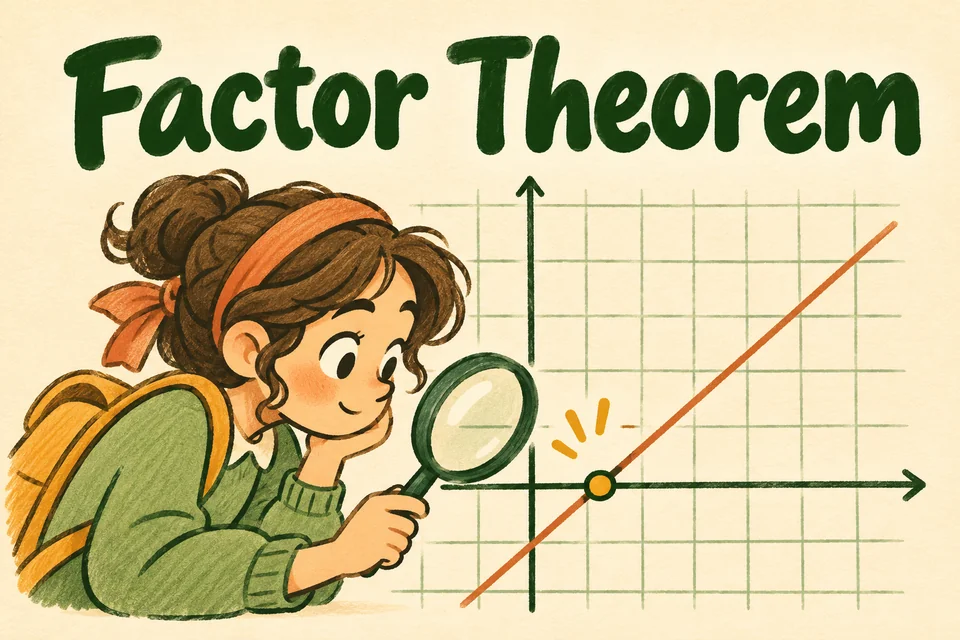
Factor Theorem definition
The factor theorem says x − c is a factor of a polynomial P(x) exactly when P(c) = 0.
Factor Theorem in a picture
How it works
When you divide P(x) by x − c, the remainder equals P(c). A zero remainder means the divisor is a factor. To test x + 3, evaluate P(−3) because x + 3 equals x − (−3). A real zero can correspond to a graph that crosses the x-axis or just touches it.
Worked examples
Is x − 3 a factor of x² − 5x + 6?
P(3) = 9 − 15 + 6 = 0, so yes.
Is x + 2 a factor of x² + x − 2?
P(−2) = 4 − 2 − 2 = 0, so yes.
Is x − 1 a factor of x³ + 2?
P(1) = 3, so no.
Common mistake
Check the sign of c. A divisor x + 5 calls for evaluating at −5.
Quick check
What factor corresponds to a zero of −4?
Show answer
x + 4.
What does a remainder of 2 tell you?
Show answer
The divisor is not a factor.
What is the remainder from dividing x² + 3 by x − 2?
Show answer
P(2) = 7.
Sources
Flashcard
Factor Theorem
Reveal the definition
The factor theorem says x − c is a factor of a polynomial P(x) exactly when P(c) = 0.
Effortless Math. “Factor Theorem.” Math Dictionary.