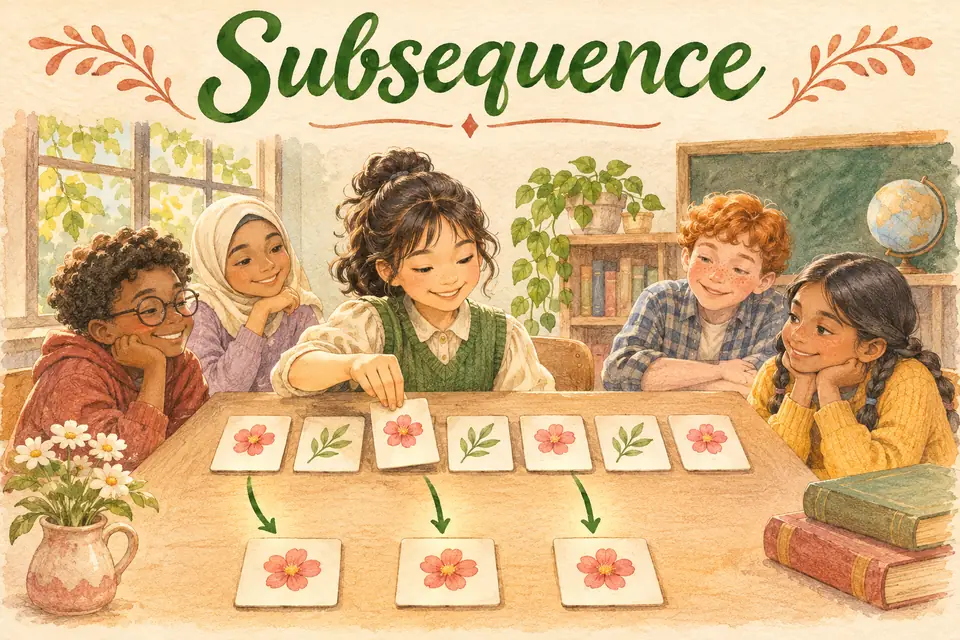
Subsequence definition
A subsequence of an infinite sequence selects infinitely many terms by taking a strictly increasing list of original indices.
Subsequence in a picture
How it works
The selected indices can skip terms, and the selected values stay in the same order. Every subsequence of a convergent sequence has the same limit as the original sequence. Finding two subsequences with different limits proves divergence.
Worked examples
Select the odd terms of aₙ = n.
Use n = 1, 3, 5, … to get 1, 3, 5, ….
Can a subsequence equal the whole sequence?
Yes. Choose every index in order.
What do even terms of (−1)ⁿ equal?
They are all 1, so this subsequence converges to 1.
Common mistake
Keep the original indices strictly increasing. Reversing or repeating selected indices does not give a subsequence.
Quick check
Can values repeat in a subsequence?
Show answer
Yes. The rule concerns indices.
If aₙ → 9, what is the limit of a₂ₙ?
Show answer
9.
Sources
Flashcard
Subsequence
Reveal the definition
A subsequence of an infinite sequence selects infinitely many terms by taking a strictly increasing list of original indices.
Effortless Math. “Subsequence.” Math Dictionary.