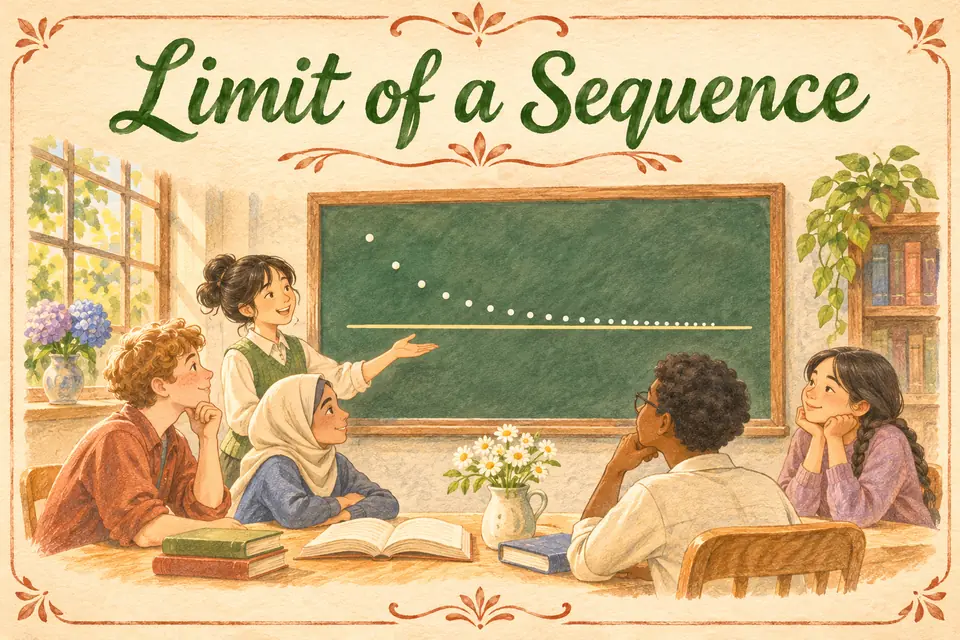
Limit of a Sequence definition
A sequence has limit L if all sufficiently late terms are arbitrarily close to L.
Limit of a Sequence in a picture
How it works
For each tolerance ε > 0, choose an index N so that |aₙ − L| < ε for every n ≥ N. The index N may depend on the tolerance. Early terms need not lie close to the limit.
Worked examples
Find the limit of 3 + 1/n.
The limit is 3 because 1/n tends to zero.
Can a sequence equal its limit at every position?
Yes. A constant sequence does.
Does a term have to reach the limit?
No. The sequence 1/n never reaches 0.
Common mistake
A single term inside the tolerance is insufficient. Every term after the chosen index must satisfy the bound.
Quick check
Can early terms be far away?
Show answer
Yes.
What inequality expresses closeness to L?
Show answer
|aₙ − L| < ε.
Sources
Flashcard
Limit of a Sequence
Reveal the definition
A sequence has limit L if all sufficiently late terms are arbitrarily close to L.
Effortless Math. “Limit of a Sequence.” Math Dictionary.