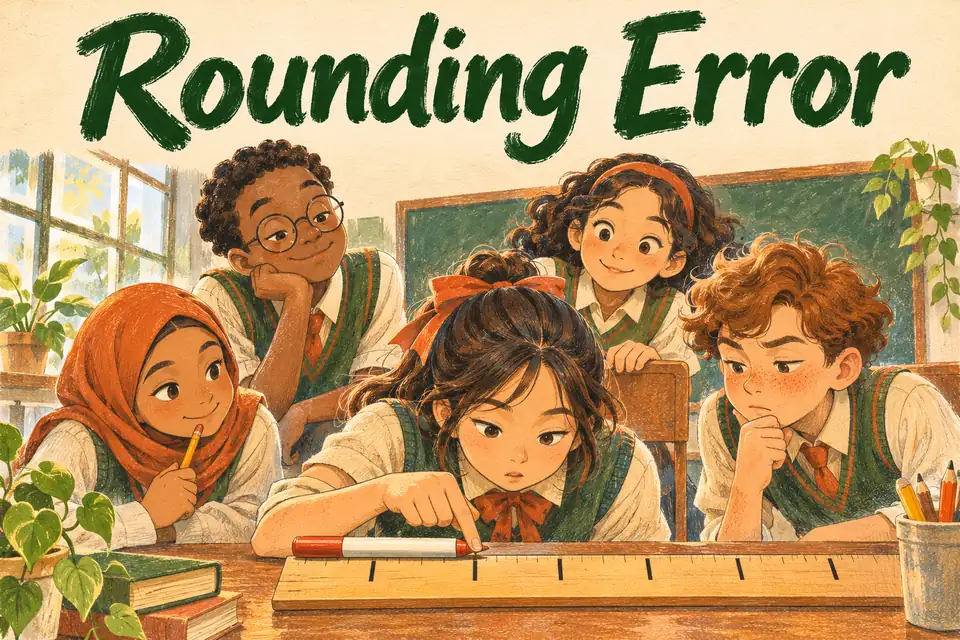
Rounding Error definition
Rounding error is the difference caused by replacing a number with a nearby value that can be written or stored at the chosen precision.
Rounding Error in a picture
How it works
Decimal rounding keeps a specified number of places or significant digits. Computers also round because their number formats have finite precision. A signed rounding error can be reported as rounded value minus exact value, and its magnitude is the absolute error.
Worked examples
Round 7.382 to the nearest tenth and find the error.
The result is 7.4. The signed error is +0.018.
Round 15.241 to the nearest hundredth and find the error.
The result is 15.24. The signed error is −0.001.
What is the largest possible magnitude when rounding to the nearest 0.01?
0.005, halfway between two adjacent rounded values.
Common mistake
Keep extra precision during intermediate work when practical. Rounding repeatedly can change the final result.
Quick check
Can rounding error be zero?
Show answer
Yes, when the value is already representable at that precision.
What unit sets the error bound for rounding to the nearest tenth?
Show answer
The step is 0.1, so the maximum magnitude is 0.05.
What kind of error comes from omitting terms of a series?
Show answer
Truncation error.
Sources
Flashcard
Rounding Error
Reveal the definition
Rounding error is the difference caused by replacing a number with a nearby value that can be written or stored at the chosen precision.
Effortless Math. “Rounding Error.” Math Dictionary.