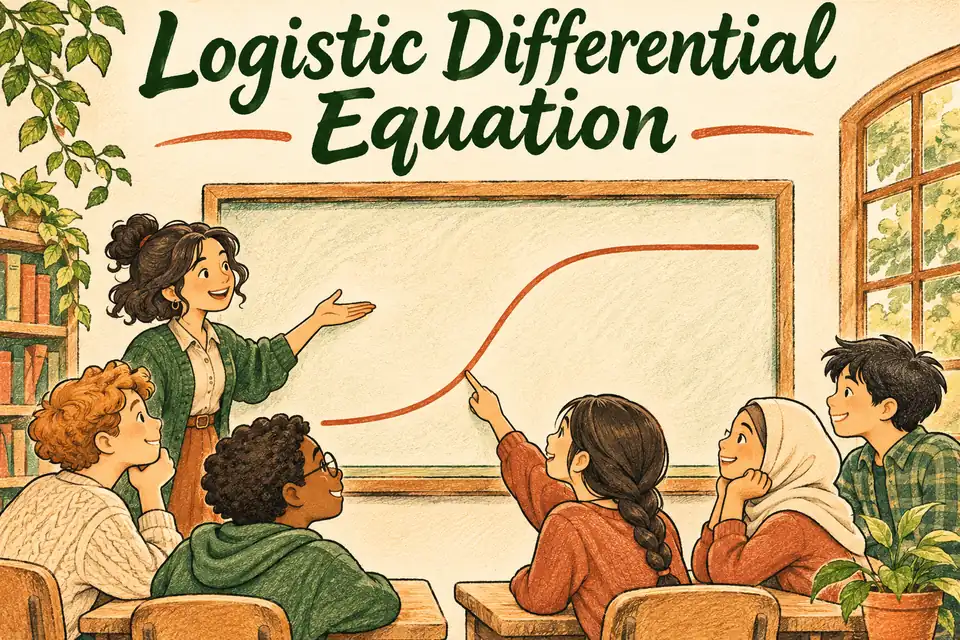
Logistic Differential Equation definition
The logistic differential equation models growth that slows as the amount approaches a carrying capacity.
Logistic Differential Equation in a picture
How it works
A common form is P′ = rP(1 − P/K), where r > 0 is a growth parameter and K > 0 is the carrying capacity. Growth is positive for 0 < P < K and negative for P > K. The equilibria are P = 0 and P = K. Below K, the maximum growth rate occurs at P = K/2.
Worked examples
If K = 200, where are the equilibria?
P = 0 and P = 200.
If P is just above K, what is the sign of P′?
Negative.
If r = 0.2, K = 100, and P = 50, find P′.
0.2 × 50 × (1 − 50/100) = 5 units per time unit.
Common mistake
Keep the factor 1 − P/K. Omitting it gives an exponential model with no carrying capacity.
Quick check
What does K represent?
Show answer
Carrying capacity.
When is growth fastest for 0 < P < K?
Show answer
At P = K/2.
Does P = K change over time?
Show answer
No. It is an equilibrium.
Sources
Flashcard
Logistic Differential Equation
Reveal the definition
The logistic differential equation models growth that slows as the amount approaches a carrying capacity.
Effortless Math. “Logistic Differential Equation.” Math Dictionary.