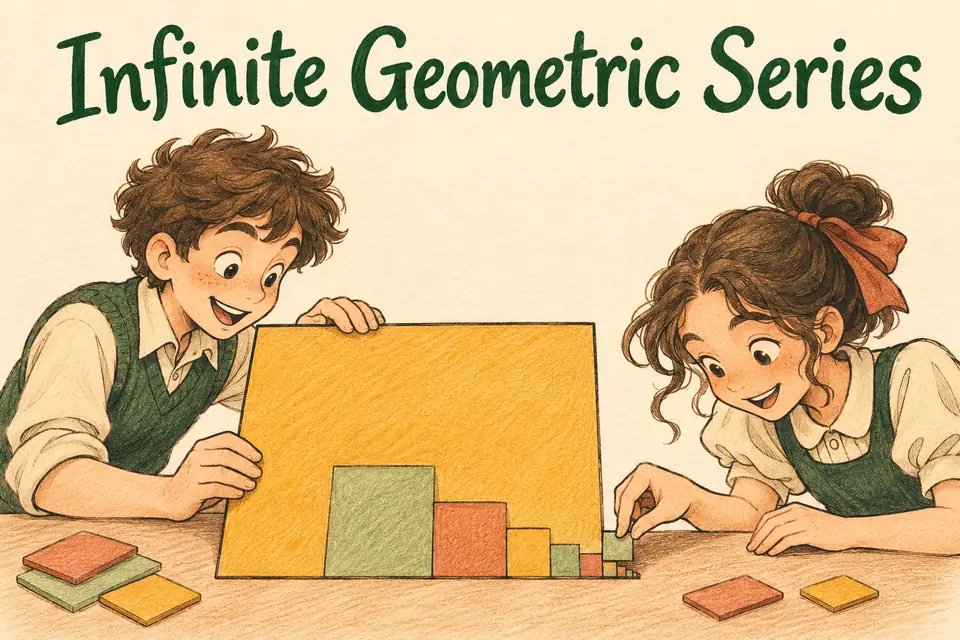
Infinite Geometric Series definition
An infinite geometric series adds all terms of a geometric sequence, with its sum defined as the limit of the finite partial sums.
Infinite Geometric Series in a picture
How it works
For a nonzero first term a, the series a + ar + ar² + … converges exactly when |r| < 1. Then rⁿ approaches zero and the finite sum formula approaches a/(1 − r). If |r| ≥ 1, the terms do not approach zero, so the series diverges. A series of all zeros has sum zero.
Worked examples
Find 6 + 3 + 1.5 + ….
Use r = 1/2. The sum is 6/(1 − 1/2) = 12.
Find 1 − 1/2 + 1/4 − 1/8 + ….
r = −1/2, so the sum is 1/(1 + 1/2) = 2/3.
Does 2 + 4 + 8 + … converge?
No. Its ratio is 2, so its terms do not approach zero.
Common mistake
Check the absolute value of the ratio before using the formula. A large negative ratio also gives divergence.
Quick check
Does r = −0.8 allow convergence?
Show answer
Yes, because |r| < 1.
Find 1 + 1/3 + 1/9 + ….
Show answer
3/2.
Does r = −1 allow convergence for a nonzero first term?
Show answer
No.
Sources
Flashcard
Infinite Geometric Series
Reveal the definition
An infinite geometric series adds all terms of a geometric sequence, with its sum defined as the limit of the finite partial sums.
Effortless Math. “Infinite Geometric Series.” Math Dictionary.