Geometric Series definition
A geometric series is the sum of terms in a geometric sequence, where each term is the previous term multiplied by a fixed ratio.
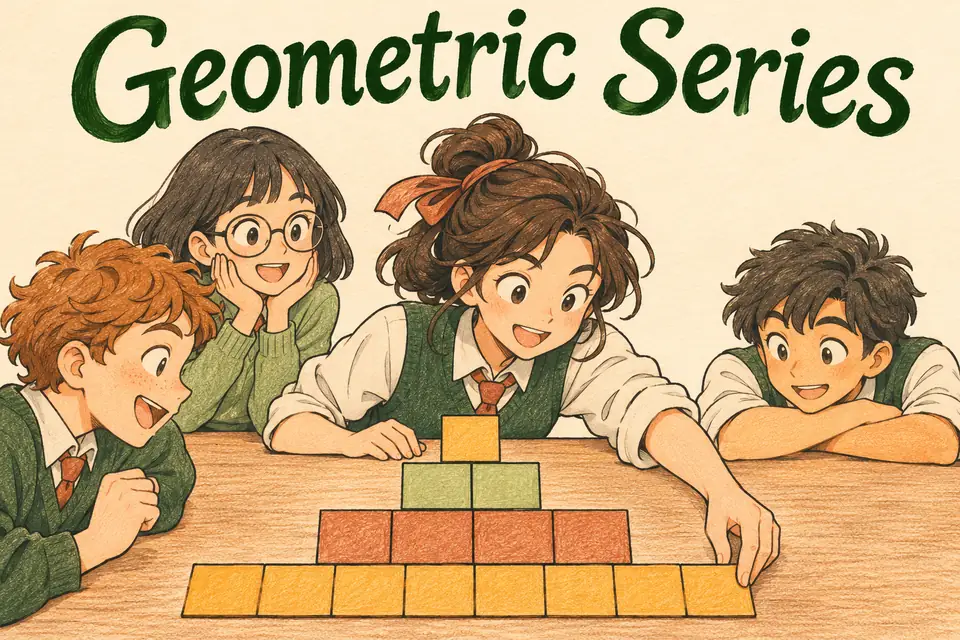
Geometric Series in a picture
How it works
For n terms with first term a and common ratio r ≠ 1, the sum is a(1 − rⁿ)/(1 − r). To derive it, multiply the sum by r and subtract so the middle terms cancel. When r = 1, all terms equal a, so their sum is na.
Worked examples
Sum 1 + 2 + 4 + 8 + 16.
1(1 − 2⁵)/(1 − 2) = 31.
Sum the first three terms with a = 8 and r = 1/2.
8 + 4 + 2 = 14.
Find the sum of five terms each equal to 4.
r = 1, so use 5 × 4 = 20.
Common mistake
Use the ratio, not the difference between terms. Use the finite formula only with the stated number of terms.
Quick check
What is the ratio in 2 + 6 + 18?
Show answer
3.
What is the sum of those terms?
Show answer
26.
What happens to the standard quotient formula at r = 1?
Show answer
It has a zero denominator. Use na.
Sources
Flashcard
Geometric Series
Reveal the definition
A geometric series is the sum of terms in a geometric sequence, where each term is the previous term multiplied by a fixed ratio.
Effortless Math. “Geometric Series.” Math Dictionary.