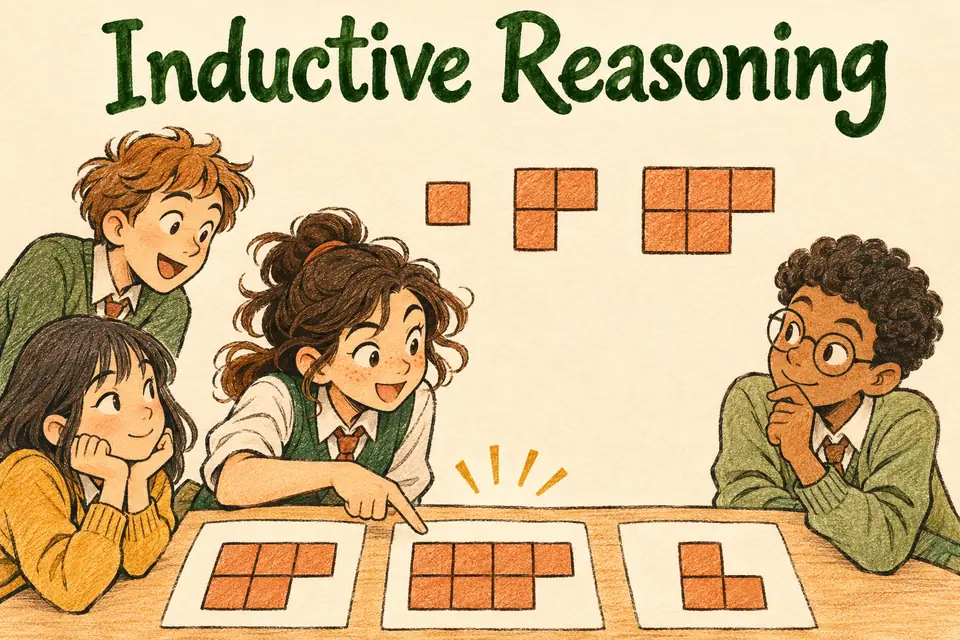
Inductive Reasoning definition
Inductive reasoning uses observations or examples to suggest a broader conclusion.
Inductive Reasoning in a picture
How it works
Look for a pattern and state a conjecture about what may happen in other cases. Supporting examples can make the conjecture more plausible. One counterexample refutes a claim about every case, and a general proof is needed to establish such a claim. Mathematical induction is a separate proof technique.
Worked examples
The numbers 2, 4, 6, and 8 appear in a pattern. What is one plausible next value?
10, if the rule is to add 2. Other rules could fit the observed terms.
All three prime numbers you tried were odd. What refutes the claim that every prime is odd?
2 is an even prime.
Does a fourth confirming case prove the general rule?
No. A proof must cover every case in the claim.
Common mistake
Treat the suggested rule as a conjecture. A finite list of observations can fit more than one rule.
Quick check
Does inductive reasoning start from observations?
Show answer
Yes.
What can disprove a universal claim?
Show answer
A counterexample.
Does mathematical induction use a deductive proof?
Show answer
Yes.
Sources
Flashcard
Inductive Reasoning
Reveal the definition
Inductive reasoning uses observations or examples to suggest a broader conclusion.
Effortless Math. “Inductive Reasoning.” Math Dictionary.