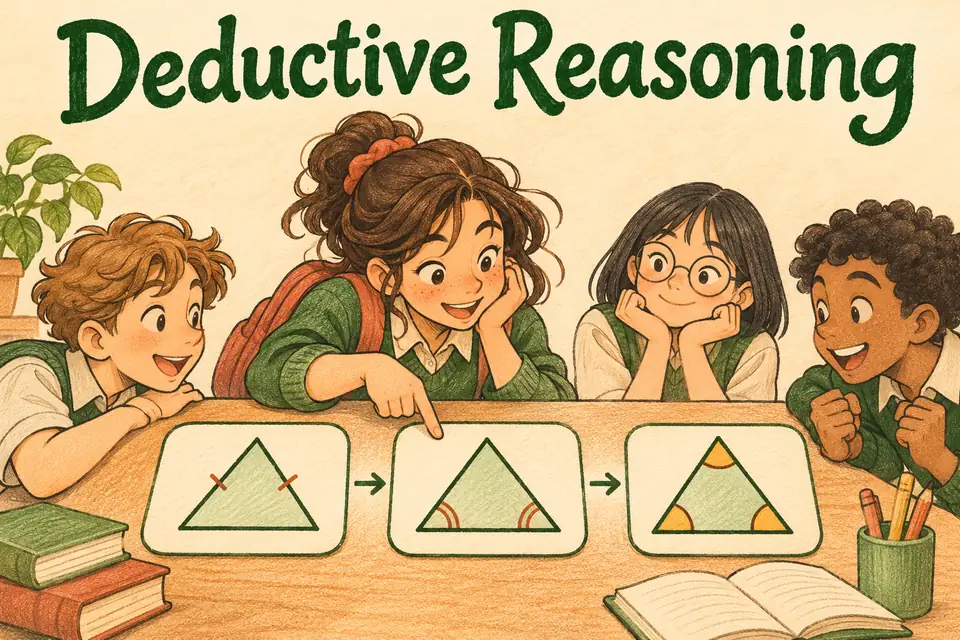
Deductive Reasoning definition
Deductive reasoning uses premises and valid logical steps to reach a conclusion that must follow from those premises.
Deductive Reasoning in a picture
How it works
A deductive argument is valid when true premises cannot lead to a false conclusion. An argument is sound if it is valid and its premises are true. In a proof, definitions, accepted assumptions, and earlier theorems provide premises for justified steps.
Worked examples
Every multiple of 4 is even. What follows for 28?
28 is a multiple of 4, so it is even.
If p implies q and p is true, what follows?
q is true.
Does a valid argument guarantee a true conclusion when a premise is false?
No. Validity guarantees that true premises cannot yield a false conclusion.
Common mistake
A conclusion can be true even when the argument for it is invalid. Check whether it follows from the stated premises.
Quick check
Does a valid proof rely on a logical connection at each step?
Show answer
Yes.
Is looking at several examples by itself a deduction?
Show answer
No.
What is a valid argument with true premises called?
Show answer
Sound.
Sources
Flashcard
Deductive Reasoning
Reveal the definition
Deductive reasoning uses premises and valid logical steps to reach a conclusion that must follow from those premises.
Effortless Math. “Deductive Reasoning.” Math Dictionary.