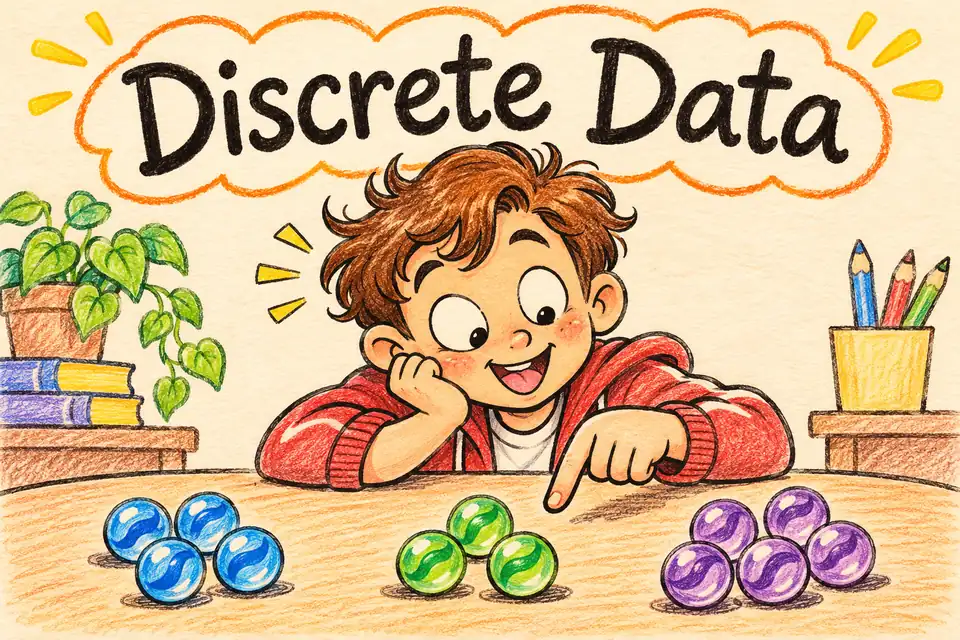
Discrete Data definition
Discrete data have possible numerical values that can be counted one by one. Counts such as numbers of books are common examples.
Discrete Data in a picture
How it works
A discrete variable can have a finite list of values or a list that continues without end, like the nonnegative integers. The values do not have to be integers. Prices recorded in whole cents are discrete because they change in separate steps. A summary of counts can have a fractional value even when the individual counts cannot.
Worked examples
Is the number of cars in a parking lot discrete?
Yes. Its values are whole-number counts.
Is a price recorded to the nearest cent discrete as recorded?
Yes. The recorded values are separated by one cent.
Two households have 1 and 2 bicycles. Can their mean be 1.5?
Yes. An average can fall between allowed individual values.
Common mistake
A fractional mean does not make the original observations continuous.
Quick check
Is the number of calls received in an hour discrete?
Show answer
Yes.
Is unrounded running time a count?
Show answer
No. It is modeled as continuous.
Can discrete data include zero?
Show answer
Yes, when zero is a possible value.
Sources
Flashcard
Discrete Data
Reveal the definition
Discrete data have possible numerical values that can be counted one by one. Counts such as numbers of books are common examples.
Effortless Math. “Discrete Data.” Math Dictionary.