YOUR CRCST CERTIFICATION PREP STARTS HERE
CRCST Certification Online Center
Prepare for CRCST Certification with independent practice, flashcards, and connected lessons. Connect a process with its purpose and the terminology used in the current test outline. Review one skill before your next practice session.
Free study tools · Focused review · Books to compare
CRCST Certification Practice Tests
Use the existing form and explanations to identify a skill to review. Results are study feedback, not official scores.
CRCST Certification Flashcards
Recall the concept and explain an example before revealing the answer.
CRCST Certification Study Guides
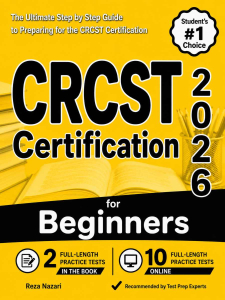
CRCST Certification for Beginners: The Ultimate Step-by-Step Guide to Preparing for the CRCST Certification Exam
Subject-specific independent study. Compare the preview and contents with the current assessment topics before choosing a book.
View book & purchase options →CRCST Certification Quick Review
Choose a lesson or worked explanation, then return to practice.
Open this resource →MEET THE ASSESSMENT · CHOOSE YOUR NEXT SKILL
Know CRCST Certification before you start.
The HSPA CRCST examination has 150 multiple-choice questions with a three-hour testing period. Preparation spans the current seven content domains, including decontamination, preparation and packaging, sterilization, storage, equipment, departmental considerations, and professional relations. Confirm HSPA eligibility and hands-on experience requirements. Independent study does not replace required experience or produce an official certification score.
Official assessment information ↗Decontamination and preparation
Connect a process with its purpose and the terminology used in the current test outline.
Explore this study route →Sterilization and storage
Review how a step fits into the complete workflow instead of recalling an isolated term.
Explore this study route →Departmental work and professional practice
Compare a practice question with the official domain and identify the knowledge it is checking.
Explore this study route →Official assessment guidance
Check the current format, eligibility, and preparation information before test day.
Explore this study route →CRCST Practice Center
Take a full practice test, review the explanations, then use the flashcards to repair the terms and ideas that slowed you down.
CRCST Study Blueprint
Open each area to see what to master. The bars show how this Online Center distributes its lessons, so you can plan study time without mistaking the map for an official exam weighting.
01 Exam plan and sterile-processing foundationsEstablish the workflow, terminology, microbiology, standards, and safety principles. 19lessons
- Department roles, regulations, infection prevention, and PPE
- Medical terminology, quality systems, and risk control
02 Anatomy, instruments, and departmental needsRecognize instruments and adapt processing to clinical use. 16lessons
- Anatomy, procedures, instrument identification, and care
- Operating room, endoscopy, and specialty considerations
03 Cleaning, decontamination, and disinfectionMove contaminated devices through safe, effective soil removal. 14lessons
- Point-of-use treatment, transport, chemicals, and equipment
- Manual and mechanical cleaning, testing, and disinfection
04 Preparation, packaging, and sterilizationInspect, assemble, package, sterilize, monitor, and release devices. 27lessons
- Inspection, assembly, packaging systems, and labeling
- Steam and low-temperature methods, monitoring, and recalls
05 Storage, distribution, equipment, and professionalismProtect processed items and maintain reliable service after sterilization. 15lessons
- Storage, transport, inventory, and patient-care equipment
- Communication, ethics, continuing education, and improvement
Study-map shares describe the learning resources on this page. They are not presented as official test percentages.
CRCST Study Online Center 2026: Every Sterile Processing Exam Topic: a single starting point that brings together the lessons, worksheets, practice tests, and review material for this subject, arranged in a sensible order so you can work through it from start to finish.
Effortless Math • CRCST Sterile Processing Prep Center
One place to learn everything the CRCST certification exam asks of you — from the dirty-to-clean workflow and instrument names to cleaning, packaging, sterilization, storage, and professional practice. Each topic links to a full lesson with plain-language teaching, a short video, and practice questions.
🧬 All 7 exam domains
🛡 Decontamination to sterile storage
🎥 Video for every topic
📝 Practice questions
🃏 Study flashcards
Start Here: What the CRCST Exam Really Measures
The CRCST exam is less about memorizing trivia and more about making safe, defensible decisions. You read a situation, weigh the evidence, and choose what a careful sterile processing technician should do next — clean it, package it, sterilize it, hold it, document it, or escalate. If you understand the whole dirty-to-clean process and why each step exists, you can reason your way through most questions.
Exam details reflect the current HSPA CRCST Certification Handbook and Exam Content Outline. Requirements can change — always confirm the current handbook with HSPA before applying.
How to Use This Online Center
Work top to bottom if you are starting fresh: the first groups build the language, science, anatomy, and instrument knowledge that every later decision depends on. Then move through the seven exam domains in the order the work actually happens — decontamination, preparation and packaging, sterilization, storage and distribution, patient-care equipment, and professional practice. Already comfortable with the basics? Jump straight to the domain you want to review, then finish with the game-plan lessons before test day.
All CRCST Exam Topics
91 of 91 lessons live
Start Here & Exam Plan
Sterile Processing Foundations
- The Hospital, Sterile Processing, and the Patient Journey
- Device Parts, Materials, Joints, and Lumens
- Microorganisms and Resistance
- The Chain of Infection, Bioburden, and Biofilm
- Cleaning, Disinfection, and Sterilization
- Units, Measurement, and Conversions
- Ratios, Concentrations, and Dilutions
- Chemistry, pH, Water, and Contact Time
- Acronyms, IFUs, Standards, and Records
- Disinfectant Families and Safe Use
- Supply Distribution Systems Basics
- Patient-Care Equipment Basics
Anatomy & Surgical Instruments
- Body Directions, Planes, and Cavities
- Major Body Systems and Organs
- Medical Word Parts and Procedure Families
- Cutting and Dissecting Instruments
- Grasping, Holding, and Clamping Instruments
- Retracting and Exposing Instruments
- Probing, Dilating, and Suctioning Instruments
- Specialty, Powered, Endoscopic, and Ophthalmic Instruments
Departmental Considerations
- Temperature, Humidity, and Airflow
- Environmental Corrective Actions and Area Cleaning
- Chemical Safety, SDSs, Spills, Eyewashes, and Disposal
- Attire, Hand Hygiene, and Personnel Practices
- Traffic Control, One-Way Workflow, and Ergonomics
- Regulations, Standards, Guidelines, and IFUs
- Records, Retention, and Legal Documentation
- Quality Benchmarks and Process Improvement
Cleaning, Decontamination & Disinfection
- Microbiology, Infection Transmission, Biofilm, and CJD
- PPE, Bloodborne Pathogens, Sharps, and Area Safety
- Point-of-Use Care and Soiled-Item Transport
- Cleaning Tools, Chemicals, Dilution, and IFUs
- Decontamination Equipment and Efficacy Testing
- Maintenance, Alarms, Feed Lines, Drains, and Outlets
- Reusable vs. Disposable Items and Waste Handling
- Manual Cleaning, Disassembly, Sinks, Water, and Aerosols
- Brushes, Water Quality, and Complex Devices
- Mechanical Washers, Ultrasonics, and Cart Washers
- Ophthalmic Instruments and TASS Prevention
- Spaulding Classification and Disinfectant Selection
- MEC Testing, Exposure Requirements, and Corrective Action
- Drying, Labeling, Transport, Storage, and Documentation
Preparation & Packaging
- Prep-Area Safety, Equipment, and Workspace Readiness
- Visual Cleanliness Inspection
- Function Testing, Damage, and Lubrication
- Instrument Identification and Count Sheets
- Assembly, Positioning, Protection, and Organizers
- Chemical Indicators and Integrators
- Weight Limits and Distribution
- Packaging Compatibility and Selection
- Wrapping, Closures, and External Indicators
- Package Inspection and Integrity
- Labeling and Special Identifiers
Sterilization
- Sterilization Safety and Exposure Control
- Workspace Supplies, Maintenance, and Functionality
- Sterilizer Quality Tests
- Steam and Dry-Heat Methods
- Low-Temperature Sterilization Methods
- Sterilizer Anatomy and Cycle Phases
- Gravity, Dynamic-Air-Removal, Standard, and Advanced Cycles
- Immediate-Use Steam Sterilization
- Package Integrity and Method Verification
- Load Configuration and Prioritization
- Biological Indicators and Process Challenge Devices
- Operation Monitoring and Post-Repair Testing
- Physical Monitoring, Cooling, Staging, and Handling
- BI Incubation, Implant Quarantine, and Early Release
- Failures, Wet Packs, Recalls, and Corrective Action
- Load Records, Traceability, and Retention
Storage, Transport & Inventory
- Storage Safety and Environmental Requirements
- Replenishment, Ordering, and Product Identification
- Breakout Areas, Reconciliation, Inspection, and Shortages
- Shelf Life, FIFO, Storage, and Locator Systems
- Sterile and Nonsterile Distribution and Transport
- Specialty and Vendor Inventory, Recalls, Tracking, and Waste
Patient Care Equipment
Study Flashcards
Flip through the key terms the CRCST exam expects you to know. Click a card to reveal the definition, use Next and Prev to move, and Shuffle to quiz yourself in random order.
A Simple 8-Week CRCST Study Plan
Weeks 1–2 — Foundations
The dirty-to-clean flow, microorganisms and the chain of infection, basic chemistry and measurement, anatomy, and instrument families. This is the language everything else uses.
Weeks 3–4 — Decontamination
PPE and safety, point-of-use care, manual and mechanical cleaning, Spaulding classification, and disinfection. The largest hands-on slice of the work.
Weeks 5–6 — Prep, Packaging & Sterilization
Inspection, assembly, indicators, packaging, and the sterilization methods, cycles, and monitoring that prove a load is safe to release.
Weeks 7–8 — Storage, Pro Practice & Review
Sterile storage, distribution, patient-care equipment, professional skills, then full-length practice tests under real timing.
Make the Most of This Online Center
Bookmark this page and study one topic at a time. Each lesson is written for beginners, pairs with a short video, and ends with practice questions and links to the next topics in the same domain. When you can teach a topic back in your own words, move on — and finish with the game-plan lessons and full-length practice tests before test day.
CRCST Exam FAQ
How many questions are on the CRCST exam?
The exam has 150 multiple-choice questions. 125 are scored and 25 are unidentified pretest questions that do not count. You get three hours to finish.
Do I need work experience to get certified?
Yes. CRCST certification requires 400 hours of hands-on experience. You can complete them before testing, or pass first as a provisional and document the hours within six months. Always confirm the current rule with HSPA.
What are the seven exam domains?
Cleaning and decontamination; preparation and packaging; sterilization; sterile storage and inventory; patient-care equipment; and departmental and professional practice. This Online Center is organized around them.
Is this Online Center an official HSPA product?
No. These are original, independent study lessons. They are not created, reviewed, or endorsed by HSPA. Always verify current exam details in the official HSPA Certification Handbook.
Related Prep Centers
Make This Your CRCST Starting Point
Bookmark this Online Center, pick a topic, and start building real confidence for the sterile processing exam — one clear lesson at a time.
Every lesson in one place
Open a lesson in a new tab and keep this Online Center nearby as your study home.
Browse the complete lesson directory
A USEFUL NEXT STEP
CRCST Certification: study questions
What should I know about CRCST Certification?
The HSPA CRCST examination has 150 multiple-choice questions with a three-hour testing period. Preparation spans the current seven content domains, including decontamination, preparation and packaging, sterilization, storage, equipment, departmental considerations, and professional relations. Confirm HSPA eligibility and hands-on experience requirements. Independent study does not replace required experience or produce an official certification score.
Official source ↗How should I use these independent CRCST Certification study tools?
Start with a practice activity, review explanations for missed questions, and use quick review or flashcards for one weak topic. The practice results are study feedback, not official exam scores. Compare a book’s contents with your course or test requirements before buying.
Resources from Effortless Math · Editorial standards