Praxis 8005 Plant Growth: Where Does a Plant Get Its Mass? (2027 Prep)
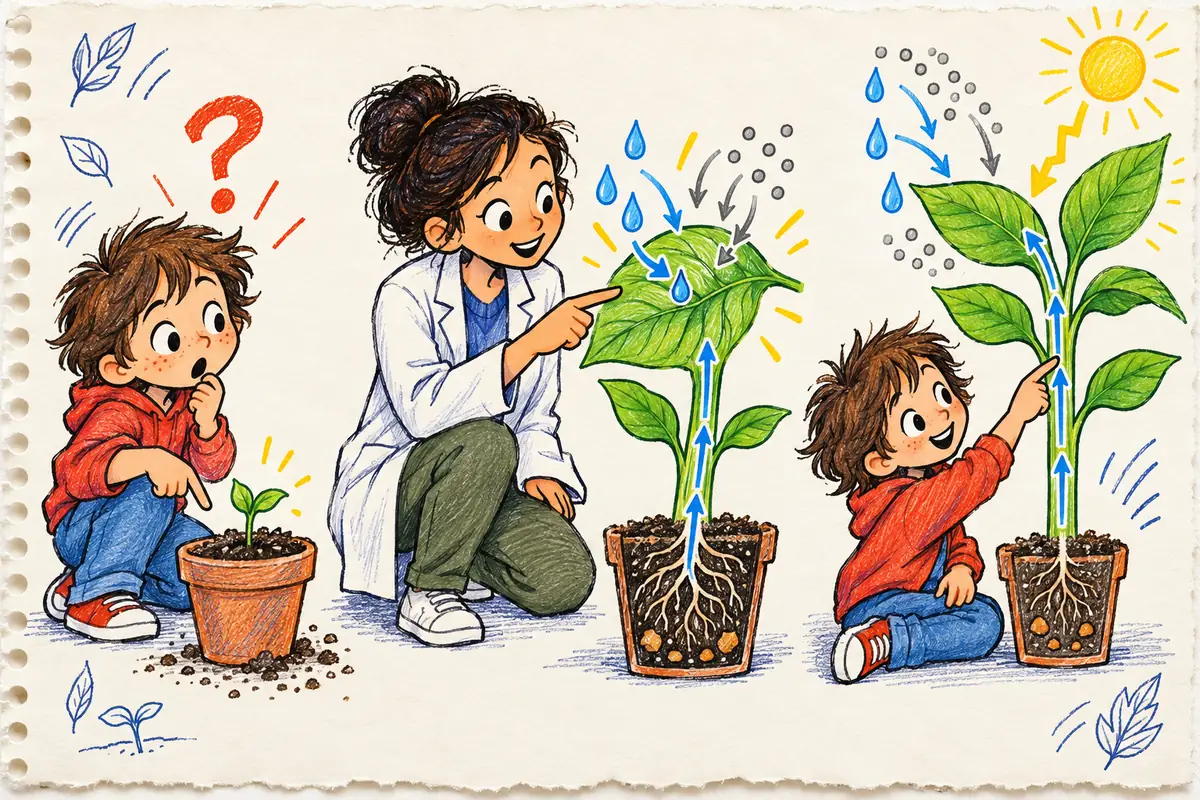
A student points to the pot and says, “The plant ate the soil.” Another points up at the sun: “Sunlight turned into those new leaves.” Both ideas sound reasonable when you watch a seedling grow. Let’s sort them out with a simple model, one careful claim, and a practice question.
The short answer: a growing plant gets most of the matter that builds its body from air and water. Sunlight supplies energy. Soil supports roots and provides water and mineral nutrients, yet its bulk is not the main source of a plant’s added dry matter. That distinction is the heart of this lesson.
This is an original, unofficial study example. It connects an elementary life-science idea with evidence-based reasoning, a useful way to practice for Praxis 8005. It does not predict a specific ETS question.
Praxis 8005 snapshot: science content and teaching applications
ETS lists Elementary Education Fundamentals: Science (8005) as a computer-delivered, selected-response test with 74 questions in 90 minutes. An on-screen scientific calculator is provided. ETS estimates that about 10–15% of questions integrate science content with a Science and Engineering Practice, while another 10–15% ask you to apply science ideas in a teaching scenario or instructional task. Some items may be unscored. Life science is one part of the assessment, but ETS does not publish a plant-growth question quota on the current overview page. [1]
Praxis Steps became available for tests 8002–8005 in September 2026 where a state adopts the option. Where adopted, candidates can take the 8005 science assessment one smaller Step at a time. Check the test your state requires before registering. The 2027 wording marks this preparation edition, not a new ETS version. [1]
8005 checks science knowledge for entry-level elementary teachers. It also names Science and Engineering Practices and classroom applications. So when you study plant growth, pair the biology with a second question: what claim does the evidence support, and what would a teacher say next? [1]
First separate matter from energy
Start with the job each input does. Water and carbon dioxide are matter sources that enter the plant. Light carries energy for photosynthesis. Soil minerals help the plant function, and the soil anchors the roots.
| Input or material | What it contributes | What to avoid saying |
|---|---|---|
| Air, including carbon dioxide | Matter used as a source of plant material | Air is empty or contributes no matter |
| Water | Matter plants use as they grow | Water is only a trigger for growth |
| Sunlight | Energy for photosynthesis | Light turns directly into plant matter |
| Soil minerals | Needed nutrients in comparatively small amounts | Most plant mass comes from the soil |
| Soil bulk | Root support and a source of minerals and water | The pot’s full soil mass moves into the stem |
NGSS 5-LS1-1 sets the science target. Plants get most material for growth from air and water. That standard also asks students to support a claim with evidence, data, or a model. This is useful here. It connects the science idea to an evidence task. The current Praxis page does not predict that exact question. [2]
At a deeper level, carbon dioxide from air supplies most of the carbon in plant dry matter, while water contributes matter as well. For this elementary explanation, keep the main contrast clear. Matter has mass and becomes part of the plant, while light transfers energy for the process. You do not need a chemical equation to diagnose the misconception.
Listen for the idea underneath the answer
Imagine a learner points at the pot and says, “The plant eats the soil.” Take a breath before correcting them. Ask what “eats” means here. A seedling’s roots take up dissolved minerals and water from the soil. Could those inputs alone explain the new dry matter in every stem and leaf?
Now consider, “The sun becomes part of the plant.” The student has noticed that a plant needs light. Ask whether sunlight has mass that can be measured in the new stem. Light supplies energy for the process. The atoms in new plant tissue come from materials entering the system, chiefly air and water.
Those phrases describe different jobs: conditions that help growth and materials that become part of the plant. Need does not mean source. Keep the two ideas separate when you read a classroom question.
A small evidence model, read carefully
Try this model. The class starts with a seedling and dry soil, then supplies light and water while leaving leaves exposed to air. Values below are invented and rounded. They are not a reported experiment or a lab protocol.
| Measurement | At the start | Four weeks later |
|---|---|---|
| Seedling dry mass | 2.0 g | 8.0 g |
| Soil dry mass | 500.0 g | 499.8 g |
The seedling’s dry mass rose by 6.0 g. A much smaller change appeared in the measured dry-soil mass, which fell by only 0.2 g. That measured soil loss cannot account for the full gain on its own. Air and water also entered the model. These values do not trace each atom or assign an exact share to each source.
The research behind this lesson points to a real teaching challenge. In a peer-reviewed interview study, Dauer and colleagues examined 22 middle- and high-school students after instruction. Some students interpreted plant-growth evidence through the idea that soil, water, sunlight, and air simply enable growth, rather than tracking where matter moves. The authors report that scaffolding helped some students connect evidence with an explanation. The sample was small and older than elementary students. Treat it as an example of a reasoning challenge, not an estimate of how common the misconception is in every classroom. [3]
A patient claim-evidence-reasoning routine
- Claim: State what the measurements support. Here, the plant gained more dry mass than the soil lost.
- Evidence: Use both values with units. The plant gained 6.0 g of dry mass, while the soil lost 0.2 g.
- Reasoning: Connect those observations to the model. The measured soil loss is too small to explain the plant’s gain by itself, and air and water entered the system.
- Limit: Say what remains unknown. These measurements do not tell us the exact share supplied by carbon dioxide, water, or minerals.
If a learner brings up sunlight, preserve the correct part: light matters. Ask what job it does. Energy drives the process. Then separate that energy from the matter that becomes part of new plant tissue. That follow-up lets a student revise the explanation without shame for noticing sunlight.
Try one original Praxis-style practice question
In the simplified model above, the seedling’s dry mass increases by 6.0 g while the soil’s dry mass decreases by 0.2 g. Air and water can reach the plant. Which conclusion is best supported?
- The plant gained all 6.0 g from the soil because its roots grew in soil.
- The plant gained all 6.0 g from sunlight because light powers photosynthesis.
- The measured soil loss alone cannot explain the plant’s mass increase, and the model allows air and water to supply matter.
- The data prove that exactly 5.8 g of plant matter came from carbon dioxide.
Answer: C. The numbers show that soil dry mass fell by only 0.2 g while plant dry mass rose by 6.0 g. The model also allows air and water into the system. That supports a limited conclusion about sources. It does not measure the exact contribution of each source, so choice D claims more than the evidence shows. Choice A treats root contact as proof that soil supplied the plant’s mass. Choice B confuses energy with matter.
Try saying the reasoning aloud in one sentence: “The plant gained 6.0 g of dry mass while the soil lost 0.2 g, so the measured soil loss cannot explain the increase by itself.” Then add the limit. The model does not track every atom.
Common answer traps
“The plant eats dirt.”
Roots absorb water and minerals from soil. That true observation can lead to an oversized conclusion about where plant mass comes from. Ask whether the evidence measures a change in soil dry mass and compare that change with plant growth.
“Sunlight becomes food.”
This phrase blends energy with matter. Sunlight provides energy for photosynthesis, while matter comes into the plant from air and water. A strong answer names both roles instead of treating them as interchangeable.
“The data prove exactly where every gram came from.”
A comparison can rule against one explanation without measuring every source. In the fictional model, the soil’s measured loss is too small to explain the full increase. A source-tracing method would be needed to assign an exact share to air, water, and minerals entering the plant during those four weeks.
“If a plant needs something, it must become part of the plant.”
Need and source mean different things. Light is needed for photosynthesis, but it does not become plant matter. Minerals from soil matter too. That small need does not make bulk soil the main source of plant mass.
What to study next
When you review 8005 life science, practice switching between three tasks: identify the science idea, interpret what a classroom model actually shows, and choose a teacher response that helps a learner use evidence. The current Praxis 8005 study hub covers the wider test and study resources. Come back to this example when you need a quick check on matter, energy, or evidence in a plant-growth explanation. [4]
Sources
- ETS, Elementary Education Fundamentals: Science (8005), current test information
- Next Generation Science Standards, 5-LS1-1: From Molecules to Organisms: Structures and Processes
- Dauer, Doherty, Freed, and Anderson (2014), “Connections between Student Explanations and Arguments from Evidence about Plant Growth,” CBE—Life Sciences Education, 13(3), 397–409. https://doi.org/10.1187/cbe.14-02-0028
- Effortless Math, Praxis Elementary Science Study Hub

Related to This Article
More math articles
- Overview of the GED Mathematical Reasoning Test
- 6th Grade Georgia Milestones Assessment Math Worksheets: FREE & Printable
- Peers
- How to Prepare for Maths Exams?
- Math anxiety is a common reality, yet the signs can be misinterpreted
- Top 10 Tips to Overcome AFOQT Math Anxiety
- Top Tablets for Online Math Teaching
- Free Grade 3 English Worksheets for Michigan Students
- Present bias creates conflict between today’s self and tomorrow’s self
- Comparing and Ordering Numbers for 5th Grade: Tips and Practice



















What people say about "Praxis 8005 Plant Growth: Where Does a Plant Get Its Mass? (2027 Prep) - Effortless Math"?
No one replied yet.