How to Help Your 8th Grade Student Prepare for the New Hampshire NH SAS Math Test


As a parent, you play a crucial role in supporting your 8th-grade student as they prepare for the NH SAS (New Hampshire Statewide Assessment System) Math Test. Understanding how to help your child succeed on this test can make a significant difference in their academic journey. This comprehensive guide is designed to provide you with actionable strategies, tips, and resources to assist your child in their preparation. For official information, visit the New Hampshire Department of Education website.
Understanding the New Hampshire NH SAS 8th Grade Math Test
The NH SAS Math Test assesses your child’s understanding of various math concepts and skills. It covers key domains such as operations, geometry, measurement, data, and more. The test format includes a set number of questions, time limits, and different question types to evaluate students’ proficiency. Understanding the scoring system, proficiency levels, test administration dates, and how results are used can help you guide your child effectively. For additional educational resources, visit the U.S. Department of Education website.
| Day | Study Time | Focus Areas |
|---|---|---|
| Monday | 1-2 hours | Number Operations |
| Tuesday | 1-2 hours | Problem Solving |
| Wednesday | 1-1.5 hours | Review & Practice |
| Thursday | 1-2 hours | Geometry & Measurement |
| Friday | 1-2 hours | Data & Statistics |
| Weekend | 1 hour | Review & Games |
Key Math Skills Your 8th Grader Needs to Master
To excel in the NH SAS Math Test, your child needs to master essential math skills specific to their grade level. These include:
Operations & Algebraic Thinking
- Understanding and applying algebraic concepts
- Solving equations and inequalities
- Interpreting functions and graphs
Number & Operations in Base Ten
- Working with decimals and fractions
- Understanding place value
- Performing operations with multi-digit numbers
Number & Operations – Fractions
- Comparing and operating with fractions
- Understanding decimal notation for fractions
- Converting between fractions and decimals
Measurement & Data
- Converting units of measurement
- Interpreting data and graphs
- Understanding probability and statistics
Geometry
- Identifying and classifying geometric shapes
- Calculating area, perimeter, and volume
- Applying geometric transformations
Building Strong Math Foundations at Home
Daily Practice Strategies
Encourage your child to practice math daily through worksheets, online resources, or math apps. Consistent practice reinforces concepts and improves problem-solving skills.
Making Math Part of Everyday Activities
Involve math in daily tasks like grocery shopping, cooking, or budgeting. This practical application helps your child see the relevance of math in real life.
Games and Activities
Engage your child in math games that build number sense and critical thinking. Games like Sudoku, Math Bingo, or Logic Puzzles make learning fun and interactive.
Using Manipulatives and Visual Aids
Utilize physical objects like blocks, counters, or geometric shapes to help your child visualize math concepts. Visual aids enhance understanding and retention of abstract ideas.
Reading Math Books Together
Explore math-themed books that make learning enjoyable. Reading stories with math concepts can spark interest and deepen your child’s understanding of mathematical ideas.
Technology Resources
Introduce educational math apps and websites that offer interactive activities. Platforms like Khan Academy, IXL, or Prodigy provide engaging ways to practice math skills.
Effective Study and Practice Strategies
Creating a Realistic Study Schedule
Help your child create a study schedule that includes dedicated time for math practice. Break down study sessions into manageable chunks to maintain focus and consistency.
Making Practice Sessions Enjoyable and Engaging
Incorporate games, challenges, or rewards into study sessions to keep your child motivated. Making math practice enjoyable encourages active learning and retention of concepts.
Using Practice Tests Effectively
Encourage your child to take practice tests to simulate exam conditions. Reviewing test results helps identify strengths and areas for improvement, guiding further study efforts.
Reviewing Mistakes Constructively
Teach your child to learn from mistakes by analyzing incorrect answers. Understanding errors helps in identifying misconceptions and refining problem-solving strategies.
Building Stamina for Longer Practice Sessions
Gradually increase the duration of study sessions to build endurance for longer tests. Developing stamina ensures your child remains focused and performs well throughout the exam.
Tracking Progress Over Time
Monitor your child’s progress by tracking scores, completion of practice problems, and understanding concepts. Regular assessment helps in gauging improvement and adjusting study strategies.
Test-Taking Strategies and Techniques
Time Management Strategies
Teach your child effective time management techniques to allocate time wisely during the test. Encourage them to pace themselves, prioritize questions, and manage time effectively.
How to Read Word Problems Carefully
Guide your child in breaking down word problems step by step. Emphasize understanding the problem, identifying key information, and devising a plan to solve it effectively.
Problem-Solving Strategies
Introduce various problem-solving approaches such as working backward, drawing diagrams, or using logical reasoning. Encourage your child to explore different methods to tackle complex problems.
When and How to Skip Difficult Questions
Advise your child on when to skip challenging questions and come back to them later. Skipping allows them to maximize their time by focusing on questions they can answer confidently first.
Checking Work Effectively
Encourage your child to review their answers before submitting the test. Checking for errors or missed questions can prevent simple mistakes and improve overall accuracy.
Handling Different Question Types
Prepare your child to tackle various question formats like multiple-choice, short answer, or extended response. Practice different question types to build familiarity and confidence.
Supporting Your Child Emotionally
Recognizing and Managing Test Anxiety
Help your child recognize signs of test anxiety and provide coping strategies like deep breathing or positive affirmations. Creating a calm, supportive environment can reduce anxiety levels.
Building Confidence Through Small Wins
Celebrate your child’s achievements and progress, no matter how small. Encouraging a growth mindset and acknowledging effort boosts confidence and motivates further success.
Creating a Positive Learning Environment at Home
Foster a positive attitude towards learning by creating a supportive study space. Ensure there are minimal distractions, ample resources, and a comfortable environment for focused study.
Dealing with Setbacks Constructively
Teach your child resilience by addressing setbacks as learning opportunities. Encourage them to reflect on mistakes, seek help when needed, and persevere through challenges.
Celebrating Progress, Not Just Perfection
Acknowledge the progress your child makes in their math skills journey. Emphasize effort, growth, and improvement to instill a sense of accomplishment and motivation to continue learning.
Encouragement Strategies That Work
Offer words of encouragement, support, and belief in your child’s abilities. Positive reinforcement and a nurturing approach build confidence and a positive attitude towards learning.
Practice Resources and Tools
There are various resources available to support your child’s math practice:
- Review helpful practice materials
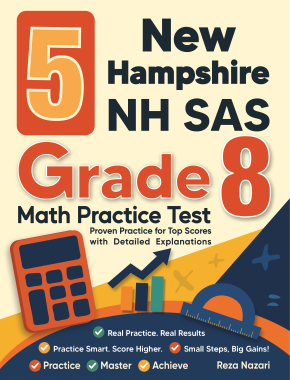
- Consider using the “5 New Hampshire NH SAS Grade 8 Math Practice Tests” book
- Explore online resources and apps for additional practice
- Learn how to select quality practice materials
- Create customized practice problems for targeted learning
- Collaborate with teachers and school resources for additional support
Creating a Test Day Success Plan
Our Best Seller Books
Prepare your child for test day by:
- Planning the week before the test
- Organizing activities the day before the test
- Ensuring your child is ready with necessary materials and routines
- Promoting healthy habits like sleep, nutrition, and exercise
- Establishing a morning routine for a smooth test day start
- Discussing the test experience with your child after completion
Final Thoughts
In conclusion, supporting your 8th-grade student in preparing for the NH SAS Math Test is a rewarding journey that strengthens their math skills and confidence. By implementing the strategies outlined in this guide and fostering a positive learning environment, you can empower your child to excel in the test and beyond. Remember, consistent practice, emotional support, and effective study techniques play a vital role in your child’s success. Encourage a growth mindset, celebrate progress, and continue to guide them on their math learning path.
For additional math resources and practice materials, explore Effortless Math’s math resources to enhance your child’s learning experience.
Recommended Math Resources

Related to This Article
More math articles
- How to Scale a Function Vertically?
- Top 10 Praxis Core Math Prep Books (Our 2023 Favorite Picks)
- How to Graph Quadratic Inequalities? (+FREE Worksheet!)
- How to Use Area Models and the Distributive Property to Multiply?
- Exploring Geometry Fundamentals: Study of Points, Lines, and Planes
- 7th Grade PSSA Math Worksheets: FREE & Printable
- Best Cheap Laptops for College Students
- A Comprehensive Collection of Free ATI TEAS 7 Math Practice Tests
- Full-Length TASC Math Practice Test-Answers and Explanations
- Using Decimals and Fractions to Solve One-Step Addition and Subtraction











What people say about "How to Help Your 8th Grade Student Prepare for the New Hampshire NH SAS Math Test - Effortless Math: We Help Students Learn to LOVE Mathematics"?
No one replied yet.