YOUR ATI TEAS READING PREP STARTS HERE
ATI TEAS Reading Online Center
Strengthen TEAS Reading with passage evidence, structure, and argument analysis. Use connected lessons and flashcards to review one skill before your next practice session.
Free study tools · Focused review · Books to compare
ATI TEAS Reading Practice Tests
Use the original practice form and explanations for study feedback.
ATI TEAS Reading Flashcards
Recall the idea and apply it to a passage.
ATI TEAS Reading Study Guides
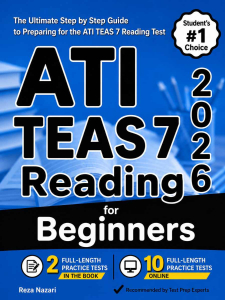
ATI TEAS 7 Reading for Beginners: The Complete Step-by-Step Guide to Mastering the ATI TEAS 7 Reading Test
Reading-specific preparation. Use the separate Math, Science, and English resources for the full TEAS.
View book & purchase options →ATI TEAS Reading Quick Review
Choose a connected reading lesson.
Open this resource →MEET THE ASSESSMENT · CHOOSE YOUR NEXT SKILL
Know ATI TEAS Reading before you start.
ATI lists 45 Reading questions in 55 minutes, including six unscored items. Prepare key ideas and details, craft and structure, and integration of knowledge and ideas. The full TEAS also includes Math, Science, and English and Language Usage. Independent practice results here are study feedback, not official ATI TEAS scores.
Official assessment information ↗Key ideas and evidence
Support an answer with the specific passage details that justify it.
Explore this study route →Structure and word meaning
Read the surrounding context before interpreting a detail or word.
Explore this study route →Claims and information
Distinguish what a source states from an inference or unsupported claim.
Explore this study route →Official ATI guidance
Check the current TEAS format and directions.
Explore this study route →ATI TEAS Reading Practice Center
Take a full practice test, review the explanations, then use the flashcards to repair the terms and ideas that slowed you down.
ATI TEAS 7 Reading Study Online Center: Lessons, Flashcards & Practice: a single starting point that brings together the lessons, worksheets, practice tests, and review material for this subject, arranged in a sensible order so you can work through it from start to finish.
Effortless Math • ATI TEAS 7 Reading Prep Center
Use this study Online Center to learn how to locate evidence, control an inference, read visuals, evaluate an argument, and work steadily through the Reading section. Every lesson below connects to a focused companion page.
Explore all four ATI TEAS 7 subjects
Use this study Online Center for one section, then move to the next subject when you are ready.
Start with the real shape of the section
ATI TEAS 7 Reading comes first. It gives you 45 questions in 55 minutes. Of those, 39 are scored across three content areas and 6 are unscored items that are not identified, so every question deserves the same careful effort.
Section details reflect ATI’s current published TEAS 7 exam outline. Confirm your program’s requirements before test day. See ATI’s exam details.
How to use this Online Center
Choose one lesson, read it actively, and then name the reason behind any wrong answer. A miss caused by scope, evidence, tone, or timing needs a different repair. That small habit turns practice into progress.
Three reading moves that matter most
The Reading section is not about memorizing literary terms. It is about making a claim that the passage, document, or visual can actually support.
Find the evidence first
For a stated detail, main idea, or summary question, return to the exact sentence or paragraph before comparing answer choices.
Keep the claim in scope
Strong answers match the passage’s limits. Be cautious when an option turns some into all, or a possibility into certainty.
Read the whole source set
When you see a chart, schedule, policy, or pair of passages, trace labels and compare the sources before deciding what follows.
ATI TEAS 7 Reading lesson directory
53 companion lessons
The sequence follows the Reading book. Work from Chapter 1 onward for a steady foundation, or open the exact skill behind a recent miss.
1. Finding What the Text Says
Details, main ideas, summaries, and evidence
2. Inference and Logical Conclusions
Clues, certainty, relationships, and conclusions
3. Organization, Sequence, and Relationships
Order, conditions, cause, comparison, and function
4. Words, Tone, Purpose, and Perspective
Meaning, attitude, audience, and author choices
5. Functional Documents and Procedures
Policies, schedules, forms, and step-by-step rules
6. Tables, Charts, Maps, and Other Visuals
Labels, measures, patterns, maps, and limits
7. Arguments and Evidence
Claims, support, bias, assumptions, and conclusions
8. Comparing and Integrating Sources
Agreement, contrast, evidence matrices, and decisions
9. The 55-Minute Reading Plan
Checkpoints, question formats, flags, and repair
TEAS Reading flashcards
Build the exact vocabulary that sharpens a Reading answer. Choose a focused set or study all 90 cards; every card includes a brief definition and a TEAS cue for using it on a question.
Click to return to the term
A practical 55-minute Reading plan
These checkpoints keep a difficult item from taking the time needed for the rest of the section. They are a practice routine, not a rule that overrides clear evidence.
Read the task
Notice whether the question asks for a detail, an inference, a purpose, a comparison, or a conclusion.
Return to proof
Find the relevant sentence, label, row, or feature. Do not choose an answer because it merely sounds reasonable.
Compare scope
Cross out choices that add certainty, switch the subject, or leave out a condition from the source.
Flag with a reason
Flag only when a later review can solve a specific problem. Vague doubt is not a useful flag.
Your full-length Reading practice
The companion book includes two print practice tests. The separate private practice course contains ten independent 45-question, 55-minute digital forms. Its address is intentionally unlisted: use the course link you were given, rather than searching for it.
After each form, record the skill behind every miss, revisit that lesson here, and rework one similar question before starting another timed form.

ATI TEAS 7 for Beginners
A complete, step-by-step ATI TEAS 7 guide for students who want Reading, Math, Science, and English explained clearly and organized into one practical study path.
- All four ATI TEAS 7 subject areas in one book
- Beginner-friendly lessons in a clear study sequence
- Worked examples before independent practice
- Chapter practice and full-length test preparation
Step-by-step lessons
Short explanations build each idea before students move into practice.
Worked examples
Examples show how to apply the method to TEAS-style questions.
All four subjects
Keep Reading, Math, Science, and English review in one organized plan.
Targeted practice
Use chapter exercises to strengthen one skill at a time before mixed review.
Test-day bridge
Connect lessons and examples to timed, full-length practice.
How to use it
- Read one focused lesson.
- Copy the worked example.
- Complete the matching practice.
- Review every missed question.
Our Best Study Guides for ATI TEAS 7
Choose the complete four-subject guide, or focus your study with a beginner book for Math, Reading, Science, or English and Language Usage.
Complete guide
ATI TEAS 7 for Beginners
Reading, Math, Science, and English in one beginner-friendly book.
 Math
Math
ATI TEAS 7 Math for Beginners 2026
Step-by-step lessons, worked examples, and focused Math practice.
 Reading
ATI TEAS 7 Reading for Beginners
A clear path through passage analysis, evidence, and inference.
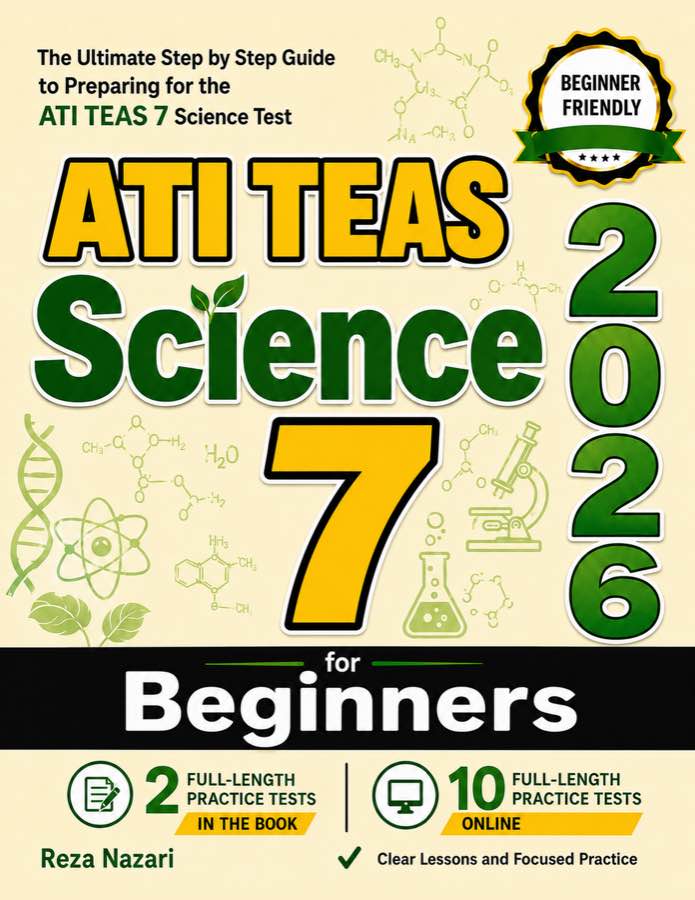 Science
ATI TEAS 7 Science for Beginners
Anatomy, Biology, Chemistry, and Scientific Reasoning review.
 English
ATI TEAS 7 English and Language Usage for Beginners
Grammar, punctuation, sentence structure, and vocabulary practice.
Keep the rest of your TEAS prep moving
Reading improves when you practice it deliberately, but nursing programs usually consider the complete exam. Use these Online Centers to keep your study plan connected.
Quick questions
Can I return to a Reading question during the exam?
Yes—you can move among questions within the active Reading section while time remains. Once you close the section and advance, you cannot return to it.
Should I read every passage the same way?
No. A narrative passage may need a quick map of change and motivation. A policy, chart, or schedule needs careful attention to labels, conditions, and exceptions. Let the source tell you what kind of reading it needs.
What should I do after a wrong answer?
Name the cause before checking another question: missed detail, scope error, weak inference, vocabulary issue, visual-reading mistake, or timing choice. Then use the matching lesson in the directory.
Start with one skill you can improve today.
Pick a lesson from the directory, use the flashcards to sharpen the language of your reasoning, and finish with a short set you can review honestly.
All 90 ATI TEAS reading terms and definitions
Every flashcard above, written out as a list and grouped by topic. Use it to revise without clicking through the cards, to search the page for a term, or to print the whole set.
Arguments
- Bias
- A preference or viewpoint that can shape which facts, examples, or words a source emphasizes.
- Claim
- A position or conclusion that a writer asks readers to accept.
- Counterclaim
- A competing position that challenges the main claim or offers a different conclusion.
- Credibility
- The trustworthiness of a source or evidence, judged through expertise, method, support, and transparency.
- Logical fallacy
- A flaw in reasoning that makes an argument weaker, such as treating one example as proof of a rule for everyone.
- Reason
- A statement explaining why a claim should be accepted or an action should be taken.
- Rebuttal
- A response that answers a counterclaim with reasoning or evidence.
- Relevant evidence
- Evidence that directly bears on the claim being evaluated.
- Sample
- The group of people, items, or events used to gather evidence for a broader claim.
- Sufficient evidence
- Enough appropriate support to justify a claim at the strength it makes.
Documents
- Condition
- A requirement that must be true before an action, exception, or result applies.
- Constraint
- A limit that narrows the available choices or actions.
- Criterion
- A standard used to judge eligibility, quality, or a decision.
- Deadline
- The latest time by which an action must be completed.
- Directive
- An official instruction requiring or guiding a specific action.
- Exception
- A stated case that does not follow the usual rule.
- Instruction
- A direction that tells a reader what action to take.
- Policy
- A rule or guideline that governs decisions or behavior in an organization.
- Prerequisite
- Something that must happen or be true before a later action can occur.
- Procedure
- A prescribed series of steps for completing a task.
Inference
- Assumption
- An unstated idea a claim or argument needs to make sense.
- Causation
- A relationship in which one event or condition produces another.
- Conclusion
- A judgment reached after considering the evidence in a text or source set.
- Correlation
- A pattern in which two things change together without proving that one caused the other.
- Generalization
- A broader statement based on a group, pattern, or set of examples.
- Inference
- A limited conclusion drawn from stated clues and ordinary background knowledge.
- Qualifying word
- A word that limits certainty or scope, such as may, often, generally, unless, or only.
- Reasoning bridge
- The sensible connection between a source clue and an unstated conclusion.
- Scope
- The boundary of a claim: the people, time, place, condition, and degree it actually covers.
- Textual clue
- A stated word, action, detail, contrast, or pattern that helps support an inference.
Integration
- Agreement
- A point two sources support in compatible ways.
- Compare
- To examine two sources using the same point or criterion.
- Consistency
- Agreement between a claim and the evidence, values, or details in a source.
- Contrast
- To explain a meaningful difference between sources, ideas, or approaches.
- Disagreement
- A difference in claim, recommendation, evidence, emphasis, or interpretation between sources.
- Evidence matrix
- A chart that records what each source claims, the evidence it uses, and relevant limits or conditions.
- Limitation
- A boundary on what evidence or a source can establish.
- Source
- A text, document, visual, speaker, or dataset that supplies information for a question.
- Supported conclusion
- The narrowest conclusion that the available source set can justify.
- Synthesis
- A conclusion that combines two or more sources while preserving where they agree, differ, or have limits.
Key Ideas
- Central idea
- A main idea in a literary or informational text, often expressed as a complete insight rather than a one-word subject.
- Evidence
- A source feature that can support or limit an answer: a sentence, example, data value, label, or visual pattern.
- Explicit detail
- Information stated directly in the text, document, or visual.
- Fact
- A statement that can be checked against reliable evidence.
- Main idea
- The central point a text develops about its topic.
- Opinion
- A judgment, preference, or belief that is not verified in the same way as a factual claim.
- Paraphrase
- A restatement that preserves the source’s meaning, relationship, and limits in different words.
- Summary
- A brief account of the central situation, important development, and result without extra examples or opinion.
- Supporting detail
- A fact, example, reason, or explanation that develops a larger point.
- Topic
- The broad subject a text is about, usually stated in one or two words.
Structure
- Cause and effect
- A structure that explains why something happened and what resulted.
- Chronology
- A sequence arranged by time.
- Classification
- A structure that sorts people, ideas, or items into categories according to a rule.
- Compare and contrast
- A structure that examines similarities and differences using a consistent point of comparison.
- Paragraph function
- The role a paragraph plays in the whole text, such as setting context, developing a reason, presenting a counterpoint, or explaining a result.
- Problem and solution
- A structure that presents a difficulty and then describes a response, proposal, or outcome.
- Sentence function
- The job a sentence performs in its paragraph, such as defining, giving evidence, qualifying, contrasting, or concluding.
- Sequence
- The order in which actions, events, stages, or reasoning steps occur.
- Text structure
- The organizational pattern a writer uses to arrange ideas, such as sequence, cause and effect, comparison, or problem and solution.
- Transition
- A word or phrase that signals a relationship such as addition, contrast, example, cause, or sequence.
Test Decisions
- All-or-nothing scoring
- A scoring rule in which an alternate-response item earns credit only when the complete response is correct.
- Distractor
- A wrong answer that may borrow a true word or detail while changing the relationship, condition, scope, or task.
- Flag
- A temporary marker for an item that has a specific, solvable issue to revisit.
- Hot spot
- A response format that asks you to select a specific location, cell, label, or feature in a visual.
- Multiple select
- A response format that requires choosing every correct option named by the prompt.
- Ordered response
- A response format that requires arranging actions, events, or steps in the required sequence.
- Pacing checkpoint
- A planned moment to compare your progress with the time remaining.
- Process of elimination
- Removing choices that are contradicted, unsupported, irrelevant, too broad, too narrow, or off-task.
- Question task
- The exact job the question asks you to do: locate, infer, summarize, compare, evaluate, or apply.
- Repair rule
- A short, observable action you will use after a miss or guess.
Visuals
- Axis
- A labeled horizontal or vertical line used to organize a graph’s categories and values.
- Data point
- One recorded value in a table, chart, graph, or map.
- Denominator
- The total group used to interpret a fraction, percentage, or rate.
- Label
- A word or number that identifies a row, column, axis, category, or feature of a visual.
- Legend
- The key that explains a visual’s symbols, colors, patterns, or lines.
- Rate
- A quantity measured in relation to another quantity, such as misses per appointment or miles per hour.
- Scale
- The ordered set of values used to measure distance or height on a graph or map.
- Title
- The heading that identifies what a table, graph, map, or diagram is showing.
- Trend
- A general pattern of increase, decrease, stability, or change over a set of values or time.
- Unit
- The measurement attached to a value, such as minutes, dollars, percent, people, or miles.
Words and Craft
- Audience
- The people a text is designed to reach or influence.
- Author’s purpose
- The result a writer intends to achieve, such as informing, explaining, persuading, warning, or reflecting.
- Connotation
- The feeling, association, or implied meaning a word carries beyond its direct definition.
- Context clue
- A nearby definition, example, contrast, synonym, or situation that helps establish a word’s meaning.
- Denotation
- A word’s direct, dictionary-level meaning.
- Diction
- An author’s deliberate choice of words and level of language.
- Mood
- The feeling or atmosphere a text creates for the reader.
- Perspective
- The position, experience, or priorities through which a person or source interprets an issue.
- Point of view
- The position from which a story or account is told.
- Tone
- The writer’s or speaker’s attitude toward a subject, revealed through wording, detail selection, and sentence patterns.
Every lesson in one place
Open a lesson in a new tab and keep this Online Center nearby as your study home.
Browse the complete lesson directory
A USEFUL NEXT STEP
ATI TEAS Reading: study questions
What is the ATI TEAS 7 Reading section format?
ATI lists 45 Reading questions in 55 minutes, including six unscored items. Prepare key ideas and details, craft and structure, and integration of knowledge and ideas. The full TEAS also includes Math, Science, and English and Language Usage. Independent practice results here are study feedback, not official ATI TEAS scores.
Official source ↗How should I use these independent ATI TEAS Reading study tools?
Start with a practice activity, review explanations for missed questions, and use quick review or flashcards for one weak topic. The practice results are study feedback, not official exam scores. Compare a book’s contents with your course or test requirements before buying.
Resources from Effortless Math · Editorial standards