Grade 3 Math: Elapsed Time

Once upon a time, in the bustling town of Timetown, there lived two best friends, Tim and Ella. Tim and Ella were known for their love of adventures and exploring new places. One sunny morning, as they were playing by the town square, they stumbled upon a mysterious old clock. The clock seemed to shimmer and glow, and before they knew it, they were whisked away into a world where time itself was a magical force.
Their adventure began in the Land of Elapsed Time, a place where time flowed differently, and solving time-related puzzles was the key to unlocking the secrets of this enchanted land. Tim and Ella were excited and ready to face any challenge that came their way.
Understanding the Concept
In this land, Tim and Ella learned about elapsed time, which means the amount of time that has passed between two events. To calculate elapsed time, they needed to know the start time and how much time had passed or changed.
| Event | Start Time | Change | Elapsed Time |
|---|---|---|---|
| Breakfast Starts | 8:00 AM | 1 hour 30 minutes | 9:30 AM |
| Playtime Begins | 3:45 PM | 1 hour 15 minutes | 5:00 PM |
Tim and Ella understood that to find the elapsed time, they had to note the start time first and then add the change in time. For example, if breakfast started at 8:00 AM and lasted for 1 hour and 30 minutes, they calculated the elapsed time to be 9:30 AM.
The Absolute Best Book to Ace Grade 3 Math
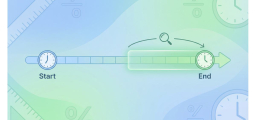
They encountered a magical clock that helped them visualize the concept of elapsed time. The clock had two hands – a blue one for the start time and a red one for the end time. By looking at where the hands pointed, they could determine the elapsed time between the start and end.
Key Concepts Explained
To calculate elapsed time more efficiently, Tim and Ella learned a step-by-step process:
Step 1: Note the Start Time
Always start by writing down the given start time. This is the point from which you will calculate the elapsed time.
Step 2: Determine the Change
Find out how much time has passed or changed between the start and end of the event. This could be in hours, minutes, or both.
Step 3: Add the ChangeAdd the change in time to the start time to find the end time, which is when the event finishes. This end time is the total elapsed time.
Example:
If Tim started reading a book at 4:45 PM and read for 1 hour and 20 minutes, what time did he finish reading?
We follow the three steps:
The Most Comprehensive Grade 3 Math Workbook
- Start Time: 4:45 PM
- Change: 1 hour 20 minutes
- 4:45 PM + 1 hour 20 minutes = 6:05 PM
So, Tim finished reading at 6:05 PM.
Common Mistakes to Avoid
Tim and Ella learned that a common mistake when calculating elapsed time is forgetting to convert hours to minutes or vice versa. It’s essential to keep track of units and ensure they match for an accurate calculation.
| Mistake | Explanation |
|---|---|
| Not Converting Units | Forgetting to convert hours to minutes or minutes to hours before adding them to the start time. |
| Mixing Up AM/PM | Confusing morning and afternoon \times which can lead to incorrect calculations. |
Summary and Key Takeaways
Tim and Ella discovered that understanding elapsed time was like solving a puzzle where each piece of time fit together to reveal the whole picture. By noting the start time, adding the change, and carefully calculating, they could unlock the mystery of elapsed time.
Remember, when faced with an elapsed time problem, always:
- Start by noting the start time.
- Determine the change in time.
- Add the change to the start time to find the end time, which is the elapsed time.
As Tim and Ella bid farewell to the Land of Elapsed Time, they carried with them the valuable skill of calculating elapsed time, ready to use it in their future adventures and explorations. The magic of time had shown them that with patience and practice, they could unravel any time-related mystery that came their way.
💡 Teaching Tip: Note the start time, then add the change.
Additional Practice Resources

Related to This Article
More math articles
- The Ultimate 6th Grade Scantron Performance Math Course (+FREE Worksheets)
- 6 Keys to Studying Effectively for Your Math Class
- Full-Length HiSET Math Practice Test
- How to Divide by Zero?
- The Math Detective: How to Find the Case of the Right Simulation that Represents the Situation
- 4th Grade WY-TOPP Math Worksheets: FREE & Printable
- 5 Tips for Surviving a Statistics Course
- 5th Grade SOL Math Worksheets: FREE & Printable
- How to Simplify Radical Expressions Involving Fractions?
- Anti-Derivative: Everything You Need to Know









What people say about "Grade 3 Math: Elapsed Time - Effortless Math: We Help Students Learn to LOVE Mathematics"?
No one replied yet.