Vector Addition definition
Vector addition combines vectors by adding their corresponding components.
Vector Addition in a picture
How it works
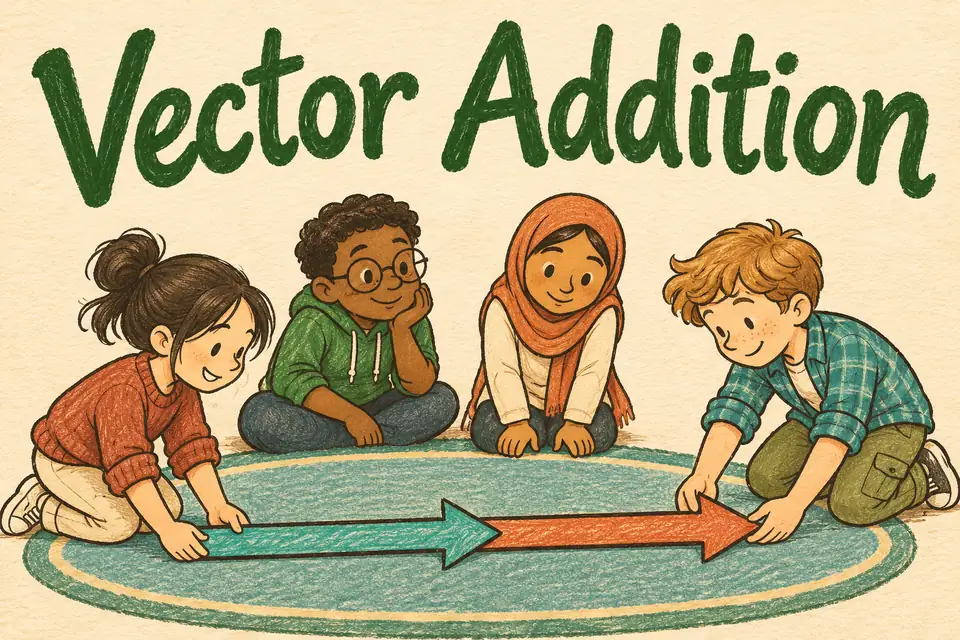
In the plane, ⟨a, b⟩ + ⟨c, d⟩ = ⟨a + c, b + d⟩. In a diagram, place the second arrow’s tail at the first arrow’s tip. The sum goes from the first tail to the second tip. The parallelogram rule gives the same sum when both starting tails share one point.
Worked examples
Add ⟨2, 3⟩ and ⟨4, −1⟩.
⟨6, 2⟩.
Add ⟨−2, 5⟩ and ⟨2, −5⟩.
⟨0, 0⟩.
What happens when you reverse the order of addition?
The sum is unchanged.
Common mistake
Add x-components together and y-components together. Do not add a horizontal component to a vertical one.
Quick check
What is ⟨1, 0⟩ + ⟨0, 1⟩?
Show answer
⟨1, 1⟩.
Does the order affect the sum?
Show answer
No.
What vector acts as the additive identity?
Show answer
The zero vector.
Sources
Flashcard
Vector Addition
Reveal the definition
Vector addition combines vectors by adding their corresponding components.
Effortless Math. “Vector Addition.” Math Dictionary.