

Triangle Angle Sum Theorem definition
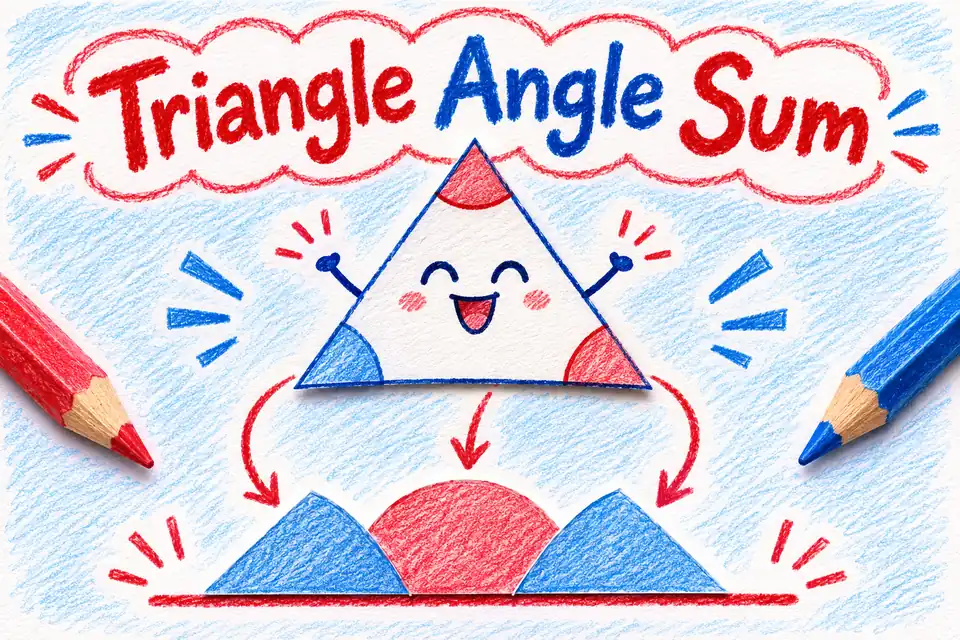
The triangle angle sum theorem states that the three interior angles of a triangle in the Euclidean plane add to 180°. If you know two interior angles, subtract their sum from 180° to find the third.
Triangle Angle Sum Theorem in a picture
How it works
To see why, draw a line through one vertex parallel to the opposite side. Alternate interior angles copy the other two triangle angles next to the angle at that vertex. Together the three form a straight angle of 180°.
Worked examples
Find the missing angle when two angles are 48° and 67°.
Add 48 + 67 = 115, then subtract from 180. The third angle is 65°.
An isosceles triangle has a 40° vertex angle. Find its base angles.
The base angles are equal and total 140°. Each is 70°.
The angles measure x, 2x, and 3x degrees. Find them.
Add to get 6x = 180, so x = 30. The angles are 30°, 60°, and 90°.
Common mistake
Use interior angles. An exterior angle must first be related to the interior angle beside it.
Quick check
Two angles are 90° and 35°. Find the third.
Show answer
55°.
Can a plane triangle have two right angles?
Show answer
No. Their sum already uses all 180°.
What is each angle of an equilateral triangle?
Show answer
60°.
Sources
Flashcard
Triangle Angle Sum Theorem
Reveal the definition
The triangle angle sum theorem states that the three interior angles of a triangle in the Euclidean plane add to 180°. If you know two interior angles, subtract their sum from 180° to find the third.
Effortless Math. “Triangle Angle Sum Theorem.” Math Dictionary.