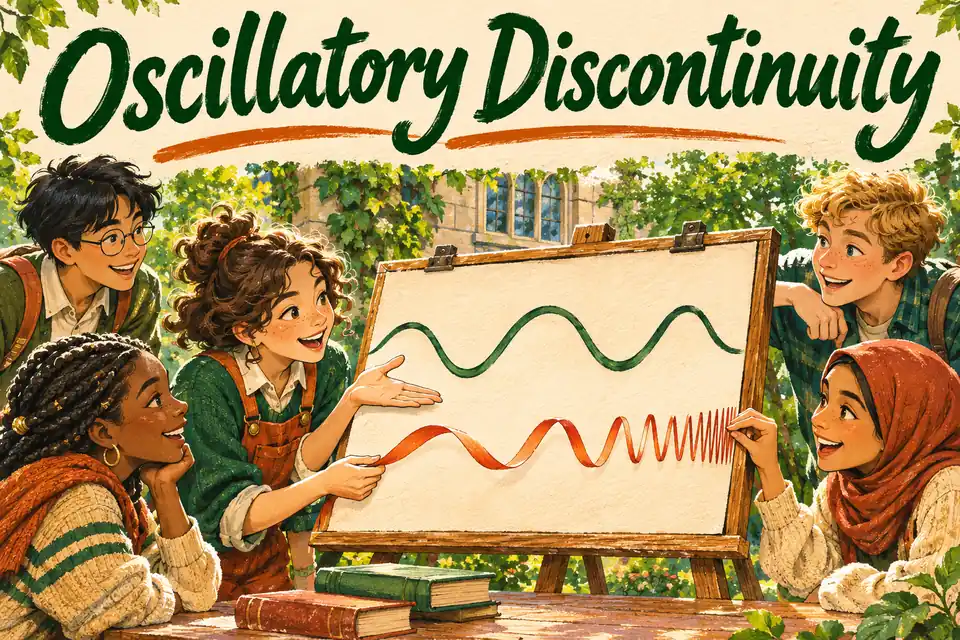
Oscillatory Discontinuity definition
An oscillatory discontinuity occurs when a function keeps oscillating near an input and fails to approach a single limit there.
Oscillatory Discontinuity in a picture
How it works
For example, sin(1/x) has increasingly rapid oscillations near x = 0. There are sequences of positive inputs approaching 0 on which the outputs are 1, and other sequences on which the outputs are −1. A value assigned at zero cannot reconcile those outputs.
Worked examples
Does boundedness alone give a limit for sin(1/x) near zero?
No. It stays between −1 and 1 but keeps reaching both extremes.
Does x sin(1/x) have a limit at zero?
Yes. Its absolute value is at most |x|, which tends to 0.
Can adding a value at x = 0 make sin(1/x) continuous there?
No. The nearby values have no single limit.
Common mistake
Oscillation alone does not prevent convergence. Check whether the oscillations shrink toward one value.
Quick check
Is the example unbounded near zero?
Show answer
No, it stays between −1 and 1.
Can a shrinking oscillation have a limit?
Show answer
Yes.
Sources
Flashcard
Oscillatory Discontinuity
Reveal the definition
An oscillatory discontinuity occurs when a function keeps oscillating near an input and fails to approach a single limit there.
Effortless Math. “Oscillatory Discontinuity.” Math Dictionary.