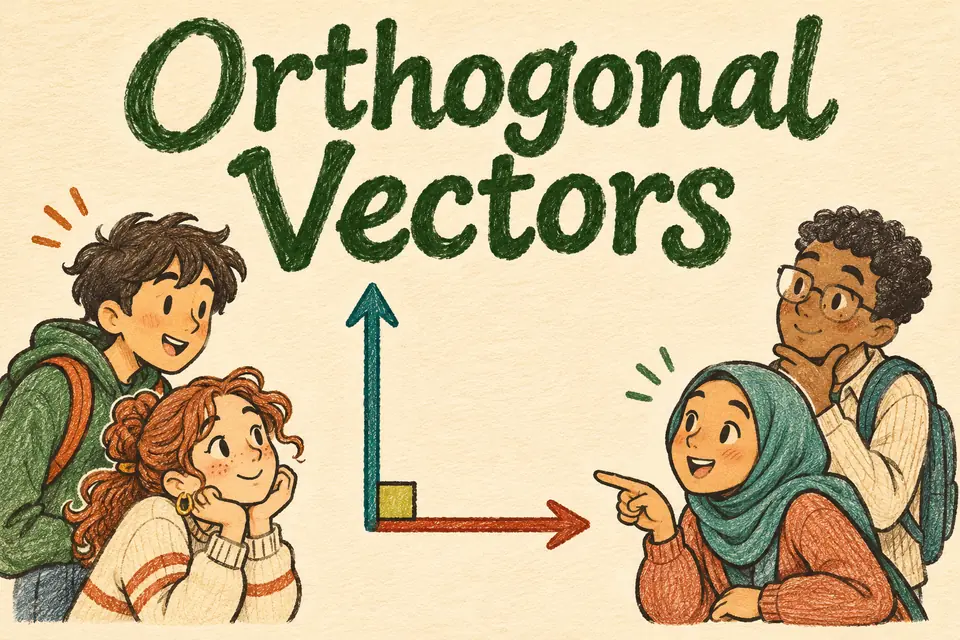
Orthogonal Vectors definition
Two vectors are orthogonal if their dot product is zero.
Orthogonal Vectors in a picture
How it works
For nonzero vectors, a zero dot product means the angle between them is 90°. In coordinate form, multiply corresponding components and sum the products. The zero vector has zero dot product with every vector, so it is orthogonal to every vector algebraically, even though it has no direction angle.
Worked examples
Are ⟨2, 3⟩ and ⟨3, −2⟩ orthogonal?
Yes. Their dot product is 6 − 6 = 0.
Are ⟨1, 1⟩ and ⟨1, 0⟩ orthogonal?
No. Their dot product is 1.
Find a nonzero vector orthogonal to ⟨4, 1⟩.
For example, ⟨1, −4⟩.
Common mistake
A zero component does not determine orthogonality. Compute the entire dot product.
Quick check
What number must the dot product equal?
Show answer
Zero.
What angle do nonzero orthogonal vectors make?
Show answer
90°.
Is the zero vector algebraically orthogonal to every vector?
Show answer
Yes.
Sources
Flashcard
Orthogonal Vectors
Reveal the definition
Two vectors are orthogonal if their dot product is zero.
Effortless Math. “Orthogonal Vectors.” Math Dictionary.