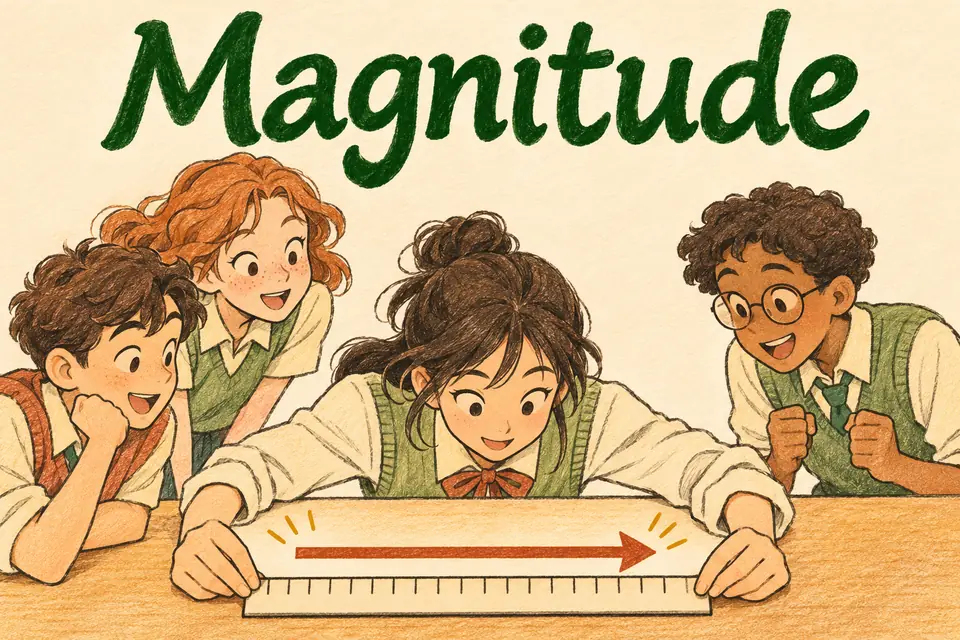
Magnitude definition
The magnitude of a vector is its length.
Magnitude in a picture
How it works
For a vector with components (a, b), compute √(a² + b²). The components act as legs of a right triangle. Magnitude is nonnegative and equals zero only for the zero vector. A vector’s direction is separate from its magnitude.
Worked examples
Find the magnitude of (6, 8).
√(36 + 64) = 10.
Find the magnitude of (−3, 4).
5, because squaring removes the component sign.
Find the magnitude of (0, 0).
0.
Common mistake
Square each component before adding. Adding the components directly usually does not give the length.
Quick check
Can magnitude be negative?
Show answer
No.
What is the magnitude of (0, −7)?
Show answer
7.
Can two vectors have equal magnitudes but different directions?
Show answer
Yes.
Sources
Flashcard
Magnitude
Reveal the definition
The magnitude of a vector is its length.
Effortless Math. “Magnitude.” Math Dictionary.