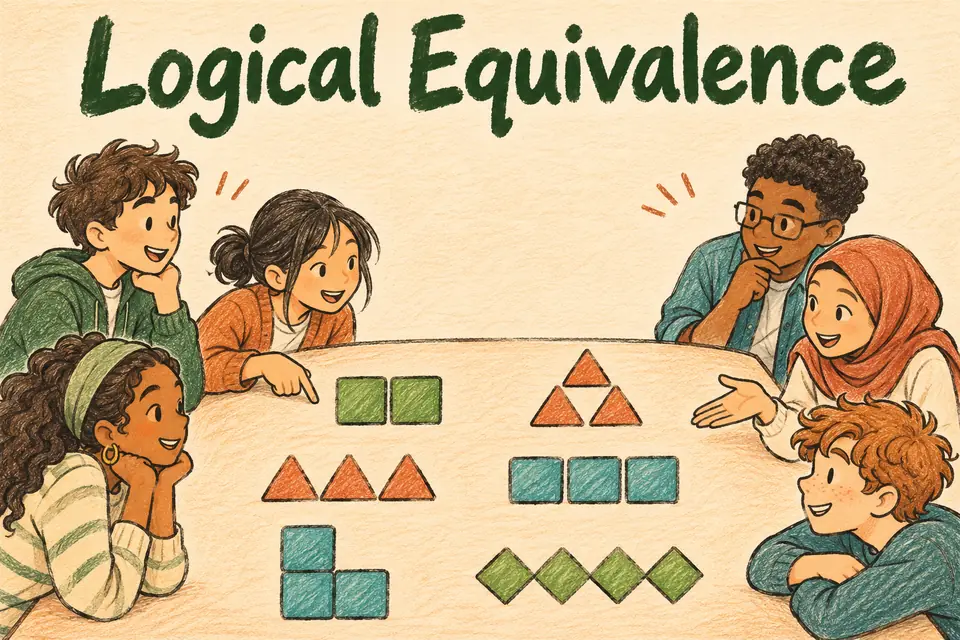
Logical Equivalence definition
Two logical statements are equivalent when they have the same truth value under every assignment of their variables.
Logical Equivalence in a picture
How it works
Write P ≡ Q when their truth tables match in every row. For example, P → Q is equivalent to its contrapositive ¬Q → ¬P. Logical equivalence can also be shown by a chain of valid rewrites. A biconditional P ↔ Q is a tautology exactly when P and Q are logically equivalent.
Worked examples
Is P equivalent to ¬¬P?
Yes. Negating twice restores its truth value.
Is P ∧ Q equivalent to Q ∧ P?
Yes. The order of and does not change truth values.
Is P generally equivalent to ¬P?
No. Their truth values always differ.
Common mistake
Matching in one situation does not prove equivalence. Check every assignment or apply a valid identity.
Quick check
What is enough to disprove equivalence?
Show answer
One assignment where the values differ.
What should matching truth tables do in every row?
Show answer
Give the same output.
Is an implication equivalent to its contrapositive?
Show answer
Yes.
Sources
Flashcard
Logical Equivalence
Reveal the definition
Two logical statements are equivalent when they have the same truth value under every assignment of their variables.
Effortless Math. “Logical Equivalence.” Math Dictionary.