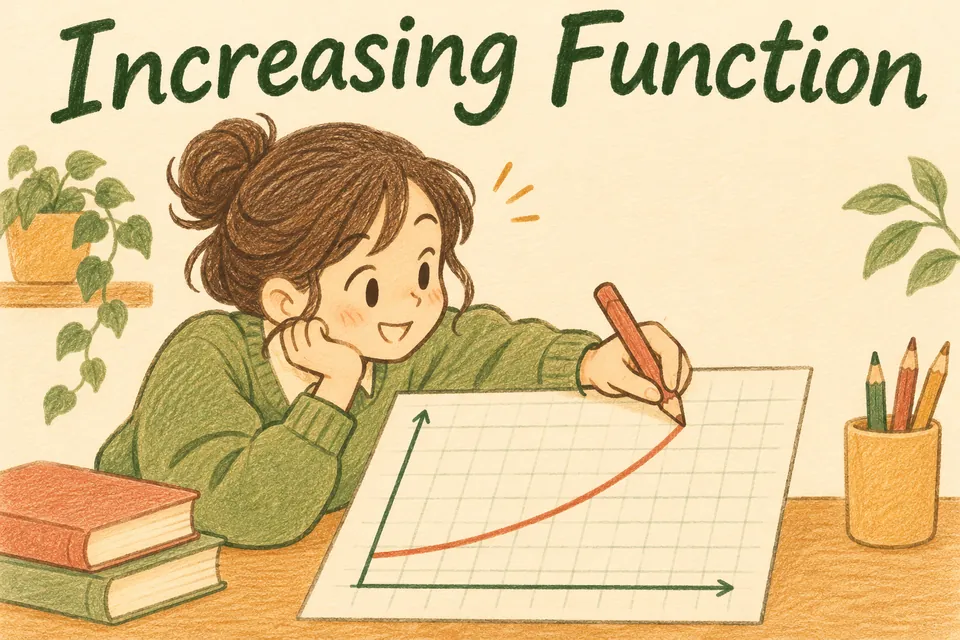
Increasing Function definition
A function is strictly increasing on an interval when larger inputs always give larger outputs there.
Increasing Function in a picture
How it works
For any x₁ < x₂ in the interval, f(x₁) < f(x₂). The graph rises as you read it from left to right. Some authors use increasing to include equal values. That weaker condition is called nondecreasing. A function can be increasing on one interval and decreasing on another.
Worked examples
Is f(x) = 3x − 4 increasing on the reals?
Yes. A larger x gives a larger value because the slope is 3.
Where does f(x) = x² increase?
It is strictly increasing on [0, ∞).
Is a constant function strictly increasing?
No. Larger inputs give equal outputs. It is nondecreasing.
Common mistake
Read the graph from left to right and compare outputs over the stated interval.
Quick check
Is a line of slope 5 increasing?
Show answer
Yes.
Does y need to be positive for a function to increase?
Show answer
No. For example, −3 is greater than −5.
Does strict increase allow two different inputs to have equal outputs?
Show answer
No.
Sources
Flashcard
Increasing Function
Reveal the definition
A function is strictly increasing on an interval when larger inputs always give larger outputs there.
Effortless Math. “Increasing Function.” Math Dictionary.