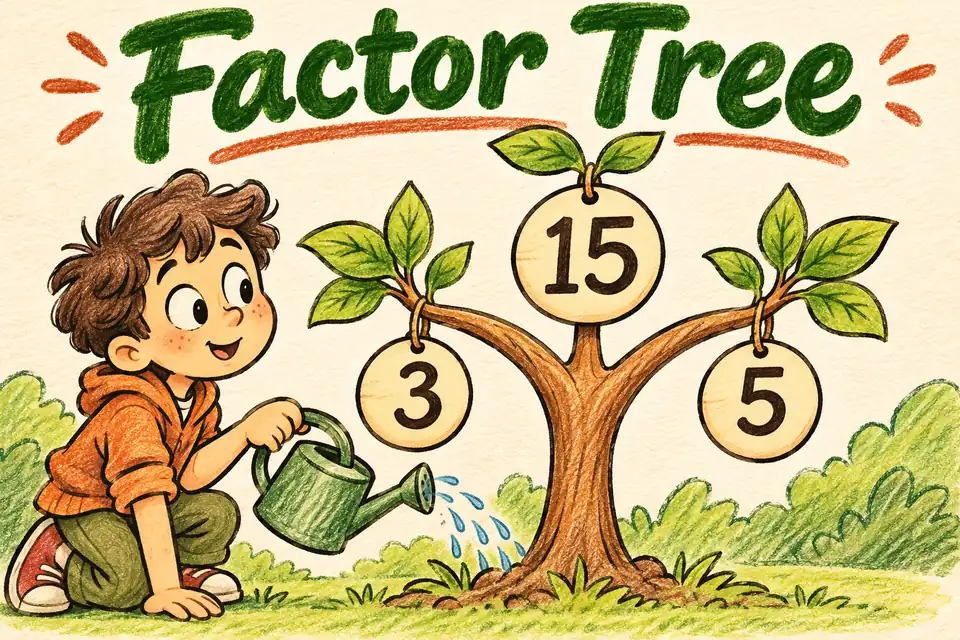
Factor Tree definition
A factor tree is a diagram that breaks a composite whole number into its prime factors. Each pair of branches multiplies back to the number above it.
Factor Tree in a picture
How it works
Start with the original number. Choose two whole-number factors greater than 1. Repeat for each composite factor and stop each branch at a prime. Multiply the prime numbers at the ends to check your work. You can start with a different factor pair and still get the same prime factors, including repeats.
Worked examples
Find the prime factorization of 24.
Split 24 into 6 × 4. Split 6 into 2 × 3 and 4 into 2 × 2. The result is 2³ × 3.
Start a factor tree for 45 with 5 and 9.
The 5 is prime, so it stops. Split 9 into 3 × 3. The result is 3² × 5.
Compare starting pairs 2 × 42 and 7 × 12 for 84.
Both end with two 2s, one 3, and one 7. The order of the branches can differ.
Common mistake
Keep a factor every time it appears. For 36, write 2 × 2 × 3 × 3, or 2² × 3². Using each prime just once gives 6.
Quick check
What are the prime factors at the ends of a tree for 18?
Show answer
2, 3, and 3.
Can you stop a branch at 9?
Show answer
No. Split it into 3 × 3.
Why avoid a split into 1 and the original number?
Show answer
1 is not prime, and the split leaves the original composite number to factor again.
Sources
Flashcard
Factor Tree
Reveal the definition
A factor tree is a diagram that breaks a composite whole number into its prime factors. Each pair of branches multiplies back to the number above it.
Effortless Math. “Factor Tree.” Math Dictionary.