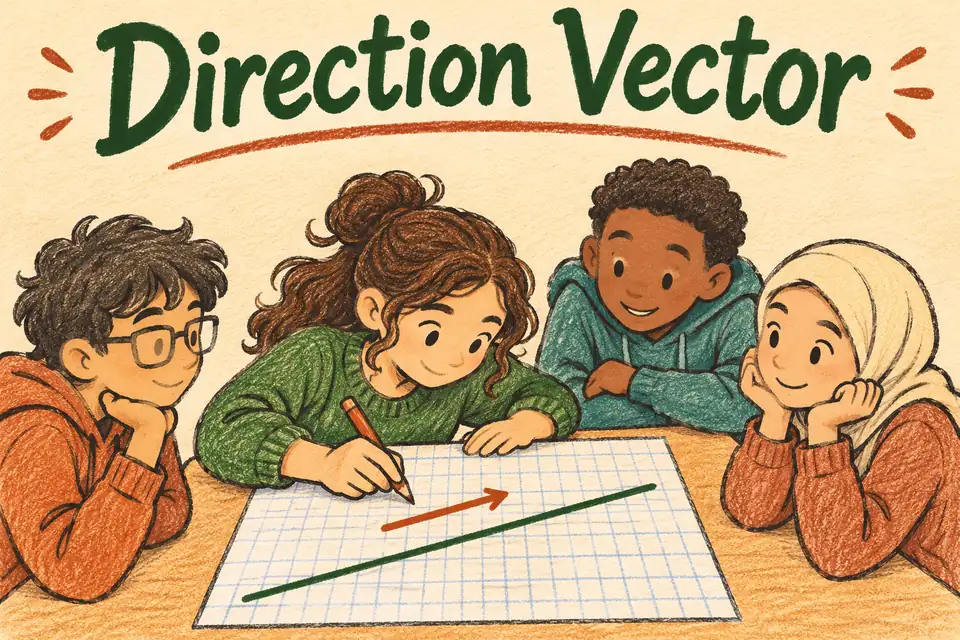
Direction Vector definition
A direction vector is a nonzero vector parallel to a line, used to describe the line’s direction.
Direction Vector in a picture
How it works
If P lies on a line and v is a direction vector, points on the line have position P + tv for real t. Any nonzero scalar multiple of v describes the same line direction up to orientation. A direction vector gives the direction but does not specify a unique location.
Worked examples
Find a direction vector for the line through (1, 2) and (4, 4).
⟨3, 2⟩.
Does ⟨6, 4⟩ give the same line direction?
Yes. It is twice ⟨3, 2⟩.
Can ⟨0, 0⟩ be a direction vector?
No.
Common mistake
A line also needs a point or equivalent location information. Many parallel lines share the same direction vector.
Quick check
What does t control in P + tv?
Show answer
How far to move along the direction vector, with sign.
Can a negative multiple describe the same line?
Show answer
Yes. It reverses orientation but traces the same line.
Can two lines share a direction vector?
Show answer
Yes.
Sources
Flashcard
Direction Vector
Reveal the definition
A direction vector is a nonzero vector parallel to a line, used to describe the line’s direction.
Effortless Math. “Direction Vector.” Math Dictionary.