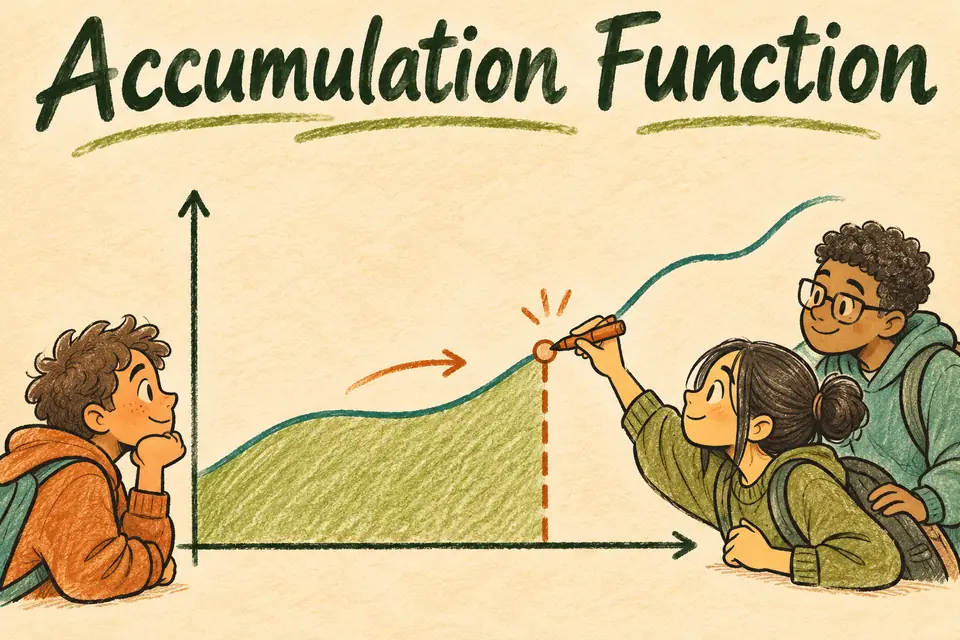
Accumulation Function definition
An accumulation function records the running total of a rate or signed area as an integral’s endpoint moves.
Accumulation Function in a picture
How it works
For A(x) = ∫ₐˣ f(t) dt, the starting value A(a) is zero. If f is continuous, the Fundamental Theorem of Calculus gives A′(x) = f(x). If f is positive, the accumulation grows, and if f is negative, it decreases. The integration variable t is local to the integral.
Worked examples
Find A(3) for A(x) = ∫₀ˣ 2t dt.
A(x) = x², so A(3) = 9.
Find the derivative of A(x) = ∫₁ˣ cos t dt.
A′(x) = cos x.
Differentiate ∫₀ˣ² f(t) dt for continuous f.
Use the chain rule to get 2x f(x²).
Common mistake
The derivative is the rate at the moving endpoint. When the endpoint itself is a function, include its derivative.
Quick check
What is A(a) when both bounds are a?
Show answer
0.
When f(x) < 0 on an interval, what happens to A(x) there?
Show answer
It decreases.
What is A′(x) when f is continuous?
Show answer
f(x).
Sources
Flashcard
Accumulation Function
Reveal the definition
An accumulation function records the running total of a rate or signed area as an integral’s endpoint moves.
Effortless Math. “Accumulation Function.” Math Dictionary.