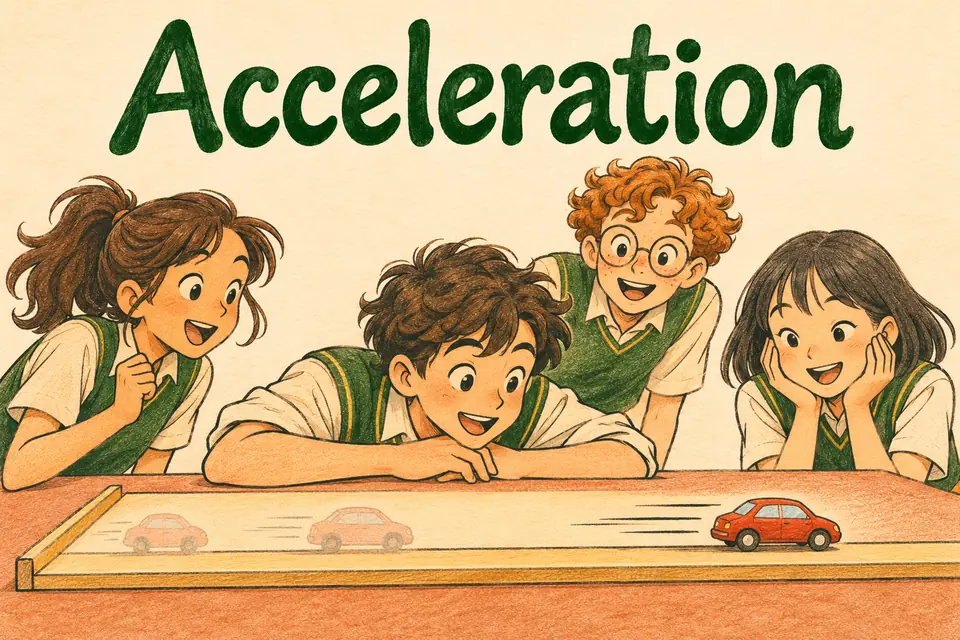
Acceleration definition
Acceleration measures how velocity changes with time.
Acceleration in a picture
How it works
In one-dimensional calculus, instantaneous acceleration is a(t) = v′(t) = s″(t). Average acceleration is change in velocity divided by elapsed time. If position is in meters and time in seconds, acceleration is in meters per second squared. A negative acceleration can speed up an object already moving in the negative direction.
Worked examples
Velocity changes from 2 to 10 m/s in 4 s. Find average acceleration.
(10 − 2)/4 = 2 m/s².
Find acceleration if s(t) = t³.
v(t) = 3t² and a(t) = 6t.
If v = −5 m/s and a = −2 m/s², is the object speeding up at that instant?
Yes. Velocity and acceleration have the same sign.
Common mistake
Check both velocity and acceleration before deciding whether speed increases or decreases.
Quick check
What is acceleration if velocity is constant?
Show answer
Zero.
What is the derivative of velocity?
Show answer
Acceleration.
Can a momentarily stopped object have nonzero acceleration?
Show answer
Yes.
Sources
Flashcard
Acceleration
Reveal the definition
Acceleration measures how velocity changes with time.
Effortless Math. “Acceleration.” Math Dictionary.