Common Core Grade 4 ELA Standards: this page sets out what students are expected to know and be able to do, standard by standard, and links a free lesson, worksheet, and practice set for each one so the list becomes something you can actually work through.
Common Core English Standards
Commoncore Grade 4 English
Commoncore Grade 4 English: plan reading, writing, vocabulary, and discussion practice. Use learning references and the state curriculum source to choose a target.
The Common Core Grade 4 English standards give teachers, tutors, and families a clear way to turn standards into daily reading, writing, speaking, and language practice. This guide turns 43 learning expectations across 6 literacy strands into plain, original language, with special attention to central ideas, evidence, text structure, claims, and nonfiction analysis; planning, drafting, revising, editing, and publishing clear writing; theme, character, plot, point of view, and literary craft. A strong plan uses consistent reading time, thoughtful annotations, precise word study, and purposeful writing, so students build confidence with real reading and writing rather than isolated worksheets.
Quick Navigation
Free Grade 4 ELA Checklist + Practice Plan
Use this Common Core Grade 4 English language arts guide as a printable standards checklist. Start with the overview, mark the skills your student already handles, then choose one weak area for focused review before Common Core or classroom assessments.
Common Core Grade 4 English Standards Overview
For Common Core, Grade 4 English helps students read more complex texts, explain ideas with evidence, grow vocabulary, and write organized responses. This overview organizes Common Core State Standards for English Language Arts into plain-language strands so you can quickly see what to teach, review, or reteach.
Reading Literature
For Common Core Grade 4, this strand supports planning around theme, character, plot, point of view, and literary craft. Includes 9 quick skill targets.
Reading Informational Text
For Common Core Grade 4, this strand gives students repeated work with central ideas, evidence, text structure, claims, and nonfiction analysis. Includes 10 quick skill targets.
Foundational Reading and Word Study
For Common Core Grade 4, this strand helps review stay focused on phonics, word parts, spelling patterns, and fluent decoding. Includes 2 quick skill targets.
Writing
For Common Core Grade 4, this strand makes room for short checks on planning, drafting, revising, editing, and publishing clear writing. Includes 10 quick skill targets.
Speaking, Listening, and Discussion
For Common Core Grade 4, this strand makes room for short checks on active listening, clear speaking, collaboration, and presentation. Includes 6 quick skill targets.
Language and Conventions
For Common Core Grade 4, this strand gives students repeated work with grammar, usage, punctuation, capitalization, spelling, and style. Includes 6 quick skill targets.
Grade 4 Common Core English Practice Plan
A useful Common Core Grade 4 plan should balance reading, writing, language, and speaking. Start with Reading Literature, Reading Informational Text, Foundational Reading and Word Study; then rotate shorter review tasks so skills stay connected.
For Common Core Grade 4, a strong weekly rhythm can be simple: a passage annotation, a vocabulary check, a brief constructed response, and a quick revision task.
Need Focused Grade 4 Common Core English Practice?
Pair this Common Core Grade 4 standards guide with targeted ELA practice so students can move from knowing the expectations to answering reading, writing, vocabulary, and language questions with confidence.
All Common Core Grade 4 English Standards, Rewritten
The codes below follow the Common Core Grade 4 source standards structure. Each skill label is intentionally short, original, and written for fast planning.
Common Core Grade 4 RL Reading Literature
Use these Grade 4 expectations as learning references. Common Core-style codes refer to the Common Core standards; they do not certify a complete match to Commoncore’s current curriculum. State-specific references also need to be checked against the current official document. Follow your teacher’s assigned targets when wording, codes, or grade placement differ.
| Code | Learning reference |
|---|---|
| RL.4.1 | Refer to details and examples in a text when explaining what the text says explicitly and when drawing inferences from the text. |
| RL.4.2 | Determine a theme of a story, drama, or poem from details in the text; summarize the text. |
| RL.4.3 | Describe in depth a character, setting, or event in a story or drama, drawing on specific details in the text (e.g., a character's thoughts, words, or actions). |
| RL.4.4 | Determine the meaning of words and phrases as they are used in a text, including those that allude to significant characters found in mythology (e.g., Herculean). |
| RL.4.5 | Explain major differences between poems, drama, and prose, and refer to the structural elements of poems (e.g., verse, rhythm, meter) and drama (e.g., casts of characters, settings, descriptions, dialogue, stage directions) when writing or speaking about a text. |
| RL.4.6 | Compare and contrast the point of view from which different stories are narrated, including the difference between first- and third-person narrations. |
| RL.4.7 | Make connections between the text of a story or drama and a visual or oral presentation of the text, identifying where each version reflects specific descriptions and directions in the text. |
| RL.4.9 | Compare and contrast the treatment of similar themes and topics (e.g., opposition of good and evil) and patterns of events (e.g., the quest) in stories, myths, and traditional literature from different cultures. |
| RL.4.10 | By the end of the year, read and comprehend literature, including stories, dramas, and poetry, in the grades 4-5 text complexity band proficiently, with scaffolding as needed at the high end of the range. |
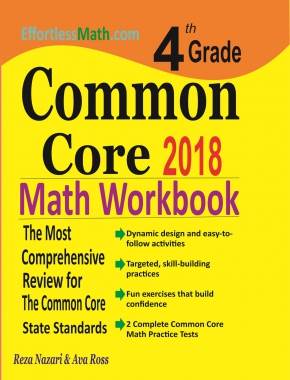
Also Reviewing Common Core Grade 4 Math?
Many Common Core families prepare English and math together. If your Grade 4 student also needs math support, this matching resource can help keep review organized.
Common Core Grade 4 RI Reading Informational Text
| Code | Learning reference |
|---|---|
| RI.4.1 | Refer to details and examples in a text when explaining what the text says explicitly and when drawing inferences from the text. |
| RI.4.2 | Determine the main idea of a text and explain how it is supported by key details; summarize the text. |
| RI.4.3 | Explain events, procedures, ideas, or concepts in a historical, scientific, or technical text, including what happened and why, based on specific information in the text. |
| RI.4.4 | Determine the meaning of general academic and domain-specific words or phrases in a text relevant to a grade 4 topic or subject area . |
| RI.4.5 | Describe the overall structure (e.g., chronology, comparison, cause/effect, problem/solution) of events, ideas, concepts, or information in a text or part of a text. |
| RI.4.6 | Compare and contrast a firsthand and secondhand account of the same event or topic; describe the differences in focus and the information provided. |
| RI.4.7 | Interpret information presented visually, orally, or quantitatively (e.g., in charts, graphs, diagrams, time lines, animations, or interactive elements on Web pages) and explain how the information contributes to an understanding of the text in which it appears. |
| RI.4.8 | Explain how an author uses reasons and evidence to support particular points in a text. |
| RI.4.9 | Integrate information from two texts on the same topic in order to write or speak about the subject knowledgeably. |
| RI.4.10 | By the end of year, read and comprehend informational texts, including history/social studies, science, and technical texts, in the grades 4-5 text complexity band proficiently, with scaffolding as needed at the high end of the range. |
Common Core Grade 4 RF Foundational Reading and Word Study
| Code | Learning reference |
|---|---|
| RF.4.3 | Know and apply grade-level phonics and word analysis skills in decoding words. |
| RF.4.4 | Read with sufficient accuracy and fluency to support comprehension. |
Common Core Grade 4 W Writing
| Code | Learning reference |
|---|---|
| W.4.1 | Write opinion pieces on topics or texts, supporting a point of view with reasons and information. |
| W.4.2 | Write informative/explanatory texts to examine a topic and convey ideas and information clearly. |
| W.4.3 | Write narratives to develop real or imagined experiences or events using effective technique, descriptive details, and clear event sequences. |
| W.4.4 | Produce clear and coherent writing in which the development and organization are appropriate to task, purpose, and audience. (Grade-specific expectations for writing types are defined in standards 1-3 above.) |
| W.4.5 | With guidance and support from peers and adults, develop and strengthen writing as needed by planning, revising, and editing. (Editing for conventions should demonstrate command of Language standards 1-3 up to and including grade 4 here .) |
| W.4.6 | With some guidance and support from adults, use technology, including the Internet, to produce and publish writing as well as to interact and collaborate with others; demonstrate sufficient command of keyboarding skills to type a minimum of one page in a single sitting. |
| W.4.7 | Conduct short research projects that build knowledge through investigation of different aspects of a topic. |
| W.4.8 | Recall relevant information from experiences or gather relevant information from print and digital sources; take notes and categorize information, and provide a list of sources. |
| W.4.9 | Draw evidence from literary or informational texts to support analysis, reflection, and research. |
| W.4.10 | Write routinely over extended time frames (time for research, reflection, and revision) and shorter time frames (a single sitting or a day or two) for a range of discipline-specific tasks, purposes, and audiences. |
Common Core Grade 4 SL Speaking, Listening, and Discussion
| Code | Learning reference |
|---|---|
| SL.4.1 | Engage effectively in a range of collaborative discussions (one-on-one, in groups, and teacher-led) with diverse partners on grade 4 topics and texts , building on others' ideas and expressing their own clearly. |
| SL.4.2 | Paraphrase portions of a text read aloud or information presented in diverse media and formats, including visually, quantitatively, and orally. |
| SL.4.3 | Identify the reasons and evidence a speaker provides to support particular points. |
| SL.4.4 | Report on a topic or text, tell a story, or recount an experience in an organized manner, using appropriate facts and relevant, descriptive details to support main ideas or themes; speak clearly at an understandable pace. |
| SL.4.5 | Add audio recordings and visual displays to presentations when appropriate to enhance the development of main ideas or themes. |
| SL.4.6 | Differentiate between contexts that call for formal English (e.g., presenting ideas) and situations where informal discourse is appropriate (e.g., small-group discussion); use formal English when appropriate to task and situation. (See grade 4 Language standards 1 here for specific expectations.) |
Common Core Grade 4 L Language and Conventions
| Code | Learning reference |
|---|---|
| L.4.1 | Demonstrate command of the conventions of standard English grammar and usage when writing or speaking. |
| L.4.2 | Demonstrate command of the conventions of standard English capitalization, punctuation, and spelling when writing. |
| L.4.3 | Use knowledge of language and its conventions when writing, speaking, reading, or listening. |
| L.4.4 | Determine or clarify the meaning of unknown and multiple-meaning words and phrases based on grade 4 reading and content, choosing flexibly from a range of strategies. |
| L.4.5 | Demonstrate understanding of figurative language, word relationships, and nuances in word meanings. |
| L.4.6 | Acquire and use accurately grade-appropriate general academic and domain-specific words and phrases, including those that signal precise actions, emotions, or states of being (e.g., quizzed, whined, stammered) and that are basic to a particular topic (e.g., wildlife, conservation, and endangered when discussing animal preservation). |
Recommended Common Core Grade 4 resources
Build a Strong Common Core Grade 4 English Practice Library
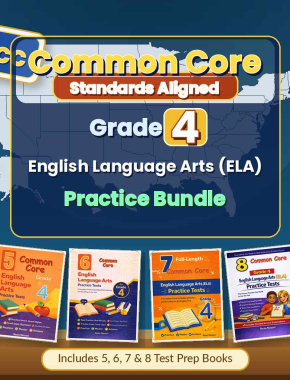
Use these Common Core Grade 4 resources for reading comprehension, language, writing, and full-length practice where available. Click any cover to open the resource page.
What does grade 4 English language arts cover?
In grade 4, English language arts usually centers on theme and summary, text structure, figurative language, and multi-paragraph essays. This page turns the Common Core grade 4 targets into short lessons, skill quizzes and printable worksheets.
Free Common Core Grade 4 English Worksheets
Looking for printable practice that lines up with Common Core Grade 4 English standards? Our companion worksheets page collects 57 single-skill PDFs aligned to the CCSS, reading, writing, grammar, vocabulary, and fluency, each with a Quick Review and an answer key. No login, no email required.
How to Use This Common Core Grade 4 English Checklist
- Choose one Grade 4 English strand. Start with the current Common Core unit, a recent assessment, or the skill that needs the most support.
- Use a real text. Practice Common Core Grade 4 reading standards with teacher-selected passages, independent-reading excerpts, poems, and focused nonfiction.
- Ask for evidence. Common Core Grade 4 students should point to words, sentences, or details that support the answer.
- Write a short response. Turn Common Core Grade 4 reading work into a short constructed response, a reading journal entry, or a polished paragraph.
- Spiral for Common Core review. Revisit Grade 4 vocabulary, grammar, comprehension, and writing each week so skills stay active.
Common Core Grade 4 English Standards FAQ
What does this page cover?
This page explains Common Core Grade 4 English Language Arts expectations in clear, original language for families, teachers, tutors, and homeschool planners.
Is this official standards wording?
No. This Common Core Grade 4 page is an independent, student-friendly guide for planning and practice. Use the official standards source for formal policy wording.
How should students practice English standards?
For Common Core Grade 4, build practice around texts first, then add response writing, language checks, vocabulary work, and discussion. Strong English practice connects skills instead of isolating them.
How does this connect to testing?
The Common Core Grade 4 standards are learning expectations; local schools and states choose assessments and curriculum resources. Strong preparation comes from careful reading, evidence-based answers, clear writing, and command of language conventions.
Source Note
This independent Common Core guide paraphrases Grade 4 English Language Arts expectations for readability and learning support. It is not official wording and is not affiliated with corestandards.org. Always consult official standards documents for formal language, updates, and compliance decisions.
For more Common Core Grade 4 support, visit the Grade 4 Learning Center.
Common Core excerpts: © Copyright 2010. National Governors Association Center for Best Practices and Council of Chief State School Officers. All rights reserved. Public license and attribution.
A USEFUL NEXT STEP
Commoncore Grade 4 English: study questions
How should I choose a Grade 4 english study target?
Choose a current classroom target, find the matching learning reference, and use a lesson or available practice resource to check understanding. State documents control local wording and placement; shared reference codes are not a certified crosswalk.
Official source ↗Are these activities official state assessments?
These are independently published learning resources. A practice score does not predict or replace an official state score. Use the directions in each activity and consult your school for official testing and accommodation rules.
Resources from Effortless Math · Editorial standards