Grade 3 Math: Introduction to Multiplication

Once upon a time in the land of Numeria, there lived two curious creatures named Multi and Plica. Multi had a magical power – every time he touched an object, it would multiply! Plica, on the other hand, could split objects into equal groups. They were good friends and loved to explore the concept of multiplication together.
Understanding the Concept
One sunny day, Multi and Plica found a field full of colorful flowers. Multi touched one flower, and suddenly, the field was filled with many more flowers, all multiplied by that one touch! Plica, fascinated by this, decided to organize the flowers into groups to understand multiplication better. They started by making groups of different sizes.
Imagine we have 3 groups of flowers, each with 4 flowers in them. To find the total number of flowers, we can multiply the number of groups by the number in each group. This is just like repeated addition!
\[3 \times 4 = 12\]
So, in this case, we have 12 flowers in total. Each group had 4 flowers, and we had 3 groups.
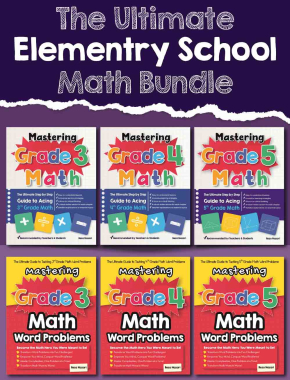
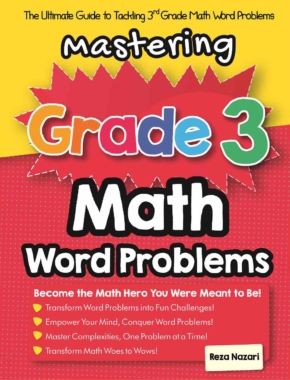
The Absolute Best Book to Ace Grade 3 Math
Multi and Plica continued exploring, this time with some colorful blocks. They decided to investigate what happens when you multiply by 1 and 0.
Key Concepts Explained
Let’s \dive deeper into the key concepts of multiplication. When we multiply a number by 1, we get the same number back. It’s like saying there is one group of that number. For example, \(3 \times 1 = 3\).
When we multiply a number by 0, we always get 0. This is because there are zero groups of that number. For example, \(5 \times 0 = 0\).
Now, let’s look at how multiplication connects with addition. Multiplication is like a fast way of adding the same number several \times.
For instance, if we have \(2 \times 3\), it means we are adding 2 three \times: \(2 + 2 + 2 = 6\). This is the same as \(2 \times 3 = 6\).
To understand this better, picture a scenario where there are 4 bags, and each bag contains 3 apples. How many apples are there in total?
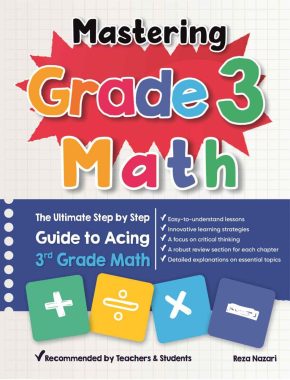
The Most Comprehensive Grade 3 Math Workbook
By multiplying the number of bags (4) by the number of apples in each bag (3), we find the total number of apples: \(4 \times 3 = 12\).
Common Mistakes to Avoid
One common mistake is mixing up multiplication with addition. Remember, multiplication is like repeated addition but done more efficiently by directly finding the total groups or items.
Another mistake is forgetting the properties of multiplying by 1 and 0. Multiplying by 1 gives the same number back, and multiplying by 0 always gives 0.
Summary and Key Takeaways
Today, we delved into the magical world of multiplication with Multi and Plica. We learned how multiplication helps us find the total when objects are grouped. Remember, multiplication is like quick addition, and multiplying by 1 keeps the number the same while multiplying by 0 always gives 0.
Practice your multiplication skills, and soon you’ll be a multiplication wizard like Multi and Plica!
💡 Teaching Tip: Think: groups of or repeated addition!
Additional Practice Resources

Related to This Article
More math articles
- A Comprehensive Look at Average vs Instantaneous Rate of Change
- Multiplying by 10, 100, and 1,000 for 4th Grade
- How to Interpret Remainders of Division Bigger Numbers Via One-digit Numbers
- 7th Grade CMAS Math Worksheets: FREE & Printable
- Measuring Angles with a Protractor for 4th Grade
- How to Combine Like Terms? (+FREE Worksheet!)
- The Ultimate SSAT Upper Level Math Formula Cheat Sheet
- 5th Grade ACT Aspire Math Practice Test Questions
- Number Properties Puzzle – Challenge 8
- Exponential and logarithmic integrals Simplified










What people say about "Grade 3 Math: Introduction to Multiplication - Effortless Math: We Help Students Learn to LOVE Mathematics"?
No one replied yet.