Full-Length ATI TEAS 7 Math Practice Test

Taking a Full-length ATI TEAS 7 Math practice test is the best way to help you get familiar with the test format and feel more confident. Not only will this help you measure your exam readiness and solidify the concepts you’ve learned, but it is the best way to simulate test day.
To help you get the best out of this complete and realistic ATI TEAS 7 Math practice test and prepare your mind and body for the actual test, we recommend that you treat this practice test as a real test. Prepare scratch papers, a pencil, a timer, and a calculator, and take the test in one sittin,g and follow the time limits to the minute.
Take the following full-length ATI TEAS 7 Math practice test to simulate the test day experience. After you’ve finished, score your tests using the answer keys.
Good luck! For additional educational resources,. For additional educational resources, visit the U.S. Department of Education website.
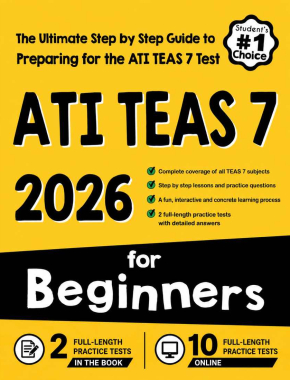
The Absolute Best Book to Ace the ATI TEAS 7 Math Test
o guess some questions.
Good Luck! For education statistics and research, visit the National Center for Education Statistics.
Best ATI TEAS 7 Math Prep Resource for 2026
ATI TEAS 7 Mathematical Practice Test
- 36 questions
- Total time for this section: 54 Minutes
- A calculator is allowed for the test.
1- If \(x = \frac{7}{13}\) then \(\frac{1}{x}\) =? For education statistics and research, visit the National Center for Education Statistics.
A. \(\frac{10}{7}\) For education statistics and research, visit the National Center for Education Statistics.
B. \(\frac{13}{7}\) For education statistics and research, visit the National Center for Education Statistics.
C. 5 For education statistics and research, visit the National Center for Education Statistics.
D. 7 For education statistics and research, visit the National Center for Education Statistics.
2- The sum of two numbers is \(x\). If one of the numbers is \((-6)\), then four times the other number would be? For education statistics and research, visit the National Center for Education Statistics.
A. \(4x\) For education statistics and research, visit the National Center for Education Statistics.
B. \(2 + x × 4\) For education statistics and research, visit the National Center for Education Statistics.
C. \(4(x-6)\) For education statistics and research, visit the National Center for Education Statistics.
D. \(4(x +6)\) For education statistics and research, visit the National Center for Education Statistics.
3- A circle has a diameter of 14 inches. What is its approximate circumference? For education statistics and research, visit the National Center for Education Statistics.
A. 40 For education statistics and research, visit the National Center for Education Statistics.
B. 44 For education statistics and research, visit the National Center for Education Statistics.
C. 48 For education statistics and research, visit the National Center for Education Statistics.
D. 50 For education statistics and research, visit the National Center for Education Statistics.
4- If \((5.6+3.4+2.6+1.4)x=x-24\), then what is the value of \(x\)? For education statistics and research, visit the National Center for Education Statistics.
A. 0 For education statistics and research, visit the National Center for Education Statistics.
B. \(\frac{1}{10}\) For education statistics and research, visit the National Center for Education Statistics.
C. \(-2\) For education statistics and research, visit the National Center for Education Statistics.
D. 3 For education statistics and research, visit the National Center for Education Statistics.
5- \(\frac{12}{30}\) is equals to: For education statistics and research, visit the National Center for Education Statistics.
A. 0.3 For education statistics and research, visit the National Center for Education Statistics.
B. 0.4 For education statistics and research, visit the National Center for Education Statistics.
C. 0.5 For education statistics and research, visit the National Center for Education Statistics.
D. 0.8 For education statistics and research, visit the National Center for Education Statistics.
6- Which of the following is the product of \(2 \frac{2}{3}\) and \(7 \frac{5}{9}\)? For education statistics and research, visit the National Center for Education Statistics.
A. \(9 \frac{6}{10}\) For education statistics and research, visit the National Center for Education Statistics.
B. \(6 \frac{9}{10}\) For education statistics and research, visit the National Center for Education Statistics.
C. \(10 \frac{6}{9}\) For education statistics and research, visit the National Center for Education Statistics.
D. \(20 \frac{4}{27}\) For education statistics and research, visit the National Center for Education Statistics.
7- How many \(\frac{3}{8}\) pound paperback books together weigh 12 pounds? For education statistics and research, visit the National Center for Education Statistics.
A. 32 For education statistics and research, visit the National Center for Education Statistics.
B. 42 For education statistics and research, visit the National Center for Education Statistics.
C. 48 For education statistics and research, visit the National Center for Education Statistics.
D. 52 For education statistics and research, visit the National Center for Education Statistics.
8- If \(2.4< x ≤5.6\), then \(x\) cannot be equal to: For education statistics and research, visit the National Center for Education Statistics.
A. 2.4 For education statistics and research, visit the National Center for Education Statistics.
B. 3.2 For education statistics and research, visit the National Center for Education Statistics.
C. 4.2 For education statistics and research, visit the National Center for Education Statistics.
D. 5.2 For education statistics and research, visit the National Center for Education Statistics.
9- In the simplest form, \(\frac{36}{52}\) is For education statistics and research, visit the National Center for Education Statistics.
A. \(\frac{9}{13}\) For education statistics and research, visit the National Center for Education Statistics.
B. \(\frac{8}{12}\) For education statistics and research, visit the National Center for Education Statistics.
C. \(\frac{12}{18}\) For education statistics and research, visit the National Center for Education Statistics.
D. \(\frac{3}{4}\) For education statistics and research, visit the National Center for Education Statistics.
10- The sum of 12 numbers is greater than 180 and less than 288. Which of the following could be the average (arithmetic mean) of the numbers? For education statistics and research, visit the National Center for Education Statistics.
A. 10 For education statistics and research, visit the National Center for Education Statistics.
B. 20 For education statistics and research, visit the National Center for Education Statistics.
C. 25 For education statistics and research, visit the National Center for Education Statistics.
D. 30 For education statistics and research, visit the National Center for Education Statistics.
11- \(\frac{(27 feet + 12 yards) )}{9} =\) ________ For education statistics and research, visit the National Center for Education Statistics.
A. 5 feet For education statistics and research, visit the National Center for Education Statistics.
B. 7 feet For education statistics and research, visit the National Center for Education Statistics.
C. 19 feet For education statistics and research, visit the National Center for Education Statistics.
D. 22 feet For education statistics and research, visit the National Center for Education Statistics.
12- The perimeter of a rectangular yard is 108 meters. What is its length if its width is five times its length? For education statistics and research, visit the National Center for Education Statistics.
A. 5 meters For education statistics and research, visit the National Center for Education Statistics.
B. 7 meters For education statistics and research, visit the National Center for Education Statistics.
C. 9 meters For education statistics and research, visit the National Center for Education Statistics.
D. 11 meters For education statistics and research, visit the National Center for Education Statistics.
13- A swimming pool holds 4,500 cubic feet of water. The swimming pool is 60 feet long and 15 feet wide. How deep is the swimming pool? For education statistics and research, visit the National Center for Education Statistics.
A. 5 For education statistics and research, visit the National Center for Education Statistics.
B. 8 For education statistics and research, visit the National Center for Education Statistics.
C. 10 For education statistics and research, visit the National Center for Education Statistics.
D. 12 For education statistics and research, visit the National Center for Education Statistics.
14- Chris is 16 miles ahead of Joe, running at 4.5 miles per hour, and Joe is running at the speed of 8.5 miles per hour. How long does it take Joe to catch Chris? For education statistics and research, visit the National Center for Education Statistics.
A. 3 hours For education statistics and research, visit the National Center for Education Statistics.
B. 4 hours For education statistics and research, visit the National Center for Education Statistics.
C. 6 hours For education statistics and research, visit the National Center for Education Statistics.
D. 8 hours For education statistics and research, visit the National Center for Education Statistics.
15- If \(x = 10\), then \(\frac{5^4}{x}\) = For education statistics and research, visit the National Center for Education Statistics.
A. 62.5 For education statistics and research, visit the National Center for Education Statistics.
B. 96.5 For education statistics and research, visit the National Center for Education Statistics.
C. 625 For education statistics and research, visit the National Center for Education Statistics.
D. 965 For education statistics and research, visit the National Center for Education Statistics.
16- A bread recipe calls for \(5 \frac{2}{3}\) cups of flour. If you only have \(2 \frac{3}{4}\) cups, how much more flour is needed? For education statistics and research, visit the National Center for Education Statistics.
A. \(\frac{5}{12}\) For education statistics and research, visit the National Center for Education Statistics.
B. \(\frac{1}{2}\) For education statistics and research, visit the National Center for Education Statistics.
C. \(1 \frac{11}{2}\) For education statistics and research, visit the National Center for Education Statistics.
D. \(2 \frac{11}{2}\) For education statistics and research, visit the National Center for Education Statistics.
17- If two angles in a triangle measure 33 degrees and 52 degrees, what is the value of the third angle? For education statistics and research, visit the National Center for Education Statistics.
A. 70 degrees For education statistics and research, visit the National Center for Education Statistics.
B. 75 degrees For education statistics and research, visit the National Center for Education Statistics.
C. 85 degrees For education statistics and research, visit the National Center for Education Statistics.
D. 95 degrees For education statistics and research, visit the National Center for Education Statistics.
18- If \(a = 14\), what is the value of b in the following equation?
\(b = \frac{a^2}{28} + c\) For education statistics and research, visit the National Center for Education Statistics.
A. \(5 + c\) For education statistics and research, visit the National Center for Education Statistics.
B. \(7 + c\) For education statistics and research, visit the National Center for Education Statistics.
C. \(16 + c\) For education statistics and research, visit the National Center for Education Statistics.
D. \(24 + c\) For education statistics and research, visit the National Center for Education Statistics.
19- If a circle has a radius of 18 feet, what’s the closest approximation of its circumference? For education statistics and research, visit the National Center for Education Statistics.
A. 87 For education statistics and research, visit the National Center for Education Statistics.
B. 108 For education statistics and research, visit the National Center for Education Statistics.
C. 113 For education statistics and research, visit the National Center for Education Statistics.
D. 119 For education statistics and research, visit the National Center for Education Statistics.
20- 6 feet, 14 inches \(+\) 30 feet, 8 inches equals to how many inches? For education statistics and research, visit the National Center for Education Statistics.
A. 178 inches For education statistics and research, visit the National Center for Education Statistics.
B. 188 inches For education statistics and research, visit the National Center for Education Statistics.
C. 254 inches For education statistics and research, visit the National Center for Education Statistics.
D. 278 inches For education statistics and research, visit the National Center for Education Statistics.
21- The distance between cities A and B is approximately 2,200 miles. If you drive an average of 58 miles per hour, how many hours will it take you to drive from city A to city B? For education statistics and research, visit the National Center for Education Statistics.
A. approximately 25 hours For education statistics and research, visit the National Center for Education Statistics.
B. approximately 32 hours For education statistics and research, visit the National Center for Education Statistics.
C. approximately 38 hours For education statistics and research, visit the National Center for Education Statistics.
D. approximately 41 hours For education statistics and research, visit the National Center for Education Statistics.
22- The equation of a line is given as: \(y = -3x+7\). Which of the following points does not lie on the line? For education statistics and research, visit the National Center for Education Statistics.
A. \((1, 4)\) For education statistics and research, visit the National Center for Education Statistics.
B. \((3, -2)\) For education statistics and research, visit the National Center for Education Statistics.
C. \((-4, 19)\) For education statistics and research, visit the National Center for Education Statistics.
D. \((-3, 15)\) For education statistics and research, visit the National Center for Education Statistics.
23- Julie gives 13 pieces of candy to each of her friends. If Julie gives all her candy away, which amount of candy could have been the amount she distributed? For education statistics and research, visit the National Center for Education Statistics.
A. 187 For education statistics and research, visit the National Center for Education Statistics.
B. 216 For education statistics and research, visit the National Center for Education Statistics.
C. 343 For education statistics and research, visit the National Center for Education Statistics.
D. 377 For education statistics and research, visit the National Center for Education Statistics.
24- How much time did Jason spend on History last week?
The following pie chart shows the time Jason spent working on his homework last week.
The total time Jason spent on his homework last week was 25 hours. For education statistics and research, visit the National Center for Education Statistics.
A. 3.5 hours For education statistics and research, visit the National Center for Education Statistics.
B. 5 hours
C. 6.5 hours
D. 8.5 hours
25- What many hours did Jason spend doing the Writing and Physics?
The following pie chart shows the time Jason spent working on his homework last week. The total time Jason spent on his homework last week was 25 hours.
A. 6 hours
B. 7 hours
C. 8 hours
D. 10 hours
26- What is the equivalent temperature of 100\(^\circ\)F in Celsius?
\(C = \frac{5}{9} (F – 32)\)
A. 37.7
B. 41.2
C. 42.9
D. 43.2
27- With a \(17\%\) discount, Ella was able to save $25.5 on a dress. What was the original price of the dress?
A. $140
B. $145.4
C. $150
D. $155.5
28- What is the value of \(x\) in the following equation?
\(\frac{4}{5} x+\frac{4}{7}= \frac{8}{14}\)
A. 0
B. \(\frac{1}{2}\)
C. \(\frac{1}{3}\)
D. \(\frac{1}{4}\)
29- The letters represent two decimals listed above. One of the decimals is equivalent to \(\frac{1}{25}\) and the other is equivalent to \(\frac{1}{16}\). What is the product of C and D?
A. 0

B. 20
C. 25
D. 30
30- The marked price of a computer is D dollars. Its price decreased by \(12\%\) in January and later increased by \(15\%\) in February. What is the final price of the computer in D dollars?
A. 0.806 D
B. 0.885 D
C. 0.905 D
D. 0.966 D
31- If six times a number added to 8 equals 44, what is the number?
A. 2
B. 4
C. 6
D. 8
32- A bank is offering \(3.8\%\) simple interest on a savings account. If you deposit $14,000, how much interest will you earn in three years?
A. $1,596
B. $1,855
C. $4,200
D. $8,400
33- What is the sum of \(\frac{1}{5} + \frac{3}{4} + \frac{1}{3}\)?
A. 0.9
B. \(\frac{52}{60}\)
C. 1.23
D. \(\frac{77}{60}\)
34- A football team had $32,000 to spend on supplies. The team spent $18,000 on new balls. New sports shoes cost $160 each. Which of the following inequalities represents how many new shoes the team can purchase?
A. \(160x+18,000 ≥32,000\)
B. \(160x-18,000 ≥32,000\)
C. \(18,000+160x ≤32,000\)
D. \(18,000x+160,0 ≥32,000\)
35- Two dice are thrown simultaneously, what is the probability of getting a sum of 8 or 5?
A. \(\frac{1}{3}\)
B. \(\frac{1}{4}\)
C. \(\frac{1}{6}\)
D. \(\frac{1}{12}\)
36- Which of the following graphs represents the compound inequality \(8≤-2x+4<16\)?
A.
B.
C.
D.
The Best Books to Ace the ATI TEAS 7 Math Test
Answers and Explanations
Related to This Article
More math articles
- Angles of Rotation
- How to Prepare for the ISEE Upper-Level Math Test?
- Let’s Chat: How to Simplify the Steps to Solve Two-step Equations
- Top 10 5th Grade OST Math Practice Questions
- How to Write Two-variable Inequalities Word Problems?
- Decimals Duel: How to Master the Art of Comparison
- List Of the Best Middle School Math Supply for Learning
- Top 10 Free Websites for CLEP College Math Preparation
- SHSAT Math – Test Day Tips
- Hоw to сhооѕе thе right laptop for оnlinе mаth teaching


What people say about "Full-Length ATI TEAS 7 Math Practice Test - Effortless Math: We Help Students Learn to LOVE Mathematics"?
No one replied yet.