ISEE Upper Level · Entering Grades 9-12
ISEE Upper Level Practice Test: Free Math Practice, Topics & Vocabulary
Prepare for ISEE Upper Level with independent practice, recall, and worked explanations. Choose one skill to strengthen, review the official assessment context, and follow a study route that fits your needs.

ISEE Upper Level Practice Tests
An independent Math practice form with answers; prepare the other official sections separately.
ISEE Upper Level Flashcards
Open the existing deck and connect each word with its example.
ISEE Upper Level Study Guides
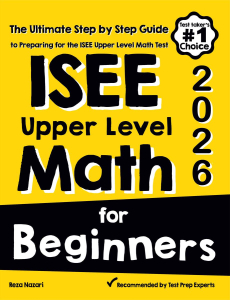
ISEE Upper Level Math for Beginners 2026: The Ultimate Step by Step Guide to Preparing for the ISEE Upper Level Math Test
Independent Math-focused preparation; prepare Verbal, Reading, and Writing separately and compare the contents with current ERB requirements.
View book & purchase options → $17.99 · PDF
ISEE Upper Level Quick Review
Use the existing example to explain a solution before practicing.
MEET THE ASSESSMENT · CHOOSE YOUR NEXT SKILL
Know ISEE Upper Level before you start.
ERB determines the ISEE level by the grade the student is applying to. ISEE Upper Level is for applicants to Grade 9–12. The level includes Verbal Reasoning, Quantitative Reasoning, Reading Comprehension, Mathematics Achievement, and an unscored essay shared with schools. The printable practice on this page is Math-focused and independent; it is not the complete official exam and does not produce an official ISEE score. Confirm current registration and delivery directions with ERB.
Reading and vocabulary
Use the passage or sentence to support the meaning you choose.
Math understanding
Explain the setup and check the quantities before calculating.
Choose the correct level
Match preparation to the grade of application, rather than the student’s current grade.
Official level and sample guidance
Check ERB’s current level and testing information.
What is on the ISEE Upper Level?
Four multiple-choice sections and one essay. The standard schedule also includes two 5–10 minute breaks.
| Section | Questions | Time | What to practice |
|---|---|---|---|
| Verbal reasoning | 40 | 20 min | Synonyms and sentence completion. |
| Quantitative reasoning | 37 | 35 min | Compare quantities and reason through multi-step problems. |
| Reading comprehension | 36 | 35 min | Analyze complex passages, inference, and author choices. |
| Mathematics achievement | 47 | 40 min | Apply arithmetic, algebra, geometry, and data skills. |
| Essay | 1 prompt | 30 min | Write a focused, supported response. |
Free Upper Level mathematics practice test
A complete, original mathematics section with 47 questions and the actual 40-minute time limit. Work online for an instant raw score and explanations, or print the PDF and mark answers by hand.
This covers the mathematics section only. It is independent practice, not an official ISEE form or a predicted ISEE score. Use ERB’s sample for the complete test experience.
Start with the section you need most
Work with words in context
Review synonyms and sentence completion. Use the whole sentence to test a word choice, then check whether its tone and meaning fit.
Prove the answer
Read the question carefully, return to the passage, and point to evidence. Practice main idea, details, inference, vocabulary, and author purpose.
Explain the setup
For quantitative reasoning, identify what the numbers mean before calculating. Check units, estimates, and whether each answer is plausible.
ISEE Upper Level Vocabulary Flashcards
Build synonym precision and sentence-completion reasoning with original vocabulary for applicants to grades 9–12. Practice reading the whole sentence, noticing contrast and cause clues, and checking the exact shade of meaning.
ERB describes the tested skills and question formats, not a fixed public word list. This is an original, curated study deck, not an official ERB list or a prediction of test items.
Practice flexible algebra and careful interpretation
Upper Level uses the same section counts as Middle Level, but its questions target older applicants. Prioritize equations, functions, geometry, and data while practicing when to estimate, substitute, or eliminate answer choices. For reading, notice the author’s reasoning and tone as well as literal details.
Your math practice center
Review linear equations and functions, exponents, radicals, quadratics, coordinate geometry, measurement, probability, and statistics. The existing Effortless Math center has topic lessons, short quizzes, worksheets, and a timed math practice test. It supports the math portions of the ISEE; use ERB’s sample for the full exam.
A quick math warm-up
If f(x) = 2x² − 3, what is f(−2)?
Show the answer and reasoning
Substitute −2: 2(4) − 3 = 5.
Original practice example; not an official ISEE question.
Flashcards and quick review
Use the 121 original Upper Level flashcards for short daily practice, then read the one-page quick review before a timed section.
Give the essay a simple structure
- Spend a few minutes choosing a clear position or story idea.
- Write an opening that answers the prompt, followed by two developed points or moments.
- Use specific details. Reserve the final minutes to reread for clarity and complete sentences.
Original practice prompt: What responsibility should a student take when a group project is not going well? Support your answer.
Write for 30 minutes. The goal is a readable response that shows how you think and communicate.
Sample ISEE-style writing response
Original practice prompt: What responsibility should a student take when a group project is not going well? Support your answer.
When a group project begins to fail, it is tempting to blame the person who missed a deadline or to quietly do that person’s work. Neither response solves the larger problem. A student has a responsibility to name the difficulty early, listen to the group, and help make a realistic new plan.
Last year, my history group was preparing a presentation on local immigration stories. Two days before our rehearsal, we had plenty of research but no clear order for the slides. One member wanted to keep collecting sources, while another thought we should cut half the material. I suggested that we spend fifteen minutes agreeing on the question our presentation needed to answer. Once we chose that question, we could sort the sources by whether they helped answer it. We kept three firsthand accounts, moved extra facts into speaker notes, and divided the remaining editing tasks. The project was still rushed, but it finally made sense.
That experience taught me that responsibility is more than completing my assigned slides. It includes noticing when the group needs a decision. A useful response is specific: What is unfinished? What matters most? Who can do each task by the next meeting? It also leaves room for a classmate to explain a problem we may not know about. Someone who has missed a deadline may need help, not a lecture.
A student cannot guarantee that every group project will succeed. A student can, however, bring the group back to a shared goal, communicate honestly, and follow through on a fair plan. Those actions give the project its best chance.
Why this response works
- It answers the prompt in the opening paragraph.
- It develops a specific example instead of repeating the main point.
- It ends by returning to the central idea.
When you practice, give yourself 30 minutes. Leave a few minutes to reread your work.
A practical four-week study path
Week 1 · Take a baseline
Use an official sample to see which section needs the most attention. Keep a short error log: topic, why the answer missed, and a better next step.
Week 2 · Repair weak skills
Alternate verbal or reading work with quantitative reasoning and math achievement. Review concepts before adding speed.
Week 3 · Practice under time
Work in actual section-length blocks. After each set, spend more time explaining missed answers than counting the score.
Week 4 · Put the sections together
Run a full rehearsal with the scheduled breaks, polish essay structure, and leave the final day for light review and sleep.
Practice with ERB’s samples
Try the official free sample first to learn the question types and screen flow. Then move to the math center for targeted repair and return to a full sample to check your progress.
Questions families ask
What is the difference between quantitative reasoning and mathematics achievement?
Quantitative reasoning emphasizes thinking through numerical situations. Mathematics achievement asks students to apply learned math content. Practice both, and review the explanation behind each missed item.
Does the essay count toward the score?
The essay is unscored. Schools that receive the score report also receive the writing sample, so it still deserves careful practice.
How is the ISEE level chosen?
The level is based on the grade the student is applying to: Lower for Grades 5–6, Middle for Grades 7–8, and Upper for Grades 9–12.
Explore the other ISEE levels
Primary 2
For applicants to Grade 2; 53 min of testing.
Open guide →
Choose your levelPrimary 3
For applicants to Grade 3; 54 min of testing.
Open guide →
Choose your levelPrimary 4
For applicants to Grade 4; 60 min of testing.
Open guide →
Choose your levelLower Level
For applicants to Grades 5–6; 2 hr 20 min of testing.
Open guide →
Choose your levelMiddle Level
For applicants to Grades 7–8; 2 hr 40 min of testing.
Open guide →
Sources and a note about format
Section counts and standard times follow the ERB ISEE Quick Facts guide. The ERB at-home family guide confirms section timing. ERB’s current registration page confirms that Primary levels have no writing sample. Older ERB guides did list Primary writing prompts; check the current test materials when preparing.
Effortless Math is an independent study resource and is not affiliated with ERB or E3n.
A USEFUL NEXT STEP
ISEE Upper Level: study questions
Which level and subjects should I prepare for ISEE Upper Level?
ERB determines the ISEE level by the grade the student is applying to. ISEE Upper Level is for applicants to Grade 9–12. The level includes Verbal Reasoning, Quantitative Reasoning, Reading Comprehension, Mathematics Achievement, and an unscored essay shared with schools. The printable practice on this page is Math-focused and independent; it is not the complete official exam and does not produce an official ISEE score. Confirm current registration and delivery directions with ERB.
Official source ↗How should I use these independent ISEE Upper Level study tools?
Start with a practice activity, review explanations for missed questions, and use quick review or flashcards for one weak topic. The practice results are study feedback, not official exam scores. Compare a book’s contents with your course or test requirements before buying.
Resources from Effortless Math · Editorial standards