YOUR PSAT/NMSQT STUDY COMPANION
PSAT/NMSQT Math Practice Test PDF with Answers
Ready to find out which PSAT Math skills need more practice? Download our free PSAT/NMSQT Math mini practice test PDF with answers , work through the questions, and use your mistakes to choose what to study next.
Ready to find out which PSAT Math skills need more practice? Download our free PSAT/NMSQT Math mini practice test PDF with answers, work through the questions, and use your mistakes to choose what to study next.
Want a longer session? Visit our PSAT Math Online Center for online practice and study resources. The printable mini test below is a short diagnostic; it is not a full-length or official College Board test.
Download the Free PSAT/NMSQT Math Practice Test PDF
Download the printable mini practice test here:
The PDF includes multiple-choice math questions, an answer key, and short explanations. It is intentionally shorter than a full exam. A shorter test is easier to finish, easier to review, and better for finding the exact topics that need repair.
After you complete the PDF, do not stop at the score. Mark each missed question by topic: arithmetic, algebra, geometry, data, functions, or word problems. That topic list becomes your study plan.
Digital PSAT/NMSQT Math: Timing and Calculator Rules
- 44 questions in 70 minutes: two modules, each with 22 questions and 35 minutes.
- Calculator allowed throughout Math: an acceptable calculator can be used in both modules.
- Two answer formats: multiple-choice questions and questions where you enter your own answer.
A printable mini test helps you review skills, but it cannot reproduce the digital test experience. Use official Bluebook practice to become familiar with the testing app and timed modules. Check your school’s instructions for your test date, device preparation, and any approved accommodations.
Format checked October 7, 2026 against College Board’s PSAT/NMSQT structure and Math section guidance.
Which PSAT Math Topics Should You Review?
College Board groups Math into four domains. After completing the PDF, sort your missed questions into these areas:
- Algebra: linear equations, inequalities, functions, and systems.
- Advanced Math: equivalent expressions, nonlinear equations, and nonlinear functions.
- Problem-Solving and Data Analysis: ratios, percentages, data interpretation, and probability.
- Geometry and Trigonometry: area, volume, angles, triangles, and circles.
Start with the area where you made the most mistakes. If you understood the topic but lost points on signs or units, review your written steps before adding harder questions.
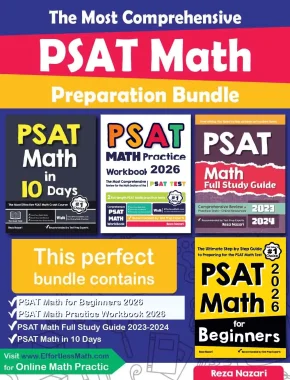
Recommended PSAT Math Practice

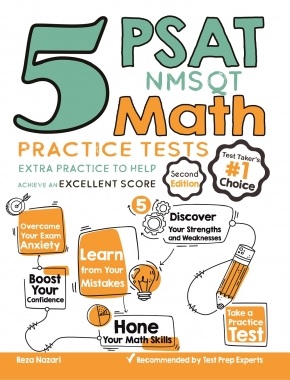
PSAT Math Practice Workbook 2026 The Most Comprehensive Review for the Math Section of the PSAT Test
How to Take the PDF Like a Real Practice Test
Print the PDF or open it on a tablet where you can show your work. Put away notes for your first attempt. Keep a calculator available, as it is allowed throughout PSAT/NMSQT Math, but choose the method that helps you solve each question clearly.
Use the mini PDF as a low-stress diagnostic, then switch to Bluebook for realistic module timing.
When time is up, circle unfinished questions instead of rushing them. Unfinished questions are useful information. They show whether the problem was too hard, too long, or just unfamiliar.
Do not check answers one at a time. Finish the set first, then score the whole page. Checking after every question trains the student to depend on feedback too early.
How to Score the Answer Key
Use three scores, not one.
Accuracy score: How many questions were correct?
Topic score: Which topics caused the misses?
Process score: Did the student show enough work to explain each answer?
The process score is often the most honest one. A student may guess correctly on a multiple-choice question, but that does not mean the method is ready. A student may also make one arithmetic slip after setting up a problem correctly. That student needs a different fix than someone who did not understand the question at all.
For every missed question, write one sentence: “I missed this because..” Keep the sentence practical. Examples: “I set up the proportion backward,” “I used area instead of perimeter,” or “I forgot to distribute the negative sign.”
Common PSAT Math Mistakes to Catch
- Solving for the wrong quantity: underline what the question asks before setting up your equation.
- Losing a negative sign: write the distribution step instead of doing it all in your head.
- Mixing units: label measurements and convert them before calculating.
- Reading an explanation without practicing: close the answer key and solve the missed question again.
Keep a short error log with the topic, the mistake, and one action for your next practice session.
What a Strong Review Looks Like
A strong review is slow for a few minutes and faster later. First, cover the explanation and try to fix the missed problem from your own work. If the answer changes, write down exactly what changed: the equation, the operation, the unit, the graph reading, or the estimate. Then read the explanation and compare it with your method.

Ask, “Which step helped me reach the right answer?” That question turns a practice test into instruction. It also keeps review from becoming passive reading. For PSAT/NMSQT Math, this matters because many missed math questions are not caused by one big topic gap. They come from small choices: setting up the ratio backward, distributing incorrectly, rounding too soon, or choosing the answer before checking the units.
A Focused Study Plan
Practice two short math sets per week, review every miss, and take official Bluebook practice before the school test window.
A good weekly routine is simple:
Day 1: Take the mini practice PDF and score it by topic.
Day 2: Review arithmetic, fractions, decimals, percents, and ratios. These topics appear inside harder problems.
Day 3: Review equations, expressions, and algebraic setup.
Day 4: Review geometry, measurement, data, and graphs.
Day 5: Do a mixed set and update the mistake log.
Day 6: Use official practice or a longer Effortless Math practice test.
Day 7: Retake only the topics missed earlier.
This plan works because it does not treat every topic equally. It starts with the student’s real work and then uses the mistakes to choose the next practice.
Related Effortless Math Practice
These resources are useful after the mini PDF:
Use the free PDF first if you are not sure where to start. Use a workbook or full-length practice test when you need more repetition, better pacing, or a complete review path.
How Parents, Teachers, or Tutors Can Help
The most useful support is not giving the answer. It is asking the right question at the right time. Try these:
- What is the question asking you to find?
- Which information is useful, and which information is extra?
- Can you estimate before calculating?
- Does the answer make sense with the units?
- Can you explain why the correct answer is correct?
Those questions keep the student doing the thinking. They also reveal whether the mistake is reading, setup, arithmetic, or content knowledge.
Frequently Asked Questions
What math is on the PSAT/NMSQT?
PSAT/NMSQT Math covers four domains set by College Board: algebra, advanced math, problem-solving and data analysis, and geometry and trigonometry. Expect linear equations, systems, quadratics, percents, ratios, statistics and basic geometry. After a practice test, sort your missed questions into these four groups so you know exactly where to focus your review.
How is the PSAT/NMSQT Math section set up?
The digital PSAT/NMSQT Math section has 44 questions in 70 minutes, split into two modules of 22 questions and 35 minutes each. A calculator is allowed on both modules, and some questions ask you to enter your own answer instead of choosing one. Practice in the official Bluebook app to get used to the timing.
How is the PSAT/NMSQT Math section scored?
The PSAT/NMSQT Math section is scored from 160 to 760, and it combines with the Reading and Writing score for a total between 320 and 1520. There is no penalty for wrong answers, so answer every question. Your score report also shows how you did in each math domain, which helps you plan your next study steps.
What is the difference between the PSAT 10 and the PSAT/NMSQT?
The two tests have the same content and format. The PSAT/NMSQT is usually given in the fall to 10th and 11th graders, and 11th grade scores can qualify students for the National Merit Scholarship Program. The PSAT 10 is given in the spring to 10th graders and does not count toward National Merit entry.
Where can I get a PSAT/NMSQT math practice test?
Effortless Math has a free printable PSAT/NMSQT Math mini practice test PDF with answers to help you spot weak skills quickly. Because the real test is digital and adaptive, also take the official full-length practice tests in College Board’s Bluebook app. Use the PDF for skill review and Bluebook for realistic timing practice.
Final Study Note
The best PSAT/NMSQT Math practice is specific, honest, and reviewed carefully. Take the PDF, mark every mistake by topic, study the weakest skills, and then test again. That cycle is not flashy, but it is how math scores improve.
Keep Building PSAT Math Confidence

Related to This Article
More math articles
- Free Grade 4 English Worksheets for Massachusetts Students
- NCLEX Delegation Questions: Right Person vs. Right Direction (2027 Prep)
- A Comprehensive Collection of FREE PSAT Math Practice Tests
- AI Homework Helpers vs. Real Math Practice: What Actually Works in 2026
- How to Multiply Fractions: A Visual Guide for Beginners
- Unlock the Future: 10 Unexpected Advantages of Online Learning in 2024
- The Best Grade 7 ELA Practice Tests for Oregon Students
- California Algebra 1 Free Worksheets: Skill-by-Skill Algebra 1 Worksheets You Can Print Today
- Hawaii SBAC Grade 4 Math Free Worksheets: Printable Practice Worksheets with Worked Solutions
- Solving Percentage Word Problems












What people say about "PSAT/NMSQT Math Practice Test PDF with Answers"?
No one replied yet.