New York Regents Examination in Geometry
YOUR Regents Geometry STUDY COMPANION
Regents Geometry Practice Test: Free Full-Length Exam and Review
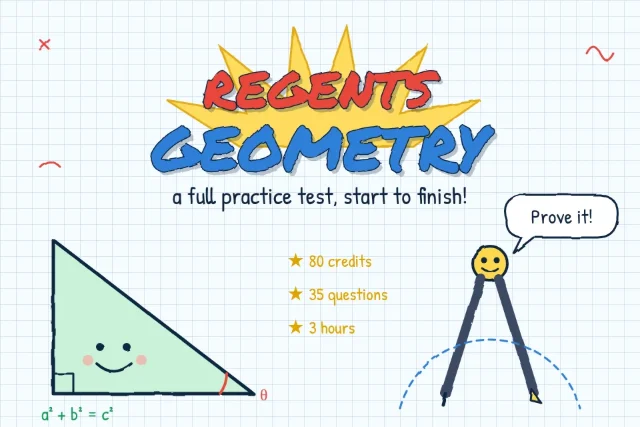
The Regents Examination in Geometry asks you to reason, not just compute: you will transform figures, prove that triangles are congruent, and use trigonometry and coordinates to solve problems. This Online Center gives you a free full-length practice exam that follows the official test design: 35 questions, 80 credits and three hours, with a worked solution for every question and a credit guide for every written answer. Start with the practice test, then use the Quick Review and flashcards to close the gaps it shows you.
MEET THE TEST
Know the Geometry Regents before you start
The current exam is aligned to the New York State Next Generation Mathematics Learning Standards and was first given in June 2025. It has four parts and 35 questions in all. Part I has 24 multiple-choice questions worth 2 credits each. Part II has 7 constructed-response questions worth 2 credits each, Part III has 3 worth 4 credits each, and Part IV has 1 question worth 6 credits, for a total of 80 credits.
You have three hours. A graphing calculator is required for the whole exam, and a compass and straightedge must be available for constructions. The reference sheet at the back of the booklet lists only volume formulas, so the Pythagorean theorem, trigonometric ratios, circle formulas and the equation of a circle are yours to remember. In Parts II, III and IV you must show the necessary steps, including formula substitutions and diagrams, and leave all construction marks.
Your raw score is converted to a scale score from 0 to 100. A scale score of 65 is passing and 85 marks mastery. On the August 2026 conversion chart, 35 raw credits converted to 65 and 67 raw credits converted to 85. On the June 2026 chart the numbers were 36 and 66. The chart can change from one administration to the next.
AT A GLANCE
Regents Geometry Test Outline
24 questions • 2 credits each • 48 credits
Multiple choice with four answer choices
No partial credit
7 questions • 2 credits each • 14 credits
Constructed response
Show your work. Often includes a construction.
3 questions • 4 credits each • 12 credits
Constructed response
Explain, justify or prove
1 question • 6 credits
Constructed response
A multi-step proof, often on the coordinate plane
Congruence 27 to 34% of credits
Transformations, angle relationships, triangle congruence, quadrilaterals and constructions
Similarity, Right Triangles and Trigonometry 29 to 37% of credits
Dilations, similar triangles, special right triangles and trigonometry
Expressing Geometric Properties with Equations 12 to 18% of credits
Equations of circles, slope, partitions and coordinate proofs
Modeling with Geometry 8 to 15% of credits
Modeling objects with shapes, density and design
Circles 2 to 8% of credits
Angles, arcs, tangents, arc length and sector area
Geometric Measurement and Dimension 2 to 8% of credits
Volume formulas, cross sections and solids of revolution
Credit ranges come from the NYSED Educator Guide. NYSED sets one time limit for the whole exam, not for each part.
FIND YOUR FOCUS
Geometry Regents subjects and skills
Similarity, Right Triangles and Trigonometry
The largest share of the exam, between 29 and 37 percent of the credits. Expect dilations, similar triangles and the side-splitter theorem, special right triangles, the altitude to the hypotenuse, angles of elevation and depression, and the area formula one-half ab sin C.
Congruence
Between 27 and 34 percent of the credits. You will describe rigid motions, use angle relationships with parallel lines, prove triangles congruent, classify quadrilaterals, and do compass-and-straightedge constructions.
Expressing Geometric Properties with Equations
Between 12 and 18 percent of the credits. Questions ask for the center and radius of a circle, parallel and perpendicular lines, the point that partitions a segment, and coordinate proofs that a figure is a parallelogram, rectangle, rhombus or trapezoid.
Modeling with Geometry
Between 8 and 15 percent of the credits. Real objects are modeled with solids, and you use density and design limits to make decisions.
Circles and Geometric Measurement
Between 2 and 8 percent each. Expect inscribed angles, tangents, arc length and sector area, plus volume, cross sections and solids made by rotating a figure.
PRACTICE WITH A PLAN
Free full-length Regents Geometry practice test
Practice Test 1 matches the official test design: 24 multiple-choice items in Part I, then seven 2-credit, three 4-credit and one 6-credit constructed-response problems, including a construction, a congruence proof and a coordinate proof. The multiple-choice section is scored for you. For each constructed-response problem you work on paper, then open a full solution and a credit guide written in the style of the State’s rating guides and award yourself the credits you earned.
Treat the result as study feedback, not an official score. It is an original practice exam written by Effortless Math, not a released State test.
TRY A FEW
10 Regents Geometry sample questions
These ten questions are separate from the full-length test. Pick an answer, check it, and read the explanation. Each one names the mistake behind the most tempting wrong choice, which is often the fastest way to see what a topic tests.
Choose one answer, then check it. If the buttons do not respond, each explanation is printed below its question.
Answer A.
A translation adds the same amount to every \(x\)-coordinate and the same amount to every \(y\)-coordinate. Subtract the original coordinates from the image’s: the \(x\)-change is \(-1 – 2 = -3\) and the \(y\)-change is \(1 – (-3) = 4\). So the rule is \((x, y) \to (x – 3, y + 4)\), a move 3 left and 4 up. Choice B subtracts in the wrong order and moves the point the opposite way, choice C copies the image’s coordinates into the rule, and choice D is a rotation of \(180^\circ\), not a translation.
Answer D.
Vertical angles are congruent, so \(4x + 6 = 6x – 24\), which gives \(30 = 2x\) and \(x = 15\). Each of those angles measures \(4(15) + 6 = 66^\circ\). An adjacent angle forms a linear pair with a \(66^\circ\) angle, so it measures \(180 – 66 = 114^\circ\). The most tempting wrong choice is \(66^\circ\), which is the vertical angle itself. The choice \(15^\circ\) is only the value of \(x\), and \(90^\circ\) would be right only if the lines were perpendicular.
Answer C.
A diagonal cuts the square into two 45-45-90 triangles, with the diagonal as the hypotenuse. In such a triangle the hypotenuse is \(\sqrt{2}\) times a leg, so \(s\sqrt{2} = 10\) and \(s = \frac{10}{\sqrt{2}} = 5\sqrt{2} \approx 7.07\) inches. The Pythagorean theorem agrees: \(s^2 + s^2 = 100\), so \(s^2 = 50\). The choice \(10\sqrt{2}\) multiplies by \(\sqrt{2}\) when it should divide, which would make the side longer than the diagonal, 5 halves the diagonal as if the triangle were 30-60-90, and 2.5 divides the diagonal by 4 as if each side were a quarter of it.
Answer C.
Lengths scale by the ratio, but areas scale by the square of the ratio. The area ratio is \(3^2 : 5^2 = 9 : 25\), so \(\frac{36}{A} = \frac{9}{25}\) and \(A = \frac{36 \cdot 25}{9} = 100\) square centimeters. The choice 60 uses \(\frac{3}{5}\) as if area grew like length, which is the most common mistake here. The choice 21.6 shrinks the area instead of enlarging it, and 180 multiplies by 5 without dividing by 3 or squaring.
Answer C.
The angle of depression is measured down from a horizontal line, and it is congruent to the angle of elevation from the boat to the top, because the two are alternate interior angles. In the right triangle, 120 feet is opposite the \(9^\circ\) angle at the boat and the distance \(d\) is adjacent, so \(\tan 9^\circ = \frac{120}{d}\) and \(d = \frac{120}{\tan 9^\circ} \approx 758\) feet. The choice 19 feet comes from placing \(9^\circ\) at the top of the lighthouse and multiplying by \(\tan 9^\circ\), 767 feet is the slanted line of sight, \(\frac{120}{\sin 9^\circ}\), not the distance along the water, and 121 feet comes from \(\frac{120}{\cos 9^\circ}\), which treats 120 feet as the side next to the \(9^\circ\) angle.
Answer B.
An arc is the same fraction of the circumference as its central angle is of \(360^\circ\). The circumference is \(2\pi(8) = 16\pi\), so the arc length is \(\frac{135}{360} \cdot 16\pi = \frac{3}{8} \cdot 16\pi = 6\pi \approx 18.8\) centimeters. The choice \(24\pi\) is the area of the sector, \(\frac{3}{8} \cdot 64\pi\), which answers a different question. The choice \(3\pi\) uses \(\pi r\) instead of \(2\pi r\) for the circumference, and \(16\pi\) is the whole circumference.
Answer B.
A tangent is perpendicular to the radius drawn to the point of tangency, so \(\triangle OTP\) is a right triangle with legs \(OT = 5\) and \(PT = 12\). The hypotenuse is \(OP = \sqrt{5^2 + 12^2} = \sqrt{169} = 13\). That is the distance from \(P\) to the center, and the closest point of the circle lies on \(\overline{OP}\), one radius from \(O\). So the shortest distance is \(13 – 5 = 8\) units. The choice 13 stops at the center, 12 is the length of the tangent segment itself, and 7 is \(12 – 5\), which skips the right triangle.
Answer D.
The midpoint is halfway, so the trip from \(A\) to \(M\) is repeated from \(M\) to \(B\). From \(A(-3, 4)\) to \(M(2, -1)\) the coordinates change by \(+5\) and \(-5\), so \(B = (2 + 5, -1 – 5) = (7, -6)\). The formula agrees: \(\frac{-3 + x}{2} = 2\) gives \(x = 7\), and \(\frac{4 + y}{2} = -1\) gives \(y = -6\). The choice \((-0.5, 1.5)\) is the midpoint of \(\overline{AM}\), \((-8, 9)\) goes the wrong direction from \(A\), and \((5, -5)\) is the change from \(A\) to \(M\), not a point on the segment.
Answer C.
A great circle has the same radius as the sphere. From \(2\pi r = 18\pi\), the radius is \(r = 9\) inches. The reference sheet gives \(V = \frac{4}{3}\pi r^3 = \frac{4}{3}\pi(729) = 972\pi \approx 3053.6\) cubic inches. The choice 1017.9 is the surface area, \(4\pi r^2\), the choice 1526.8 is half the volume, a hemisphere, and 24,429.0 uses 18 as the radius.
Answer A.
Put every measurement in feet before multiplying: 3 inches is \(\frac{3}{12} = 0.25\) foot. The mulch fills a rectangular prism with volume \(12 \cdot 8 \cdot 0.25 = 24\) cubic feet, and \(24 \div 2 = 12\) bags. The choice 144 comes from using 3 feet for the depth, which gives 288 cubic feet. The choice 24 is the number of cubic feet, not bags, and 48 multiplies by 2 instead of dividing.
UNDERSTAND THE IDEA
Regents Geometry Quick Review
The Quick Review walks through all six conceptual categories on the blueprint in plain language, from rigid motions and proofs to equations of circles and density. Each topic has a short explanation, a worked example, a common mistake to avoid and a pointer to the practice that fits it.
RECALL AND APPLY
Regents Geometry flashcards
The deck has 46 cards across congruence, similarity, trigonometry, circles, coordinates, measurement, modeling and the test itself. Because the reference sheet lists only volume formulas, the cards are a good way to keep the rest in memory. Set aside the cards you miss so you can come back to them.
ONE STEP AT A TIME
Plan your Geometry Regents study route
- Diagnose. Take the full-length practice test under real conditions: three hours, your graphing calculator, a compass, a straightedge and the reference sheet. Score it honestly with the credit guides.
- Review. Sort your missed questions by category. Read the matching Quick Review sections first, starting with similarity and trigonometry and with congruence, because they carry most of the credits.
- Practice. Work the sample questions and the flashcards for your weakest topics. Then rewrite the proofs and constructions you lost credit on, giving every statement a reason.
- Check. A week or two before the exam, rework the questions you missed under timed conditions and check each one against its solution and credit guide. Then work the sample questions again to confirm the gaps are closed.
GO DEEPER
Geometry study guide
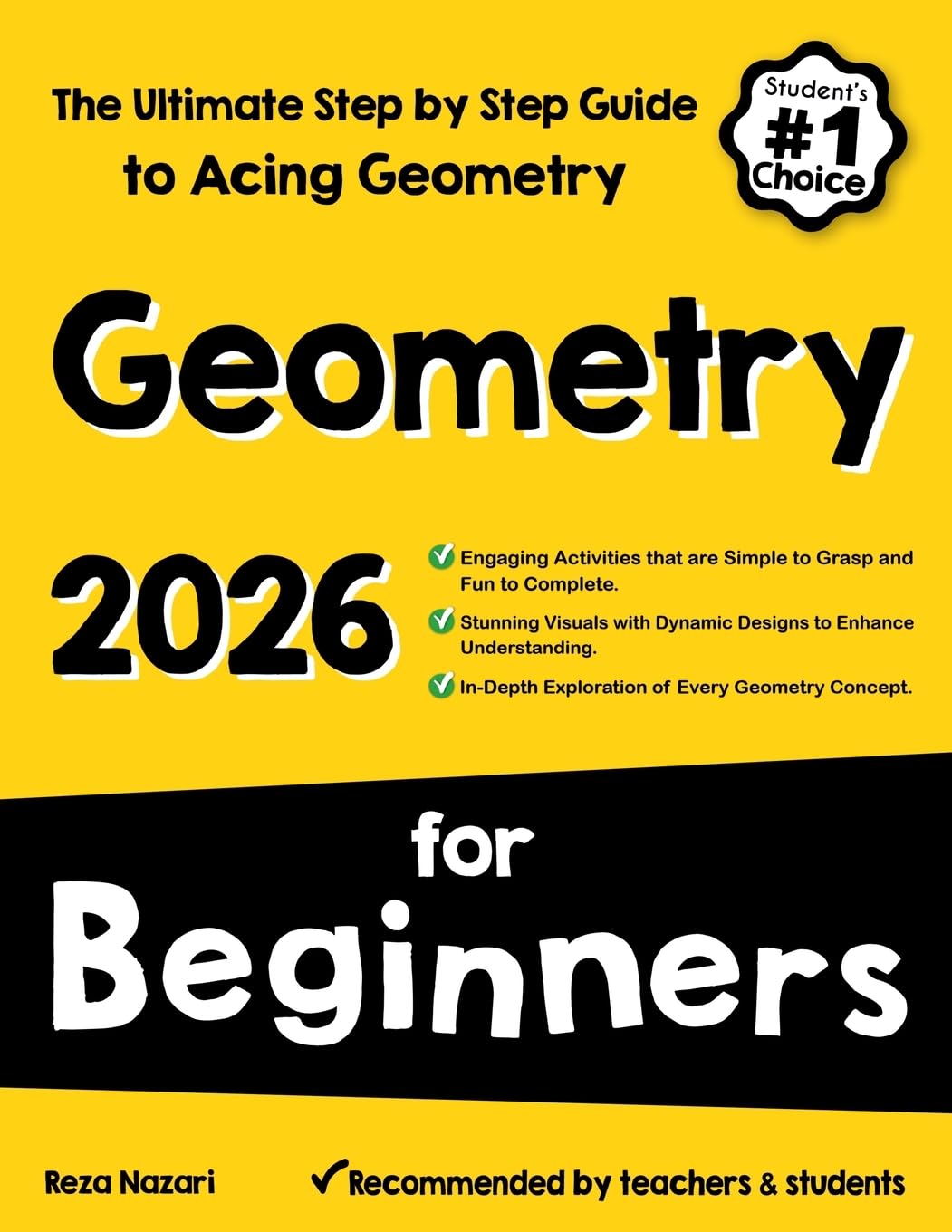
If you want to rebuild a topic from the ground up, Geometry for Beginners from Effortless Math explains each idea step by step with worked examples and practice. It is optional. Everything in this Online Center is free to use.
QUICK ANSWERS
Regents Geometry questions, answered
How many questions are on the Geometry Regents?
There are 35 questions worth 80 raw credits: 24 multiple-choice questions in Part I and 11 constructed-response questions in Parts II, III and IV.
How long is the Geometry Regents exam?
You have three hours for the whole exam. NYSED does not set separate time limits for the four parts.
What score do I need to pass the Geometry Regents?
A scale score of 65 passes and 85 shows mastery. On the August 2026 conversion chart, 35 of 80 raw credits converted to 65 and 67 converted to 85. On the June 2026 chart those numbers were 36 and 66. Each administration has its own chart.
What tools can I use on the Geometry Regents?
A graphing calculator is required for the entire exam, and a compass and straightedge must be available. Calculators with symbolic algebra features are not allowed, and you should use the pi key rather than 3.14 when pi appears in a problem.
Is there a formula sheet?
Yes, but it is short. The reference sheet lists volume formulas for cylinders, prisms, cones, pyramids and spheres. You need to remember the rest, including the Pythagorean theorem, trigonometric ratios, the equation of a circle, and arc length and sector area.
Are there proofs on the Geometry Regents?
Yes. The 4-credit questions in Part III often ask you to explain, justify or prove, and the 6-credit question in Part IV asks for a multi-step argument, often a coordinate proof. A proof needs a reason for every statement and a concluding statement.
Do I still need to pass the Geometry Regents to graduate?
Under current rules, a Regents diploma requires passing one math Regents exam, and Geometry can meet that requirement. A Regents diploma with advanced designation requires passing three math Regents exams, including Geometry. In September 2026 the Board of Regents considered a plan under which students graduating in January 2028 or later would earn one State diploma without separate Regents exam requirements. The change still needs regulations, so check with your school counselor about your graduation year.
When is the next Geometry Regents?
The State has scheduled Regents exam periods for January 26 to 29, June 15 to 25 and August 17 to 18, 2027. Confirm the Geometry session time on the official NYSED schedule for your exam period.
STUDY WITH CONFIDENCE
Sources and your next step
- NYSED Educator Guide to the Regents Examination in Geometry
- NYSED Geometry assessment resources, including the Next Generation Geometry Reference Sheet
- NYSED Regents Examination in Geometry: past exams, rating guides and conversion charts
- NYSED Regents diploma requirements for mathematics
- NYSED final dates for the 2027 Regents examination periods
- Board of Regents item on moving to one diploma, September 2026
Effortless Math is an independent publisher. The practice exam, sample questions, flashcards and Quick Review are original study materials. They are not produced or endorsed by the New York State Education Department, and practice results are not official Regents scores.