New York Regents Examination in Algebra I
YOUR Regents Algebra I STUDY COMPANION
Regents Algebra I Practice Test: Free Full-Length Exam and Review
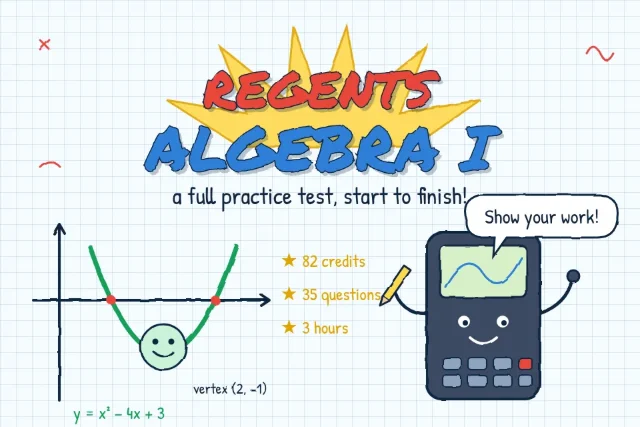
The Regents Examination in Algebra I is often the first math Regents a New York student takes, and it rewards steady, careful work. This Online Center gives you a free full-length practice exam that follows the official test design: 35 questions, 82 credits and three hours, with a worked solution and a credit guide for every answer. Start with the practice test, then use the Quick Review and flashcards to close the gaps it shows you.
MEET THE TEST
Know the Algebra I Regents before you start
The current exam is aligned to the New York State Next Generation Mathematics Learning Standards and was first given in June 2024. It has four parts and 35 questions in all. Part I has 24 multiple-choice questions worth 2 credits each. Part II has 6 constructed-response questions worth 2 credits each, Part III has 4 worth 4 credits each, and Part IV has 1 question worth 6 credits, for a total of 82 raw credits.
You have three hours. A graphing calculator is required for the whole exam, along with a straightedge, and a reference sheet of formulas and conversions is printed at the back of the booklet. In Parts II, III and IV you must show your work. A correct numerical answer with no work shown earns only 1 credit. Write each step you use.
Your raw score is converted to a scale score from 0 to 100. A scale score of 65 is passing and 85 marks mastery. On the June 2026 and August 2026 conversion charts, 29 raw credits converted to 65 and 69 raw credits converted to 85. The chart can change from one administration to the next.
AT A GLANCE
Regents Algebra I Test Outline
24 questions • 2 credits each • 48 credits
Multiple choice with four answer choices
No partial credit
6 questions • 2 credits each • 12 credits
Constructed response
Show your work. Partial credit is possible.
4 questions • 4 credits each • 16 credits
Constructed response
Multi-step problems, often with a graph or table
1 question • 6 credits
Constructed response
An extended modeling task
Number and Quantity 4 to 10% of credits
Rational and irrational numbers, units and quantities
Algebra 48 to 61% of credits
Expressions, polynomials, equations, inequalities and systems
Functions 24 to 32% of credits
Interpreting, building and comparing linear, quadratic and exponential functions
Statistics and Probability 7 to 15% of credits
Data displays, center and spread, two-way tables, regression and correlation
Credit ranges come from the NYSED Educator Guide. NYSED sets one time limit for the whole exam, not for each part.
FIND YOUR FOCUS
Algebra I Regents subjects and skills
Algebra
The largest share of the exam, between 48 and 61 percent of the credits. Expect to rewrite expressions, factor and multiply polynomials, write equations and inequalities from a situation, and solve linear equations, quadratics and systems by more than one method.
Functions
Between 24 and 32 percent of the credits. You will read key features from graphs and tables, use function notation, find average rates of change, compare linear and exponential growth, and describe how a graph shifts or stretches.
Statistics and Probability
Between 7 and 15 percent of the credits. Questions ask you to compare data sets with box plots and dot plots, read two-way frequency tables, find a regression line on your calculator and explain what the correlation coefficient tells you.
Number and Quantity
Between 4 and 10 percent of the credits. These questions check whether a sum or product is rational or irrational and whether you can choose and convert units sensibly.
PRACTICE WITH A PLAN
Free full-length Regents Algebra I practice test
Practice Test 1 matches the official test design: 24 multiple-choice items in Part I, then six 2-credit, four 4-credit and one 6-credit constructed-response problems. The multiple-choice section is scored for you. For each constructed-response problem you work on paper, then open a full solution and a credit guide written in the style of the State’s rating guides and award yourself the credits your work earns. Your raw total out of 82 is then matched to the August 2026 official conversion chart so you can see roughly where you stand.
Treat the result as study feedback, not an official score. It is an original practice exam written by Effortless Math, not a released State test.
TRY A FEW
10 Regents Algebra I sample questions
These ten questions are separate from the full-length test. Pick an answer, check it, and read the explanation. Each one names the mistake behind the most tempting wrong choice, which is often the fastest way to see what a topic tests.
Choose one answer, then check it. If the buttons do not respond, each explanation is printed below its question.
Answer C.
Simplify each choice before you judge it. Choice A is \(7+\frac{2}{3}=\frac{23}{3}\), choice B is \(\sqrt{12\cdot3}=\sqrt{36}=6\), and choice D is \(\sqrt{\frac{50}{2}}=\sqrt{25}=5\), so all three are rational. In choice C, 20 is not a perfect square, so \(\sqrt{20}=2\sqrt{5}\) is irrational. Adding the rational number \(\frac{5}{8}\) to an irrational number always gives an irrational sum, which makes \(\frac{5}{8}+\sqrt{20}\) the answer. Many students pick choice B because a square root sign looks irrational at first glance, but multiplying the radicands gives \(\sqrt{36}\), a perfect square, and the radical disappears.
Answer B.
After \(w\) weeks Priya has \(385+45w\) dollars, and she needs at least \(\$1{,}260\), so solve \(385+45w\geq1260\). Subtracting 385 gives \(45w\geq875\), and dividing by 45 gives \(w\geq19.\overline{4}\). She saves in whole weeks, so round up to 20. A check confirms it: after 19 weeks she has \(385+45(19)=\$1{,}240\), which is \(\$20\) short, and after 20 weeks she has \(385+45(20)=\$1{,}285\). Choice A comes from rounding 19.44 down out of habit, but a partial week still calls for one more full week of saving. Choice C ignores the \(\$385\) she already has, and choice D adds the \(\$385\) to the price instead of subtracting it, since \(\frac{1260+385}{45}\approx36.6\) rounds up to 37.
Answer D.
Compare consecutive rows to decide what kind of model fits. The differences are \(-250\), \(-200\), \(-160\), and \(-128\), so the value does not drop by the same amount each year and the data are not linear. The ratios are all equal, though: \(\frac{1000}{1250}=\frac{800}{1000}=\frac{640}{800}=\frac{512}{640}=0.8\). A constant ratio means an exponential model \(y=ab^x\) with starting value \(a=1250\) and factor \(b=0.8\), so \(y=1250(0.8)^x\). Watch out for choice B. The drone loses 20% of its value each year, but the factor \(b\) is the part that remains, \(1-0.20=0.8\), not the 0.2 that is lost. Choice A matches only the first two rows, since it predicts \(\$750\) at \(x=2\) instead of \(\$800\), and choice C would make the value grow.
Answer A.
Subtracting a polynomial means subtracting every one of its terms, so distribute the negative sign first: \((4x^2-3x+7)-(x^2-5x-2)=4x^2-3x+7-x^2+5x+2\). Then combine like terms: \(4x^2-x^2=3x^2\), \(-3x+5x=2x\), and \(7+2=9\), which gives \(3x^2+2x+9\). Choice B is the slip to watch for: it is what you get when the negative sign reaches only the \(x^2\) term and \(-5x\) and \(-2\) are copied without changing their signs. Choice C changes the sign of \(-5x\) but forgets the \(-2\), and choice D adds the polynomials instead of subtracting them.
Answer B.
The vertex of the graph is \((3,4)\), so the maximum value of \(f\) is 4. For \(g\), the axis of symmetry is \(x=-\frac{b}{2a}=-\frac{10}{2(-1)}=5\), and the maximum value is \(g(5)=-25+50-22=3\). Since \(4>3\), the maximum value of \(f\) is greater. Choice C fails because the axes of symmetry are \(x=3\) and \(x=5\), and choice D fails because \(g(5)=3\), not 0. If you chose A, you probably mixed up the two coordinates of the vertex. The value \(x=5\) tells you where the maximum of \(g\) occurs, and you have to substitute 5 into \(g\) to find the maximum value itself.
Answer C.
Let \(s\) be the number of small trays and \(\ell\) the number of large trays, so \(s+\ell=86\) and \(3.5s+6\ell=411\). Substitute \(s=86-\ell\) into the money equation: \(3.5(86-\ell)+6\ell=411\) becomes \(301+2.5\ell=411\), so \(2.5\ell=110\) and \(\ell=44\). That leaves \(s=42\), and the check works: \(3.5(42)+6(44)=147+264=411\). Choice A, 42, is the number of small trays. It is an easy pick if you solve for the other variable and forget to return to what the question asks. Choice B simply splits 86 in half, and choice D comes from dividing \(\$411\) by \(\$6\) as if every tray were large, which gives 68.5, and then dropping the decimal.
Answer A.
In function notation, the value inside the parentheses is the input and the value on the other side of the equals sign is the output. Here the input \(n=200\) is a number of flyers and the output 88 is a price in dollars, so the statement says that 200 flyers cost \(\$88\). You can confirm it with \(0.35(200)+18=70+18=88\). Choice B reverses the input and the output, which is the usual way function notation gets misread. Choice C is false because 200 more flyers add only \(0.35(200)=\$70\), and the 18 in choice D is the fixed charge included in every order, not the total price for 200 flyers.
Answer D.
This trinomial does not factor over the integers, so use the quadratic formula with \(a=2\), \(b=-6\), and \(c=-3\). The discriminant is \(b^2-4ac=(-6)^2-4(2)(-3)=36+24=60\), so \(x=\frac{6\pm\sqrt{60}}{4}\). Because \(\sqrt{60}=\sqrt{4\cdot15}=2\sqrt{15}\), the solutions are \(x=\frac{6\pm2\sqrt{15}}{4}=\frac{3\pm\sqrt{15}}{2}\) after dividing every term by 2. That is about \(3.44\) and \(-0.44\), which you can confirm as the zeros of \(y=2x^2-6x-3\) on your graphing calculator. Choice B is what you get by computing \(36-24\) instead of \(36+24\), a sign slip on \(-4ac\) that is easy to make when \(c\) is negative. Choice A starts with \(b\) instead of \(-b\), and choice C divides by \(a\) instead of \(2a\).
Answer B.
The slope is the coefficient of \(x\), and it tells how much \(y\) changes when \(x\) increases by 1. Here the slope is \(-2.4\), so for each additional degree in the high temperature, the model predicts about 2.4 fewer cups of hot cocoa. The model says about 2.4 cups because a regression line describes a trend, not an exact rule for every day. Choice A is a common mix-up, but it describes the \(y\)-intercept, 196, which is the predicted number of cups at \(0^\circ\)F. Choice C turns the rate upside down, and choice D swaps which quantity depends on which.
Answer A.
Since \(1.21=(1.1)^2\), the power of a power rule gives \((1.21)^t=\left((1.1)^2\right)^t=(1.1)^{2t}\), so \(V(t)=2500(1.1)^{2t}\). The exponent \(2t\) counts half years, and the value is multiplied by 1.1 once every half year, which is a growth rate of \(1.1-1=0.10\), or 10%. Choice B splits the 21% yearly rate in half, which ignores compounding. Growing 10.5% twice gives \((1.105)^2=1.221025\), more than the yearly factor of 1.21. Choice C is the yearly rate, and choice D comes from \((1.21)^2=1.4641\), which is the growth over two years, not over half a year.
UNDERSTAND THE IDEA
Regents Algebra I Quick Review
The Quick Review walks through all four conceptual categories on the blueprint in plain language, from rational and irrational numbers to regression on the graphing calculator. Each topic has a short explanation, a worked example, a common mistake to avoid and a pointer to the practice that fits it.
RECALL AND APPLY
Regents Algebra I flashcards
The deck has 46 cards across Number and Quantity, Algebra, Functions, Statistics and the test itself. Use them in short sessions to keep formulas, vocabulary and calculator steps fresh, and set aside the cards you miss so you can come back to them.
ONE STEP AT A TIME
Plan your Algebra I Regents study route
- Diagnose. Take the full-length practice test under real conditions: three hours, your graphing calculator and the reference sheet. Score it honestly with the credit guides.
- Review. Sort your missed questions by category. Read the matching Quick Review sections first, starting with Algebra and Functions because they carry most of the credits.
- Practice. Work the sample questions and the flashcards for your weakest topics, then redo the constructed-response problems you lost credit on, writing out every step.
- Check. A week or two before the exam, time yourself again on a fresh set of problems and compare your raw credits with the conversion chart.
GO DEEPER
Regents Algebra I study guides
If you want more practice than one exam can give, Effortless Math publishes New York Regents Algebra I books, including Regents Algebra I for Beginners and several practice-test collections. They are optional. Everything in this Online Center is free to use.
QUICK ANSWERS
Regents Algebra I questions, answered
How many questions are on the Algebra I Regents?
There are 35 questions worth 82 raw credits: 24 multiple-choice questions in Part I and 11 constructed-response questions in Parts II, III and IV.
How long is the Algebra I Regents exam?
You have three hours for the whole exam. NYSED does not set separate time limits for the four parts.
What score do I need to pass the Algebra I Regents?
A scale score of 65 passes and 85 shows mastery. On the June 2026 and August 2026 conversion charts, 29 of 82 raw credits converted to 65 and 69 converted to 85, but each administration has its own chart.
Can I use a calculator on the Algebra I Regents?
Yes. A graphing calculator is required for the entire exam. Calculators with symbolic algebra features are not allowed, and you should use the pi key rather than 3.14 when pi appears in a problem.
Is there a formula sheet?
Yes. A reference sheet with conversions and formulas, including the quadratic formula, slope, exponential growth, compound interest, sequences and the interquartile range, is printed at the back of the test booklet.
Do I lose credit if I only write the answer?
On Parts II, III and IV, a correct numerical answer with no work shown earns only 1 credit. Show each step and label your graphs.
Do I still need to pass the Algebra I Regents to graduate?
It depends on your graduation year. In September 2026 the Board of Regents considered a plan, prepared by the State Education Department, under which students graduating in January 2028 or later would earn one State diploma without separate Regents exam requirements. The change still needs regulations, and Regents exams would continue as assessments of the State learning standards. Until the new rules take effect, the current requirements apply, so ask your school counselor which rules cover you.
When is the next Algebra I Regents?
The State has scheduled Regents exam periods for January 26 to 29, June 15 to 25 and August 17 to 18, 2027. Confirm the Algebra I session time on the official NYSED schedule for your exam period.
STUDY WITH CONFIDENCE
Sources and your next step
- NYSED Educator Guide to the Regents Examination in Algebra I
- NYSED Reference Sheet for Algebra I
- NYSED Regents Examination in Algebra I: past exams, rating guides and conversion charts
- NYSED final dates for the 2027 Regents examination periods
- Board of Regents item on moving to one diploma, September 2026
Effortless Math is an independent publisher. The practice exam, sample questions, flashcards and Quick Review are original study materials. They are not produced or endorsed by the New York State Education Department, and practice results are not official Regents scores.