YOUR AWS AIF-C01 STUDY COMPANION
AWS Certified AI Practitioner (AIF-C01) Practice Tests & Subject Review
Prepare for AWS Certified AI Practitioner (AIF-C01) with an original practice form, five domain lessons, interactive flashcards, and scenario review based on public AWS objectives.
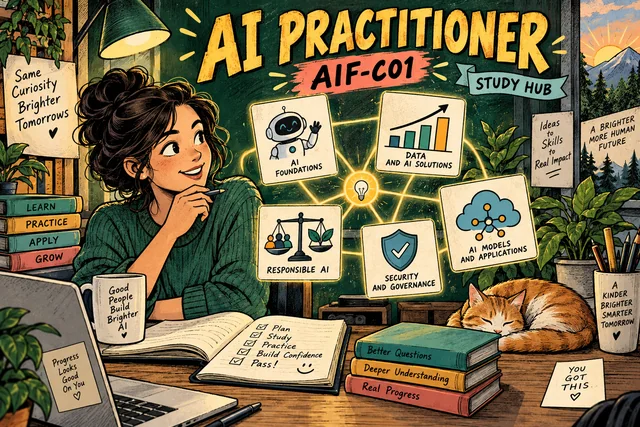
MEET THE TEST
Know AIF-C01 before you start
AWS's certification overview lists a 90-minute exam with 65 questions. The exam guide says 50 questions affect the score and 15 do not. AWS does not identify those items. This independent practice form provides answer feedback for all 65 questions, calculates its local raw score from 50 author-selected questions, and reports 15 additional feedback-only answers separately. This author-selected grouping does not claim to identify AWS's unscored items. The practice score is not calibrated to AWS scaled scoring. Check AWS before your appointment.
Current facts checked October 15, 2026 against AWS certification overview ↗ and AWS exam guide ↗.
FIND YOUR FOCUS
Five domains, one current blueprint
Use AWS’s published weights to plan your review. Every domain links to an expanded lesson below.
DOMAIN 1 · 20%
Fundamentals of AI and ML
Identify the task before choosing a method. Separate data, training, inference, prediction, and evaluation. Then check whether examples and labels fit the intended use.
DOMAIN 2 · 24%
Fundamentals of Generative AI
Understand foundation models, prompts, tokens, embeddings, retrieval, agents, and where generated output needs evidence or review.
DOMAIN 3 · 28%
Applications of Foundation Models
Choose a model and adaptation pattern against representative quality, latency, cost, retrieval, and human-review requirements.
DOMAIN 4 · 14%
Guidelines for Responsible AI
Consider fairness, safety, robustness, veracity, environmental impact, explainability, user feedback, and the consequences of error.
DOMAIN 5 · 14%
Security, Compliance, and Governance for AI Solutions
Protect data and actions with scoped identity, access controls, secure transport, logging, policy, and clear shared responsibilities.
See the full official domain weights and exam guide ↗ and current revision history ↗.
PRACTICE WITH A PLAN
AIF-C01 full-length practice test
One original 65-question practice form, designed for a 90-minute session, covers all five domains and includes multiple-choice, multiple-response, ordering, and matching items. Every answer includes an explanation.
Original local scoring design: 50 items contribute to the study-set raw score, distributed 10/12/14/7/7 across the five published weighted domains. The other 15 provide feedback only and do not contribute. These author-selected feedback-only items do not claim to identify AWS's unscored questions.
Try the AIF-C01 practice test ↗ in this study center, or open it in the Practice Tests menu above.
Independent study feedback only. This is not an AWS exam, calibrated score, pass prediction, or endorsement.
ONE STEP AT A TIME
Choose an AIF-C01 study route
20 minutes
New to AI terms?
Read the expanded Domain 1 lesson, answer its six Quick Review scenarios, then work the 13 Domain 1 flashcards and mark any that need another look.
30 minutes
Working on prompts and retrieval?
Read Domain 2, compare the RAG cards with the adaptation cards in Domain 3, then try the context-budget and retrieval scenarios.
30 minutes
Choosing a model or service?
Read the model-selection section in Domain 3, define the task's quality, latency, and total-cost limits, then take the practice form untimed.
25 minutes
Responsible for review or risk?
Read Domain 4 and Domain 5, then work the subgroup, user-explanation, and authorization scenarios before attempting the relevant test items.
90 minutes + review
Taking the exam soon?
Take the 65-item practice form with the 90-minute timer, review every answer, then revisit missed items and their cited objectives. The local raw score is limited to the 50-item scored set.
UNDERSTAND THE IDEA
AIF-C01 Quick Review
Work through 30 original, source-linked scenarios across all five domains. Try each one before you reveal the answer and rationale.
Domain 1A retailer has thousands of completed orders labeled late or on time. It wants to flag current orders at risk. Which learning task fits, and what data check matters first?
Answer
Supervised classification fits because historical examples have categories. Check that labels are reliable and a date-based held-out set represents future orders.
Why
Known outcomes provide target labels. A realistic time split reduces leakage from future conditions.
Domain 1An analyst has unlabeled visitor activity and wants to discover common behavior groups before defining categories. Which method should be explored?
Answer
Clustering, followed by human inspection of whether the discovered groups are stable and useful.
Why
Clustering looks for structure without target labels. It does not establish that the groups are meaningful business categories.
Domain 1A model scores much better on training records than on a representative held-out set. What should the team check before deciding the cause?
Answer
Check split integrity, duplicate or related records, target leakage, label quality, and whether the held-out set matches the intended population.
Why
A performance gap can indicate overfitting, but leakage, poor labels, and distribution differences can also distort the comparison.
Domain 2Instructions and retrieved passages nearly fill a model's context budget, leaving no room for the required answer. What should be changed first?
Answer
Remove repeated background and retrieve only passages needed for this question, while reserving space for the requested response.
Why
The context limit includes both supplied input and generated output. Trimming irrelevant context preserves evidence and output capacity.
Domain 2A policy changes weekly and users need answers grounded in its latest approved wording. Which pattern should be tested first?
Answer
Retrieve current approved passages at request time and evaluate retrieval relevance and answer support.
Why
RAG can bring current source material into the request without retraining the model for each policy change.
Domain 2A support request includes a photo and a sentence. What model capability must the team verify?
Answer
The model must accept image and text inputs together for the intended request type.
Why
Multimodal support varies by model. An image captioner or text-only model may not perform joint reasoning over both inputs.
Domain 3An evaluation shows high answer quality but retrieved passages often omit a required fact. Which part should the team investigate?
Answer
Inspect retrieval relevance and coverage separately from generated-answer quality, then improve chunking, indexing, or retrieval settings as evidence supports.
Why
RAG can fail because retrieval misses evidence even when the model writes a fluent answer. Evaluate both stages.
Domain 3Two models meet the minimum quality and latency limits. One has a lower inference fee but requires more human review. Which cost belongs in the comparison?
Answer
Total cost per completed acceptable request, including inference, required review, retries, and the serving pattern.
Why
A per-token or per-call price can understate the full operating cost of an accepted outcome.
Domain 3A team uses a fixed handbook prompt prefix for many requests, but edits one prefix sentence before the next release. Can it assume the previous cache is reusable?
Answer
No. Check the service's cache rules. A changed prefix may create a different cache checkpoint.
Why
Caching depends on an eligible unchanged prefix and model-specific requirements.
Domain 4Average quality meets the target, but one affected group receives more harmful errors. What evidence is needed before approving deployment?
Answer
Review relevant subgroup outcomes and error patterns, investigate causes, and define safeguards or conditions for pausing or correcting the system.
Why
Aggregate averages can conceal unequal impact. A responsible decision uses evidence tied to affected groups and the consequences of errors.
Domain 4A smaller model uses less electricity per attempt but fails more often. What comparison supports an environmental model choice?
Answer
Estimate electricity or resources per accepted outcome, including retries and serving capacity, while checking that both options meet the same quality needs.
Why
Energy per attempt does not show the work required to deliver the accepted result.
Domain 4Applicants cannot understand a model-supported recommendation or correct old information. Which change addresses user-facing transparency?
Answer
Explain the main case-specific factors in plain language, show how to correct input errors, and provide an accountable human-review route.
Why
Aggregate metrics or source code do not give an affected user a practical way to understand and respond to a recommendation.
Domain 5An agent receives untrusted retrieved text that says to issue a refund. Where should refund authorization be enforced?
Answer
At the application or service action boundary using authenticated identity, scoped permissions, and the organization's approval rules.
Why
Retrieved text and model output are not authority. A tool or downstream service must validate whether the user and transaction are allowed.
Domain 5An audit needs to know which AWS API was called and also inspect supported model request/response bodies. Which evidence sources serve those different needs?
Answer
CloudTrail records AWS account API activity. Configured model invocation logging can capture supported model inputs and outputs.
Why
The two logging mechanisms answer different questions. Body logging needs approved access and retention because content may be sensitive.
Domain 5A company downloads an AWS compliance report from Artifact. Does that report establish that its own AI application is compliant?
Answer
No. Artifact provides AWS reports and agreements that support the customer's assessment. The customer still evaluates its own data, access, configuration, and application controls.
Why
AWS and the customer have distinct responsibilities that depend on the service and deployment.
Domain 1A demand-forecasting team has labeled weekly sales and wants a numeric future value. Which learning task fits, and what split risk should it check?
Answer
Use supervised regression. Split by time so future periods do not leak into training.
Why
A numeric target calls for regression. The deployment goal is future forecasts, so a time-based evaluation better reflects use.
Domain 1A service must transcribe a live call now, then analyze yesterday's batch of recordings overnight. Which inference patterns fit each job?
Answer
Real-time inference fits the live call. Batch inference fits the overnight collection.
Why
The response-time requirements differ: immediate response versus scheduled processing of a collection.
Domain 1A fixed policy says approve a claim only when two explicit conditions are met. Why might a rule be preferable to a model?
Answer
A deterministic rule is easier to audit when the outcome is explicit and does not require prediction.
Why
AI/ML adds value when patterns or uncertain predictions are needed. It is not automatically appropriate for fixed rules.
Domain 2An inference bill is rising while generated answers are too long. Which two request properties should the team measure first?
Answer
Measure input and output token use per successful task.
Why
Token-based costs depend on both prompt and completion length. Cost per useful result connects usage to value.
Domain 5An organization adds an AI agent that can handle customer data. What recurring governance process should it establish?
Answer
Assign review owners and a schedule to revisit policies, permissions, data handling, risks, and team training as the system changes.
Why
A named review cadence keeps governance controls aligned with changes to the system, its data, and the people who use it.
Domain 2An image generator iteratively refines noise to create an image. Which model family is being described?
Answer
A diffusion model.
Why
Diffusion models generate content through a denoising/refinement process.
Domain 3A team repeats a task with approved examples in every request but does not change model weights. Which adaptation is this?
Answer
In-context learning, such as few-shot prompting.
Why
Examples in the prompt guide the current request. Fine-tuning changes model parameters.
Domain 2A small team wants to prototype a generative AI assistant without managing model-serving infrastructure. Which advantage of AWS generative AI services addresses that need?
Answer
Managed services can lower the barrier to entry and speed up the path from prototype to application.
Why
The team can use managed capabilities instead of building and operating every part of the model-serving stack. It should still check cost, security, and service limits for its workload.
Domain 3A regulated team changes a prompt monthly and needs to compare revisions. What practice supports repeatable evaluation?
Answer
Version the prompt, retain approved revisions, and run a representative evaluation set for each change.
Why
Versioning makes changes traceable. Repeatable evaluation reveals effects before release.
Domain 4A restrictive model blocks harmful requests but also rejects some valid tasks. What should a team measure before choosing it?
Answer
Compare harmful-output and valid-task refusal rates, plus the model's interpretability and performance on representative cases.
Why
A safety control can reduce harmful responses while limiting useful ones. Representative evaluation helps the team judge that tradeoff for its intended use.
Domain 4Two candidate models meet an accuracy target. What evidence can help compare their transparency and explainability?
Answer
Review model cards, available evaluation and explainability evidence, and each model's data and licensing information.
Why
These sources describe intended use, performance, limitations, and rights. A benchmark score alone does not show whether a model is suitable or understandable for the intended users.
Domain 4A generated marketing image contains a recognizable protected character. Which check matters beyond the image tool's usage terms?
Answer
Confirm rights-holder authorization for that depicted content and use.
Why
Permission to use a generation service does not automatically grant rights to reproduce protected material.
Domain 5An application team needs to discover sensitive information in stored data. Which AWS service named in the guide is relevant?
Answer
Amazon Macie.
Why
Macie helps discover and protect sensitive data in supported storage. Access policy and response remain application responsibilities.
Domain 5A governance reviewer needs evidence of AWS API activity, resource configuration, and AWS compliance agreements. Which services map to those needs?
Answer
CloudTrail for API activity, AWS Config for resource configuration, and AWS Artifact for AWS reports and agreements.
Why
These services create different evidence. None alone certifies a customer application's compliance.
Domain 5A retrieved passage tells an agent to ignore policy and export data. What should the system do?
Answer
Treat retrieved text as untrusted input and enforce authorization at the data/tool boundary.
Why
Retrieved content can contain prompt injection. Model instructions do not override enforced access control.
RECALL AND APPLY
AIF-C01 flashcards
Use these 68 interactive, source-linked cards for active recall. Open a prompt only after trying to explain the answer yourself.
D1 · Recall firstHow are AI, machine learning, and deep learning related?
AI is the broad field. Machine learning is one approach within it. Deep learning uses multilayer neural networks.
D1 · Recall firstWhen does supervised classification fit?
When labeled examples pair inputs with known categories and the goal is to assign a category to new input.
D1 · Recall firstWhat is regression used to estimate?
A numeric target value, such as demand or delivery time.
D1 · Recall firstWhat is clustering?
An unsupervised method for grouping examples by similarity when target categories are not supplied.
D1 · Recall firstWhat is inference?
Using a trained model to produce a prediction, classification, or other output from an input.
D1 · Recall firstWhy keep related records together when splitting data?
Near-duplicates across training and evaluation sets can leak information and make generalization look stronger than it is.
D2 · Recall firstWhat is a foundation model?
A model trained on broad data that can be adapted or prompted for multiple downstream tasks.
D2 · Recall firstWhat is a token in language-model use?
A model-specific unit used to represent input or output text. It may be smaller or larger than a word.
D2 · Recall firstWhat consumes a model's context budget?
The supported input and generated output, including instructions, history, retrieved evidence, and response tokens.
D2 · Recall firstWhat does temperature affect?
Sampling variation in generated responses. It does not guarantee factual accuracy.
D2 · Recall firstWhat does an embedding represent?
A vector representation of content that a system can compare for semantic similarity.
D2 · Recall firstWhat is RAG?
A pattern that retrieves relevant external information and supplies it to a generative model at request time.
D2 · Recall firstWhat is multimodal input?
A request that uses more than one input type, such as image and text, when the selected model supports both.
D2 · Recall firstWhat is an AI agent's tool?
A callable capability the application exposes so the model-driven process can take a scoped action or retrieve information.
D2 · Recall firstDoes a prompt guarantee a correct answer?
No. Prompts can guide task and format, but factual support and error behavior still need evaluation.
D3 · Recall firstWhen can RAG be preferable to fine-tuning for changing facts?
When answers depend on current or private source material that can be retrieved at request time.
D3 · Recall firstWhat does fine-tuning change?
It trains a supported model on examples to adapt its behavior or performance for a recurring task.
D3 · Recall firstWhat is continued pretraining?
Further training a model on additional text, often to build domain familiarity, without requiring paired task answers.
D3 · Recall firstWhy evaluate retrieval and generation separately?
A final answer can fail because evidence was not retrieved or because the model used retrieved evidence poorly.
D3 · Recall firstWhat makes a model comparison fair?
Use the same representative workload, outcome definition, acceptance criteria, and full cost/latency measures.
D3 · Recall firstWhen does asynchronous inference fit?
When a workload can queue a request and return the result later instead of requiring an immediate response.
D3 · Recall firstWhen can prompt caching help?
When an eligible prompt prefix is reused unchanged and the model-specific cache requirements are met.
D3 · Recall firstWhy use a representative evaluation set?
It better reflects the users, inputs, and conditions of intended use, making observed performance more informative.
D4 · Recall firstWhat can an aggregate quality score hide?
Different error rates or harms for subgroups or high-consequence cases.
D4 · Recall firstWhat does a training/held-out performance gap suggest?
Possible overfitting or another data/evaluation problem. Inspect splits, labels, leakage, and population differences before diagnosing.
D4 · Recall firstWhat is a responsible sustainability comparison?
Resources or energy per accepted outcome, with quality held constant and retries or serving capacity included.
D4 · Recall firstWhat is a model card for?
Documenting intended use, evaluation, limitations, and other information useful for model governance.
D4 · Recall firstWhat does user-centered explanation add?
Understandable information relevant to an affected person, plus a way to give feedback or correct input when appropriate.
D4 · Recall firstWhat is a hallucination?
Plausible-sounding generated content that is unsupported or false. Fluency is not evidence.
D5 · Recall firstWhat does least privilege mean?
Grant an identity only the access needed for its approved task, for the needed scope and duration.
D5 · Recall firstWhere should an agent's action permission be enforced?
At the application or downstream tool/service boundary, where identity and policy can be checked before action.
D5 · Recall firstWhat can Bedrock Guardrails evaluate?
Configured input and output policies such as content filters, denied topics, and sensitive-information rules.
D5 · Recall firstWhat does encryption in transit protect?
Data moving between client and service against eavesdropping and tampering when encrypted protocols such as TLS are used.
D5 · Recall firstWhat does CloudTrail record?
AWS account activity and API events useful for audit and investigation.
D5 · Recall firstWhat can model invocation logging capture?
Supported model invocation input and output data, when logging is configured with an approved destination.
D5 · Recall firstWhat does AWS Artifact provide?
Access to AWS compliance reports and agreements. It does not certify a customer's own AI application.
D5 · Recall firstWhy define retention for AI logs?
Inputs and outputs may contain sensitive information. A retention rule limits exposure and supports approved audit needs.
D5 · Recall firstWho is responsible for application data access in a managed AWS AI service?
The customer remains responsible for its data, identities, access configuration, and application behavior under the shared responsibility model.
D1 · Recall firstWhat is the difference between batch and real-time inference?
Batch processes a collection on a schedule. Real-time returns a response promptly for an individual request.
D1 · Recall firstWhat does asynchronous inference support?
Longer-running requests that can be processed separately and return results later.
D1 · Recall firstWhen is reinforcement learning useful?
When an agent or model learns action choices from reward or penalty feedback.
D1 · Recall firstWhat is the difference between tabular and unstructured data?
Tabular data has defined fields and records. Text, images, and audio are commonly unstructured.
D1 · Recall firstWhat does F1 combine?
Precision and recall through their harmonic mean.
D1 · Recall firstWhen might traditional ML fit better than a foundation model?
For a narrow prediction when cost, latency, explainability, regulation, or operations favor a smaller task-specific model.
D1 · Recall firstName two metrics besides model accuracy that connect performance to a business outcome.
Examples include cost per user, customer feedback, ROI, task completion, or development cost.
D2 · Recall firstWhat does token-based inference pricing make important?
Prompt/input and generated/output token counts, along with the cost per useful completed task.
D2 · Recall firstWhat is context engineering?
Choosing and organizing instructions, evidence, examples, memory, and history within a model's context budget.
D2 · Recall firstWhat does a multi-agent pattern add?
Coordination among specialized agents or roles, with explicit communication, orchestration, and control.
D2 · Recall firstWhat does MCP provide, and what does it not provide?
A connection pattern between AI clients and external systems. It does not itself authorize requested actions.
D3 · Recall firstWhat is model distillation?
Transferring useful behavior from a larger teacher model to a smaller student model, then evaluating the tradeoff.
D3 · Recall firstWhat should fine-tuning data be before training?
Rights-cleared, representative, curated, governed, consistently formatted, and suitable in size and labels.
D3 · Recall firstWhat is the purpose of RLHF?
Use human preference feedback to guide model behavior through an additional training process.
D3 · Recall firstName two AWS vector storage options in the AIF-C01 guide.
Examples: Amazon OpenSearch Service, Amazon Aurora, Amazon Neptune, and Amazon RDS for PostgreSQL.
D3 · Recall firstWhy version prompts?
To make changes traceable, compare alternatives, and restore an approved prompt if evaluation regresses.
D3 · Recall firstWhat is one limitation of an LLM-as-a-judge metric?
It can be inconsistent or biased and should be calibrated against references or human evaluation.
D5 · Recall firstWhat should a governance review cadence revisit for an AI system?
Review policies, data handling, identities, permissions, model or prompt changes, retention, risks, and compliance evidence as the system changes.
D4 · Recall firstHow do transparency and explainability differ?
Transparency reveals information about how a system is built or governed. Explainability gives useful reasons for a specific output.
D4 · Recall firstWhat can Amazon Bedrock Guardrails help do?
Apply configured input/output safety policies. They do not replace fairness evaluation or application authorization.
D4 · Recall firstWhy examine dataset diversity and balance in a responsible AI review?
Representation gaps can hide uneven performance or harm. Check that data covers the intended population and compare relevant outcomes.
D5 · Recall firstWhat is data lineage?
A traceable record of where data came from, how it changed, and where it was used.
D5 · Recall firstWhat does AWS Config contribute to governance?
Records and evaluates supported resource configurations against rules or desired state.
D5 · Recall firstWhat does Amazon Inspector contribute?
Identifies supported workload vulnerabilities to inform security remediation.
D5 · Recall firstWhat does AWS Trusted Advisor contribute?
Checks selected AWS best practices across supported categories. It does not certify an application.
D5 · Recall firstWhat should an invocation log policy define?
Specify which inputs and outputs may be captured, the approved destination, access controls, redaction, retention, residency, and deletion. Logs can contain sensitive information.
D5 · Recall firstWhy can logs create a privacy risk?
They may store prompts, outputs, identifiers, or other sensitive data, so access, destination, retention, and redaction need control.
D4 · Recall firstWhat tradeoff can arise when increasing model safety restrictions?
Restrictions can reduce harmful outputs but may also block valid responses. Compare safety, interpretability, and task performance for the intended use.
D1 · Recall firstWhat does model monitoring contribute to MLOps?
It checks production behavior against expected performance and surfaces drift or quality changes for investigation. Monitoring does not automatically correct the model.
D4 · Recall firstHow should a team handle possible intellectual-property rights in generated output?
Review provider terms and applicable rights for the training data or depicted protected material. Do not assume tool access grants every use right.
GO DEEPER
Five AIF-C01 domain study guides
Each guide includes an expanded lesson, a worked check, a try-it prompt, and links to primary documentation.
DOMAIN 1 · 20%
Fundamentals of AI and ML
Identify the task before choosing a method. Separate data, training, inference, prediction, and evaluation. Then check whether examples and labels fit the intended use.
AI is the broad field of systems that perform tasks associated with perception, language, decisions, or generation. Machine learning is one way to build such systems: a model learns patterns from examples, then uses those patterns to make predictions or produce outputs. Deep learning uses multilayer neural networks. Generative AI creates new content. Other AI systems may classify, rank, detect, or predict. An algorithm is a procedure. A model is the learned or configured system that applies it. Bias is systematic error. Fairness concerns how outcomes affect people and groups.
Start by naming the output. If past examples include a correct category, supervised classification can estimate a category for a new case. If the target is numeric, regression may fit. When labels are absent and the goal is to discover groups, clustering can help explore structure. Reinforcement learning uses rewards or penalties to improve action choices over time. Rules are often more dependable for fixed, explicit conditions. Tabular records, time series, images, and text require different representations. Labeled and unlabeled describe whether target answers accompany examples.
Training fits model parameters using examples. Inference applies a trained model to new input: batch handles collections on a schedule, real-time returns promptly, asynchronous supports longer requests, and serverless abstracts server management. Evaluation checks performance on data not used to fit or tune the model. Keep related records together when splitting data. Near-duplicates across training and evaluation can make quality look better than it is. For imbalanced classes, accuracy alone may hide poor minority-class recall. Consider precision, recall, and F1 alongside business measures such as cost per user and customer feedback.
Choose traditional ML when a narrow prediction, lower operating burden, or clearer behavior fits the requirement. Consider a foundation model when language, multimodal input, or flexible generation matters and its cost, latency, governance, and reliability are acceptable. AWS examples include SageMaker AI for model development, Transcribe for speech-to-text, Translate for language translation, Comprehend for text analysis, Lex for conversational interfaces, and Polly for text-to-speech. Amazon Q Developer provides coding and AWS assistance during software development. The lifecycle includes data preparation, experimentation, repeatable training, evaluation, deployment, monitoring, technical-debt management, and retraining when evidence warrants.
Worked check: A store wants to predict which current orders are likely to be late. Historical orders with confirmed late/not-late outcomes support supervised classification. Check label quality, use a date-based split, and include seasons and shipping conditions the model will face. Track recall for late orders as well as the cost of unnecessary alerts.
Try it: If an image model works in a bright studio but fails under expected warehouse lighting, keep the items and labels fixed while varying lighting. That isolates the changed condition. Test a fresh representative set before deciding whether it is fit for the warehouse.
For a goal, identify AI/ML/GenAI/agentic AI, choose a learning method and inference mode, classify data types, select an appropriate managed service, and name an evaluation and business metric.
DOMAIN 2 · 24%
Fundamentals of Generative AI
Understand foundation models, prompts, tokens, embeddings, retrieval, agents, and where generated output needs evidence or review.
A foundation model is trained on broad data and can support multiple downstream tasks. A large language model works with token sequences. A token is a model-specific unit of text or other input, not always a whole word. Token-based inference pricing makes input and output length relevant to cost. The usable context window is a bounded input-and-output budget, so instructions, history, retrieved evidence, and the requested answer compete for space. Chunking divides long sources into pieces. Embeddings represent content as vectors for similarity search. Diffusion models generate content by iteratively refining noise, a common pattern in image generation.
Prompts specify the task and provide context. Effective context engineering chooses what instructions, examples, memory, and evidence enter the model, in what order, and within what token budget. Examples and format constraints can help, but do not guarantee factuality. RAG retrieves source passages and supplies them at request time. The foundation-model lifecycle runs from data and model selection through pretraining, evaluation, deployment, feedback, and possible adaptation. In a business case, compare task quality, compliance, latency, model complexity, and cost per completed task that meets requirements.
An agent can choose steps or tools using model output. Multi-agent patterns divide responsibilities among agents or coordinate specialized roles. Communication can be sequential, routed, or collaborative. Memory may preserve task context, but should be scoped, controlled, and governed. The Model Context Protocol (MCP) standardizes how an AI client connects with external tools and data. The application still has to authenticate, authorize, validate, and audit each action. Workflow orchestration manages sequence, retries, approval points, and failure handling. A fixed workflow follows predefined steps. An agent can select among allowed actions based on context.
On AWS, Amazon Bedrock provides managed access to foundation models and application features. SageMaker AI and JumpStart support model building and deployment choices. Amazon Quick supports generative-AI business intelligence. Kiro supports AI-assisted software development. Strands Agents and Bedrock AgentCore support agent development and operation. These services can lower setup effort, while regional availability, provisioned throughput, redundancy, customization, and token use create cost and performance tradeoffs. AWS infrastructure controls do not remove customer responsibilities for data, identities, configuration, and application behavior.
Worked check: A handbook changes monthly and exceeds the context budget. Retrieve a small set of current passages instead of pasting the full handbook or retraining each month. Check retrieval relevance and whether each answer claim is supported.
Try it: For a photo-plus-text request, confirm the selected model accepts both modalities. If an agent can issue a refund, scope its tool permissions and enforce user, order, and amount checks at the action boundary.
Explain tokens, chunking, embeddings, diffusion, context engineering, token cost, the model lifecycle, model-choice tradeoffs, and how agents, MCP, memory, tools, and orchestration fit together.
DOMAIN 3 · 28%
Applications of Foundation Models
Choose a model and adaptation pattern against representative quality, latency, cost, retrieval, and human-review requirements.
Choose the approach that fits the task and evidence available. Prompting changes instructions without changing model weights. RAG adds retrieved information at request time and suits answers that depend on current or private sources. Fine-tuning adjusts behavior with curated examples. Continued pretraining adds domain text to build familiarity. Distillation transfers useful behavior to a smaller model. In-context learning provides examples in a request. Compare these methods by quality, data rights, customization cost, latency, and maintenance burden.
Select a model by testing a representative workload against explicit requirements. Consider modality, multilingual support, model size, input/output length, customization, and inference parameters such as temperature. Measure tail latency, completed-request cost, and quality metrics that match the use case. For RAG, inspect retrieval quality separately from answer quality. Groundedness and correctness are related but distinct: a fluent response can cite an irrelevant passage or omit evidence. Vector storage options named in the public guide include OpenSearch Service, Aurora, Neptune, and RDS for PostgreSQL. Choose based on workload, integration, and operational needs.
Prompt engineering uses clear instructions, relevant context, examples, negative prompts when supported, and output constraints. Zero-shot provides no examples. One-shot and few-shot supply one or several examples. Chain-of-thought prompting may request structured reasoning, but sensitive internal reasoning should not be exposed as a security measure or treated as proof. Test prompt changes systematically, use guardrails where suitable, and version approved prompts in Amazon Bedrock Prompt Management. Consider prompt injection, poisoning, hijacking, and jailbreak risks. Enforce authorization outside the prompt.
Prepare fine-tuning data with representative, governed examples, suitable labels, consistent formats, and a held-out evaluation set. Instruction tuning teaches response behavior. Transfer learning adapts prior knowledge. RLHF uses human preference feedback to improve behavior through an additional training process. Amazon Bedrock evaluation tools and human review can assess models. Benchmark datasets help compare consistent tasks. ROUGE and BLEU measure forms of text overlap, BERTScore compares contextual representations, and an LLM-as-a-judge can add scalable review but needs calibration and human checks. Evaluate complete RAG, agent, and workflow behavior against task completion, user satisfaction, cost per interaction, productivity, or other business outcomes.
Worked check: If two models meet quality and response-time limits, compare total cost per completed request, including retries and required human review. A low per-token price can still create higher operating cost if the model fails more often.
Try it: Before replacing retrieval with fine-tuning, name the failure to fix. Stale facts suggest source freshness or retrieval quality. Inconsistent task behavior may call for prompt revision or adaptation. Test the smallest change against representative cases.
Choose among prompting, RAG, fine-tuning, continued pretraining, in-context learning, and distillation. Name a prompt risk, evaluation method, vector store option, and business outcome metric.
DOMAIN 4 · 14%
Guidelines for Responsible AI
Consider fairness, safety, robustness, veracity, environmental impact, explainability, user feedback, and the consequences of error.
Responsible AI begins with intended use, affected people, and the consequences of a mistake. Relevant qualities include fairness, inclusivity, robustness, safety, and veracity. Review balanced, diverse, curated datasets and outcomes by relevant groups. Average performance can hide harmful subgroup patterns. Check data and label quality, conduct human audits, and use subgroup analysis to detect bias and monitor trustworthiness. Amazon Bedrock Guardrails can apply configured safety policies to supported inputs and outputs, but do not establish that a model is fair or correct for every use.
AWS says SageMaker Clarify is no longer open to new customers. Its public documentation remains useful for understanding bias metrics and model explainability.
Bias can enter through data, labels, sampling, feature choices, or the modeling process. Variance describes sensitivity to changes in training data. A model that fits training examples unusually well but transfers poorly can be overfit, while a model that misses patterns can be underfit. A train/test gap is a warning, not a diagnosis. Check leakage, split design, label quality, and population differences before attributing the cause. If use of generated material could infringe intellectual property, expose users to biased or false outputs, or undermine trust, assess rights, safeguards, and the end-user impact before release.
Model selection also has environmental implications. Compare models on the task they must complete, not one generation attempt. Estimate energy or resource use per accepted outcome, including retries and serving capacity. A smaller model is not automatically more sustainable if it produces more failed work or requires substantially more infrastructure.
Transparency and explainability are related but different. A transparent model exposes how it works more directly. An explainable model provides useful reasons for a particular output, even if its internal operation is complex. Model Cards can document intended uses, limitations, and evaluation. Review open-source model licenses and data rights separately. Amazon Bedrock Model Evaluations can support performance assessment. Greater safety restrictions may reduce some output flexibility, while more open model details may create additional misuse or privacy risks. Explain tradeoffs to the right audience with evidence, not broad assurances.
Human-centered design tells people when AI materially shapes a decision, presents understandable case-specific factors, and offers a route to correct data or request review. Worked check: For a benefits recommendation, inspect performance across relevant groups, state the factors used, let the person correct input errors, and retain an accountable human review path.
Try it: Compare model safety, usefulness, transparency, licensing, and environmental cost for the intended users before selecting a system.
Assess fairness, safety, robustness, veracity, subgroup evidence, licensing risk, environmental impact, transparency, explainability, and human feedback for an intended use.
DOMAIN 5 · 14%
Security, Compliance, and Governance for AI Solutions
Protect data and actions with scoped identity, access controls, secure transport, logging, policy, and clear shared responsibilities.
Security and compliance apply across the data and model lifecycle. Start with data rights and permitted purpose: a record available to a team is not automatically approved for every new AI use. Preserve data lineage and source citations so a reviewer can trace where content came from. Catalog data and record provenance in governance artifacts such as SageMaker Model Cards. Secure data engineering checks quality and integrity, minimizes collection, controls access, and applies privacy-enhancing techniques where suitable. Protect sensitive content in storage and transit. Encryption does not replace authorization or data minimization.
For agents, separate credentials from permission to perform a specific action. Model-generated requests are not authorization. Enforce policy at the tool or service that carries out the action, scope credentials to the needed operation, and retain approval for consequential changes. Use IAM roles and policies, encryption, PrivateLink where appropriate, Macie for sensitive-data discovery, AgentCore Identity and Policy for agent identity and controls, and Guardrails for configured content policies. Treat retrieved content and model output as untrusted. Detect prompt injection, filter and validate output, protect against data leakage and toxicity, and maintain an audit trail. Grounded retrieval and output validation can help detect unsupported answers. Confidence thresholds can support triage only when calibrated. None guarantees correctness.
Logs answer different questions. CloudTrail records AWS account activity and API events. Model invocation logging can capture supported inputs and outputs when configured with an approved destination and retention policy. Those records may contain sensitive data, so define purpose, access, redaction, residency, and deletion. Establish a review cadence for policies, permissions, model changes, risk, and compliance evidence. Train teams and use an appropriate governance framework, such as AWS's Generative AI Security Scoping Matrix, to set controls proportionate to the use case.
AWS governance services address distinct needs: AWS Config records and evaluates supported resource configuration. Amazon Inspector identifies supported workload vulnerabilities. AWS Trusted Advisor checks selected best practices. AWS Artifact provides AWS compliance reports and agreements. CloudTrail records activity. These tools support governance evidence but do not certify that a customer application is compliant. Under shared responsibility, AWS secures service infrastructure while the customer remains responsible for its data, identities, configurations, and application behavior according to the service.
Worked check: Before an agent issues a refund, verify the authenticated user, order status, amount limit, policy approval, and audit record at the action boundary. A prompt instruction alone is not a security control.
Try it: For a customer-record RAG system, trace source, permission, Region, access policy, logging destination, retention, and the person who reviews exceptions.
Trace data lineage, identity, permission, secure data engineering, prompt-injection protection, grounding, logging, retention, governance services, policy review cadence, and shared responsibility.
QUICK ANSWERS
AIF-C01 questions, answered
How many questions and how much time does AIF-C01 have?
AWS's certification overview lists 65 questions and 90 minutes. The current exam guide says 50 questions affect the score and 15 do not. Confirm the latest details with AWS and your appointment before exam day.
What are the AIF-C01 domain weights?
AWS lists 20%, 24%, 28%, 14%, and 14% of scored content for Domains 1 through 5, respectively.
Which question formats are listed?
The current exam guide lists multiple-choice, multiple-response, ordering, and matching questions. This original study form uses those public format descriptions and does not copy AWS exam questions.
Are these official AWS exam questions?
No. This is independent study material built from public AWS objectives and documentation. AWS does not review or endorse it. No gated AWS question text was accessed.
Does the practice score predict my AWS score?
No. The practice form reports local exact-match raw feedback. AWS reports a scaled score. This independent form has no validated score conversion or predictive study.
What is the AWS passing score?
AWS lists a passing scaled score of 700 on a 100-1,000 scale. A raw percentage on this study set is not equivalent.
How were difficulty labels assigned?
They are editorial study-navigation estimates, not AWS item-level calibrations or predictions of live exam difficulty.
Where can I check AWS's official exam-prep materials?
Use the linked exam guide and AWS certification resources. The official Skill Builder question set may require sign-in. This hub did not use gated question text.
What should I do after missing a practice question?
Read the explanation, identify the objective and reasoning step you missed, then revisit that domain guide and its public source. Use a later attempt to check recall. Treat the result as study feedback. It cannot predict your AWS exam score.
CHECK THE PRIMARY SOURCES
Official AWS resources
- AWS Certified AI Practitioner exam guide ↗
- AIF-C01 guide revision history ↗
- AWS certification overview ↗
- In-scope AWS services ↗
Public AWS pages establish exam scope and current facts. The question text, flashcards, review scenarios, and study notes here are original independent preparation materials.
INDEPENDENT PREPARATION
Study with clear source limits
Effortless Math prepared this independent AIF-C01 study center from publicly available AWS objectives and documentation. AWS does not review, certify, or endorse it. AWS controls its exam items and scoring. Our practice results are for study feedback only.