Effortless Math · ASVAB study resources
ASVAB Quick Review
General Science · Cells and organization
Cells are basic units of life. In multicellular organisms, specialized cells form tissues, organs, and systems. Different structures perform different jobs: ribosomes build proteins, and the cell membrane regulates exchange with the surroundings. Match a structure to its function rather than treating every cell part as an interchangeable container.General Science · Plants, food, and energy
Photosynthesis uses light energy to build organic molecules from carbon dioxide and water. Cellular respiration releases usable energy from organic molecules. Plants carry out both processes. In a food web, arrows commonly point from a food source toward its consumer, showing energy transfer. Matter cycles through ecosystems while usable energy flows through and is dissipated.General Science · Inheritance and change
Genes are stretches of DNA that contribute to inherited traits. In a simple dominant-recessive model, a heterozygote has two different alleles while a homozygote has matching alleles. Dominant does not mean common, beneficial, or stronger. Natural selection changes populations when inherited differences affect survival and reproduction in a particular environment.General Science · Human body systems
Connect each organ with its major role and the systems it works with. The digestive system processes food, the respiratory system exchanges gases, and circulation transports materials. Arteries and veins are defined by direction relative to the heart, not by oxygen content. A familiar rule about oxygen-rich blood has exceptions in pulmonary circulation.General Science · Matter, atoms, and reactions
An atom has a nucleus containing protons and a surrounding region occupied by electrons. Most atomic nuclei also contain neutrons, but hydrogen-1 does not. An element is identified by its proton number. A chemical formula indicates kinds and counts of atoms. Physical changes alter state or form, while chemical changes create different substances. Crushing a tablet changes particle size; a reaction producing a new substance changes chemical composition.General Science · Solutions and acidity
Separate dissolution rate from solubility. Stirring can make a solid dissolve faster without changing the final amount that dissolves at equilibrium. At ordinary room temperature, aqueous solutions below pH 7 are acidic and those above pH 7 are basic. The pH scale is logarithmic, so a one-unit difference represents a tenfold hydrogen-ion activity ratio, commonly approximated by a concentration ratio in dilute solutions.General Science · Forces, energy, and measurement
Net force is the vector combination of forces; opposing forces subtract. An unbalanced net force changes velocity. Density is mass divided by volume, and pressure is normal force divided by area. Keep units attached to each quantity. Heat can transfer by conduction, convection, and radiation, which describe different mechanisms rather than different substances.General Science · Waves and electricity
Wave speed equals frequency times wavelength. In a fixed medium where speed is unchanged, greater frequency means shorter wavelength. Voltage is electric potential difference, current is charge flow per unit time, and resistance opposes that flow in a resistive component. For an ohmic resistor at a fixed condition, voltage equals current times resistance.General Science · Earth and space
Weathering breaks rock down, erosion transports material, and deposition leaves it in a new location. Igneous, sedimentary, and metamorphic rocks form by different processes. Earth's rotation explains the daily cycle, while axial tilt and orbit produce seasonal changes in sunlight. The Moon's ordinary phases reflect our view of its sunlit half. Earth's shadow causes a lunar eclipse, a separate event.General Science · Scientific evidence
Identify what an investigation deliberately changes, what it measures, and what it holds constant. A control group provides a comparison, not a predetermined answer. Repeated measurements help reveal variation and reduce reliance on one observation. A difference between two groups supports stronger causal reasoning when other relevant conditions are controlled.Arithmetic Reasoning · Translate the situation
Name the unknown and attach units to each quantity. A charge of $14 plus $6 per hour is represented by 14 plus 6 times h, where h is hours. The fixed charge occurs once. Before calculating, check that your expression answers the question asked.Arithmetic Reasoning · Fractions and remaining amounts
Find a common denominator before adding fractions. Multiply fractions by multiplying numerators and denominators. Divide by a fraction by multiplying by its reciprocal: 3 divided by the quantity fraction 3 over 4, end fraction, end quantity equals 3 times the quantity fraction 4 over 3, end fraction, end quantity equals 4. If one-fifth of $50 is spent, $40 remains. Spending one-fourth of that remainder uses $10, leaving $30. The second fraction uses the reduced amount as its base.Arithmetic Reasoning · Ratios and proportions
A ratio of 2 to 7 has 9 total parts. If 45 objects follow this ratio, each part contains 5 objects, and the two groups contain 10 and 35. Keep the order of the compared quantities consistent when writing a proportion.Arithmetic Reasoning · Rates and units
A rate compares quantities with different units. Dividing 132 miles by 3 hours gives 44 miles per hour. Multiplying this rate by hours gives miles. Convert quantities into compatible units before calculating. There are 12 inches in a foot and 60 minutes in an hour.Arithmetic Reasoning · Percents
Percent means per hundred. Eight percent of 250 is 0.08 times the quantity 250, end quantity equals 20. A 12 percent decrease leaves 88 percent of the original. To recover an original amount after a 12 percent increase, divide the new amount by 1.12. Subtracting 12 percent of the new amount uses the wrong base.Arithmetic Reasoning · Distance and elapsed time
Use d equals r times t when speed is constant. Add individual travel times when speeds differ. For two different constant speeds, the ordinary average gives the trip average only when the time spent at each speed is equal. For objects moving directly toward each other at constant speeds on the same straight route, add their speeds to find how quickly the separation closes.Arithmetic Reasoning · Work and production
Convert completion times into work per unit of time. A machine that completes a job in 8 hours finishes one-eighth of the job each hour. If a second machine finishes the same job in 8 hours, together they finish one-fourth of the job per hour and need 4 hours. Add work rates for independent workers doing the same job together. This model assumes constant rates and no interference.Arithmetic Reasoning · Means and weighted means
The arithmetic mean is total divided by count. To find a missing value, multiply the desired mean by the number of values, then subtract the known total. When groups have different sizes, combine their totals and counts before dividing. If 2 packages weigh 6 pounds each and 3 weigh 11 pounds each, the total is 45 pounds across 5 packages. The mean is 9 pounds, rather than the unweighted average of 6 and 11.Arithmetic Reasoning · Money and interest
Separate fixed charges from charges that depend on usage. Calculate overtime only for the hours that qualify. For simple interest use I equals P times r times t, with the rate as a decimal and time in years when the rate is annual. Six months is one-half of a year.Arithmetic Reasoning · Area, perimeter, and purchasing
Perimeter measures distance around an object. Area measures surface coverage. For a rectangle, P equals 2 times l plus 2 times w and A equals l times w. Use square units for area. If a job needs 6.2 boxes of material, buying complete boxes requires 7. If a budget buys 6.2 tickets, only 6 can be purchased.Arithmetic Reasoning · Mixtures
Track the volume of a non-water ingredient separately from the total mixture volume. A five-liter solution that is 40 percent of that ingredient by volume contains 2 liters of it. Adding pure water increases total volume while leaving the non-water ingredient volume unchanged, assuming no loss and additive volumes.Arithmetic Reasoning · Check the answer
Estimate the size of the result before calculating. Substitute the result into the original situation, check units, and apply whole-number restrictions. A discount should lower the price, and a journey time should be positive. Use missed questions to identify a specific setup or calculation to repair.Word Knowledge · Choose the intended sense
A word can have several legitimate meanings. Read the sentence before choosing a synonym. A light package weighs little, while a light room has plenty of illumination. Replace the target with a proposed meaning and check whether the whole sentence still makes sense. The most familiar meaning may be wrong for that context.Word Knowledge · Use contrast clues
Words such as but, although, and unlike can reveal a contrast. In a sentence saying a route is arduous but the alternative is easy, arduous points toward difficult. Use the contrast to narrow the meaning, then choose the closest option. Do not assume every contrast is an exact dictionary opposite.Word Knowledge · Notice restatement and example
A nearby explanation may restate the target or supply a concrete example. If a container is described as opaque because its contents cannot be seen through it, that explanation identifies the intended meaning. Keep the meaning precise: opaque concerns transmission of light, not whether the container is heavy or inexpensive.Word Knowledge · Use word parts carefully
A prefix, root, or suffix can suggest meaning. Pre- often means before, and -less means without. Preview and careless illustrate those patterns. Word parts are clues rather than guarantees; check the complete word and its context before accepting a choice. Similar spellings do not prove identical roots or meanings.Word Knowledge · Keep grammatical roles aligned
Check whether the target is functioning as a noun, verb, or adjective. In a question asking what it means to remedy a problem, the target is a verb and means to put something right. A remedy can also be a noun naming a treatment or solution. Read the actual sentence rather than relying on one memorized phrase.Word Knowledge · Distinguish related meanings
Related words can differ in strength, attitude, or scope. A request is different from a demand, and cautious is different from fearful. Look for the option closest to the target's meaning, not simply one associated with the same situation. A generous person may be wealthy, but generous does not mean wealthy.Word Knowledge · Handle an unfamiliar word
First use context and recognizable word parts. Then eliminate options that have the wrong grammatical role or contradict a clear clue. If two choices remain, compare their precise meanings in the sentence. Make a considered choice and move on rather than inventing a definition from one syllable.Word Knowledge · Build durable vocabulary
For each new word, record a short meaning, a sentence using that sense, and a contrasting word when useful. Revisit the word on another day without seeing its definition first. Practice using it in a fresh sentence. Recognizing an option from memory is less useful than knowing why it fits the context.Paragraph Comprehension · Find the main idea
Ask what the passage says about its subject as a whole. A paragraph about a station extending hours to serve evening travelers is mainly about that service change, not every detail about the station. Check that your answer covers the important sentences without becoming broader than the passage. A true detail can still be the wrong main idea.Paragraph Comprehension · Locate the requested detail
Identify the exact person, condition, or time the question asks about, then return to the relevant sentence. If a notice allows reservations before Friday, do not extend that rule to Friday afternoon unless the text says so. Read words such as only, except, before, and unless carefully. They can determine which choice follows the stated rule.Paragraph Comprehension · Make a supported inference
An inference follows from evidence rather than from outside knowledge. If a shop says its new ramp will let wheelchair users enter independently, improved access is a supported benefit. The passage does not establish the shop's budget or every customer's needs. Prefer the smallest conclusion the evidence supports.Paragraph Comprehension · Separate observation from cause
Two changes happening together do not by themselves show that one caused the other. If attendance rises after a building is repainted, the passage may report a sequence without proving an effect of paint. Look for comparisons, controlled conditions, or explicit reasoning before choosing a causal claim. Words such as produced and resulted from make stronger claims than occurred after.Paragraph Comprehension · Use context for word meaning
Replace the target word with each proposed meaning and read the sentence again. A word such as reserve may mean a supply kept for later, restraint in behavior, or the act of booking something. Nearby words identify which sense applies. A familiar dictionary meaning is insufficient if it does not fit this sentence.Paragraph Comprehension · Follow connections and organization
Because introduces a reason, while therefore points to a consequence. However signals contrast, and for example introduces an illustration. Notice whether the paragraph follows time, compares alternatives, or explains a problem and response. The function of a sentence depends on how it connects to the surrounding sentences.Paragraph Comprehension · Read figurative language in context
A comparison explains an idea through another familiar situation. Calling a schedule a roadmap suggests guidance through a sequence, not a literal road. Identify the shared feature that matters in the paragraph. Avoid carrying every feature of the comparison into the answer.Paragraph Comprehension · Test every answer against the text
Reject an answer if it contradicts the passage, reverses a cause, changes a condition, or adds an unsupported absolute. Keep a plausible choice until you can state the exact evidence for it. A claim may be reasonable in the world and still lack support in this passage. After practice, write the sentence or inference that decides the question.Mathematics Knowledge · Order of operations and signed numbers
First evaluate grouping symbols, then powers. Next perform multiplication and division from left to right. Finally perform addition and subtraction from left to right. For 8 minus 2 times 3, first multiply 2 by 3 to get 6, then subtract 6 from 8 to get 2. Squaring a negative number with parentheses gives a positive result: negative four times negative four is sixteen. The expression with a minus sign outside the square has a different meaning.Mathematics Knowledge · Fractions and decimals
Use equivalent fractions with a common denominator before adding or subtracting. One-half plus one-fifth equals five-tenths plus two-tenths, or seven-tenths. To divide decimals, shift both decimal points the same number of places: 1.8 divided by 0.3 equals 18 divided by 3, or 6. Shifting just one number changes the quotient.Mathematics Knowledge · Equations and inequalities
Apply the same operation to both sides of an equation. For 6x minus 4 equals 32, add 4 and divide by 6 to get x equals 6. Reverse an inequality when multiplying or dividing by a negative number. Check a candidate solution by substituting it into the original statement.Mathematics Knowledge · Expressions and distribution
Multiply a factor by every term inside parentheses. Two times the quantity x plus 7 gives 2x plus 14. Combine only like terms, so 3x plus 5x becomes 8x but 3x plus 5 stays as written. When subtracting a parenthesized expression, distribute the negative sign to every term.Mathematics Knowledge · Powers and roots
For powers with the same base, add exponents when multiplying and subtract them when dividing, with a nonzero divisor. For a nonzero base a and a positive integer n, a to the power negative n equals one divided by a to the power n. The principal square root is nonnegative. To simplify the square root of 45, factor out 9 and obtain 3 times the square root of 5. Do not distribute a square root across addition.Mathematics Knowledge · Factoring and quadratics
Look for a greatest common factor first. Then, for a monic quadratic, seek two numbers whose sum is the middle coefficient and whose product is the constant. The expression x squared plus 7x plus 12 factors as the product of x plus 3 and x plus 4. A product equals zero only if at least one factor is zero.Mathematics Knowledge · Lines and coordinates
An ordered pair gives horizontal position first and vertical position second. Slope is change in vertical coordinate divided by change in horizontal coordinate. A vertical line has undefined slope. In y equals mx plus b, m is slope and b is the vertical intercept. Keep subtraction order consistent in both numerator and denominator.Mathematics Knowledge · Angles and triangles
Triangle interior angles sum to 180 degrees, and a linear pair also sums to 180 degrees. Vertical angles are equal. For a right triangle, the hypotenuse squared equals the sum of the squares of the legs. The hypotenuse is opposite the right angle and is the longest side; do not treat an ordinary triangle as a right triangle without evidence.Mathematics Knowledge · Area and volume
Area measures two-dimensional coverage and volume measures three-dimensional space. Rectangle area is length times width. Triangle area is one-half base times perpendicular height. A cylinder has volume equal to its circular base area times height. Read radius versus diameter carefully. Diameter is twice radius. Circle area is pi times radius squared; circumference is twice pi times radius, equivalently pi times diameter.Mathematics Knowledge · Proportion and similarity
Similar figures have equal corresponding angles and proportional corresponding lengths. If every length grows by a factor of 3, area grows by a factor of 9 and volume by a factor of 27. Match corresponding sides before setting a proportion. A length scale factor cannot be applied unchanged to area or volume.Electronics Information · Voltage, current, and resistance
Voltage is a difference in electric potential. Current is charge flow per unit time, and resistance relates voltage to current in a resistive component. For an ohmic resistor under fixed conditions, voltage equals current times resistance. An 8-ohm resistor across 16 volts carries 2 amperes. Do not treat volts, amperes, and ohms as interchangeable units.Electronics Information · Trace a complete circuit
Start at the source and trace every conducting branch back to the source. A single open connection stops current only in paths that depend on that connection. In a series path the same current passes through each component. Parallel branches connect across the same two nodes, so they have the same voltage even when their currents differ.Electronics Information · Combine resistances
Series resistances add. For parallel resistances, add their reciprocals and then take the reciprocal of the result. Two equal 10-ohm resistors in parallel have equivalent resistance 5 ohms. That equivalent value is smaller than either branch resistance. Check whether a drawing actually shares two nodes before calling it parallel.Electronics Information · Power and AC quantities
For a DC resistive load, power is voltage times current and also current squared times resistance. In AC circuits, RMS voltage times RMS current is apparent power. Real power also depends on power factor. A purely resistive load has unity power factor in the ideal model; ideal transformer efficiency alone does not establish that its load is resistive.Electronics Information · Capacitors and inductors
A capacitor stores energy in an electric field and resists a rapid change in its voltage. An inductor stores energy in a magnetic field and resists a rapid change in its current. An ideal capacitor in a series DC branch carries no steady current after charging is complete. Switching transients and real leakage require separate attention.Electronics Information · Diodes and rectifiers
A diode conducts much more readily in its forward direction than in reverse below breakdown. Rectifier circuits use this behavior to produce a unidirectional output from AC. Rectified output may still pulsate; filtering and regulation are separate functions. An LED also needs suitable current control rather than an assumption that its current will limit itself safely.Electronics Information · Transformers and induction
Changing magnetic flux through a coil can induce voltage. An ideal transformer's voltage ratio follows its winding turns ratio under the model's conditions. More secondary turns give a higher secondary voltage. For a specified output power, a higher voltage requires less current at unity power factor. Distinguish voltage transformation from conversion between AC and DC.Electronics Information · Measurement and protection
A voltmeter connects across two points, while an ammeter is placed in the current path. Resistance measurements require an unpowered, suitably isolated component and the meter's specified procedure. A fuse or circuit breaker interrupts excessive current through its protected path. Neither makes a short circuit harmless or replaces correct equipment ratings.Electronics Information · Frequency and logic
Frequency counts cycles per second; period is the time for one cycle. At 25 cycles per second, one cycle lasts 0.04 second. In binary logic, AND requires every input to be 1 for output 1, while OR needs at least one 1. A NOT gate reverses a binary input. Keep the gate's logical rule separate from its physical circuit implementation.Auto Information · Follow the engine cycle
In a conventional four-stroke gasoline engine, intake draws in the charge, compression squeezes it, the power stroke extracts work from combustion, and exhaust releases burned gases. The piston rises during both compression and exhaust, so direction alone does not identify the stroke. Valve position and the purpose of the motion matter too.Auto Information · Separate fuel, air, and ignition
The fuel system stores, transports, and meters fuel. The intake system admits air and filters particles. A spark-ignition system provides a timed spark through spark plugs. A component that supplies fuel does not necessarily create the ignition spark. Modern injection layouts vary, so identify the function before assuming a particular component location.Auto Information · Understand cooling and lubrication
Coolant carries heat from the engine to a heat exchanger such as the radiator. Oil reduces friction and wear at lubricated surfaces and also performs other supporting jobs. A pump circulates a fluid; a radiator transfers heat; a thermostat regulates flow in response to temperature. These components cooperate but do not perform the same task.Auto Information · Starting and charging
The battery stores chemical energy for electrical use. The starter converts electrical energy into the initial engine rotation. Once the engine runs, the alternator supplies electrical power and supports battery charging. Cranking, generating, storing energy, and producing ignition voltage are four different functions; match the symptom or task to the relevant function.Auto Information · Transmission and differential
Transmission ratios change the relationship between engine speed and drive torque. A manual clutch can interrupt coupling between engine and transmission input. A differential permits driven wheels to turn at different speeds during a turn. The outside wheel follows a longer path, so forcing equal wheel speeds can cause tire scrub on a firm surface.Auto Information · Braking principles
Friction brakes convert much of the vehicle's motion energy into thermal energy. Hydraulic pressure transmits force from the master cylinder to wheel mechanisms. In an ideal model, piston force is pressure times piston area. Disc-brake pads act on a rotating rotor, while a caliper supports and operates the pads. Keep the pressure source separate from the friction surfaces.Auto Information · Suspension, tires, and contact
Springs support load and store energy as the suspension moves. Dampers reduce repeated oscillation. Tires provide the road contact through which accelerating, braking, and cornering forces act. Tread grooves help channel water away, while inflation, tread condition, alignment, and balance describe different conditions. One observation does not establish all of them.Auto Information · Read a system problem
Trace the stated input, component, and output before choosing an answer. If a motor shaft turns but a disconnected drive belt leaves the load stationary, producing motion and transmitting it to the load are separate questions. A symptom can have several real causes, so avoid claiming a unique diagnosis unless the problem supplies enough constraints. These study principles explain systems rather than replace a vehicle's service information.Shop Information · Choose the tool for the operation
Identify whether a task involves holding, measuring, cutting, shaping, or fastening. A tool that looks sturdy may still be wrong for the operation. For example, a center punch marks a starting location, while a drill removes material to make a hole. Match the working edge or gripping surface to the actual task.Shop Information · Read measurements
Separate outside diameter, clearance, angle, and alignment. An outside micrometer measures an external dimension, while feeler-gauge blades check small gaps. A square provides an angle reference. Read the unit and scale before calculating. A measurement across several equal intervals must be divided by the number of intervals, not by the number of boundary marks.Shop Information · Understand screw threads
Internal threads are inside a nut or hole; external threads are on a bolt or shaft. A tap cuts internal threads and a die cuts external threads. Metric pitch measures the axial spacing between corresponding points on adjacent threads. In an inch-based thread designation, threads per inch is a different way to describe spacing.Shop Information · Cut and finish material
A saw separates material along a cut, a file removes smaller amounts for shaping, and an abrasive surface produces many small scratches. Tooth form and abrasive grade depend on the material and desired finish. A higher sandpaper grit number generally gives finer scratches, rather than greater thickness or automatically faster heavy removal.Shop Information · Work with wood grain
Grain direction affects how a cutting edge meets and lifts wood fibers. A plane may tear fibers when the cutting direction is unfavorable, even with a sharp blade. A shallow cut and a suitable direction can improve the result. Do not confuse grain direction with a tool's depth adjustment or sharpening angle.Shop Information · Hold the work securely
A holding device must restrain both the workpiece and any fixture that could move under cutting torque. A vise gripping a part can still rotate if the vise itself is loose on a machine table. Distinguish measuring from holding: a square or gauge is not a substitute for a suitable clamp. Apply the equipment's workholding instructions to the actual setup.Shop Information · Torque, force, and drivers
Torque is turning effect about an axis. A torque wrench measures or limits applied torque according to its design, while an ordinary breaker bar supplies leverage without that calibrated function. Match a driver to the fastener recess. A hex socket, cross-shaped recess, and Torx recess require different matching profiles.Shop Information · Match protection to the hazard
Eye protection, hearing protection, respiratory protection, and protective footwear address different exposures. More than one can be needed on the same job. Recognizing one piece of protective equipment does not establish that the whole task is safe. Read task-specific instructions, guards, and equipment requirements rather than treating a single item as complete protection.Mechanical Comprehension · Start with forces and motion
Identify the object and draw the forces acting on it. A steady velocity requires zero net force, while an unbalanced force changes velocity. Sliding friction acts against relative sliding at the contact surface. A moving object can still have balanced forces; motion alone does not prove a forward net force.Mechanical Comprehension · Use moments about a pivot
Turning effect depends on force and its perpendicular moment arm to the line of action. For a 20-newton force with a 0.5-meter moment arm, torque is 10 newton-meters. To balance a lever, compare clockwise and counterclockwise moments. Include the lever's own weight unless the problem makes it negligible or places its weight through the pivot.Mechanical Comprehension · Trace gears and belts
Directly meshed external gears on fixed parallel axes rotate oppositely when viewed from the same side. Internal meshing has a different direction relationship. An uncrossed belt between parallel shafts gives the same rotation direction, while a crossed belt reverses it. Trace each contact in the actual picture rather than applying one rule to every mechanism.Mechanical Comprehension · Relate size to rotational speed
For ideal meshed gears, rotational speed is inversely proportional to tooth count. For a belt without slip, pulley surface speeds match, so rotational speed is inversely proportional to diameter. A driven gear twice as large in tooth count turns half as fast as its driver. More torque at lower speed does not mean free extra energy.Mechanical Comprehension · Count supporting rope segments
In an ideal pulley system, count the rope segments actually supporting the moving load assembly. A single fixed pulley changes pull direction but does not multiply force. A moving block supported by several equal-tension segments can reduce the required effort, at the cost of pulling more rope. Include pulley weight if it is part of the stated load.Mechanical Comprehension · Conserve work in ideal machines
An ideal ramp or other machine can reduce required force by increasing the distance over which effort acts. Work is force times displacement in the force's direction. Power is work per unit time. Lifting the same load through the same height takes the same ideal work, but doing it faster requires greater average power.Mechanical Comprehension · Pressure and fluid motion
Pressure is normal force divided by area. In a connected confined fluid, equal pressure acting on a larger piston gives greater force, subject to the model's conditions. Hydrostatic pressure increases with depth in the same fluid. For steady incompressible flow with no leaks, volume flow is area times average speed, so a narrower full pipe has higher speed.Mechanical Comprehension · Buoyancy and stability
Buoyant force equals the weight of displaced fluid. A floating object at rest displaces its own weight in fluid. A fully submerged solid, nonporous object displaces its submerged volume. For tipping, track whether the line of action of weight remains within the support boundary. A lower center of gravity and wider base usually improve resistance to tipping.Mechanical Comprehension · Elasticity and heat
Within a linear elastic range, spring force is proportional to extension or compression. A deformed spring stores elastic potential energy. Heating a freely expanding ordinary metal bar generally increases its length; restrained expansion instead creates stress. Separate conduction through a material from convection in a fluid and radiation by electromagnetic waves.Assembling Objects · Identify the task before moving pieces
Fitting questions ask which assembled figure can be made from the supplied pieces. Marked-connection questions ask whether particular points touch in the finished arrangement. These require different checks. A fitting task needs full boundary and join verification, while a connection task needs the correct contact points as well as preserved shapes.Assembling Objects · Track a distinctive feature
Choose an unusual corner, notch, long edge, or curved section and follow it through the proposed arrangement. A familiar general outline can hide a wrong corner. Start with a feature that is hard to confuse, then verify the rest of the piece. Naming a landmark mentally can help you keep track of it while rotating.Assembling Objects · Rotate without reflecting
A rotation turns a piece while preserving its handedness and shape. A reflection reverses handedness. Imagine an asymmetric flag turning on a tabletop: it changes direction, but its notch stays on the same side relative to its other features. If a choice requires the flag to be turned over, that is a reflection rather than a permitted rotation in these exercises.Assembling Objects · Check edges and joins
Match straight edges by direction and length, and curved edges by compatible curvature. All pieces must be used according to the directions. A tiny overlap or uncovered region invalidates a fitting arrangement even when the outside looks close. Internal joins should explain where each original piece has gone. An entire edge need not meet one entire edge of another piece. A longer straight edge can meet shorter collinear segments when their lengths and positions fit. Check the complete boundary rather than assuming every join pairs two whole edges.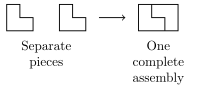
In this worked example, rotate the second L-shaped piece by a half-turn. The two pieces fill the rectangle at right. Follow the stepped internal join to see where each piece ends. Each piece has area three square units, and the assembled rectangle has area six; the matching boundary and joins establish the fit, while equal area alone would not.
Assembling Objects · Use size and shape invariants
Rigid rotation and translation preserve lengths, angles, area, and curvature. A piece cannot be stretched to fill a gap. A circular arc does not become an elliptical arc under rotation. Use these properties to reject impossible choices, then confirm a full assembly instead of relying on one convenient match.Assembling Objects · Follow marked connections
Trace each label to its exact point on its shape, such as a particular endpoint of an edge. Then track that point when the shape rotates. The connector must meet the specified point at each end. A figure can look similar while connecting to a neighboring corner, so check both contacts independently.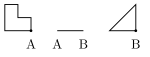

The first picture gives two marked shapes and a connector. In the completed picture, the triangle has turned a quarter-turn clockwise. Its B point is still the right-angle vertex; it has not moved to either acute vertex. The connector keeps its length and joins that vertex to the marked A corner of the L shape. Neither shape is reflected.