Effortless Math · ASVAB study resources
Assembling Objects Quick Review
Identify the task before moving pieces
Fitting questions ask which assembled figure can be made from the supplied pieces. Marked-connection questions ask whether particular points touch in the finished arrangement. These require different checks. A fitting task needs full boundary and join verification, while a connection task needs the correct contact points as well as preserved shapes.Track a distinctive feature
Choose an unusual corner, notch, long edge, or curved section and follow it through the proposed arrangement. A familiar general outline can hide a wrong corner. Start with a feature that is hard to confuse, then verify the rest of the piece. Naming a landmark mentally can help you keep track of it while rotating.Rotate without reflecting
A rotation turns a piece while preserving its handedness and shape. A reflection reverses handedness. Imagine an asymmetric flag turning on a tabletop: it changes direction, but its notch stays on the same side relative to its other features. If a choice requires the flag to be turned over, that is a reflection rather than a permitted rotation in these exercises.Check edges and joins
Match straight edges by direction and length, and curved edges by compatible curvature. All pieces must be used according to the directions. A tiny overlap or uncovered region invalidates a fitting arrangement even when the outside looks close. Internal joins should explain where each original piece has gone. An entire edge need not meet one entire edge of another piece. A longer straight edge can meet shorter collinear segments when their lengths and positions fit. Check the complete boundary rather than assuming every join pairs two whole edges.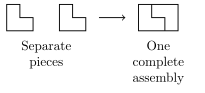
In this worked example, rotate the second L-shaped piece by a half-turn. The two pieces fill the rectangle at right. Follow the stepped internal join to see where each piece ends. Each piece has area three square units, and the assembled rectangle has area six; the matching boundary and joins establish the fit, while equal area alone would not.
Use size and shape invariants
Rigid rotation and translation preserve lengths, angles, area, and curvature. A piece cannot be stretched to fill a gap. A circular arc does not become an elliptical arc under rotation. Use these properties to reject impossible choices, then confirm a full assembly instead of relying on one convenient match.Follow marked connections
Trace each label to its exact point on its shape, such as a particular endpoint of an edge. Then track that point when the shape rotates. The connector must meet the specified point at each end. A figure can look similar while connecting to a neighboring corner, so check both contacts independently.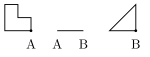

The first picture gives two marked shapes and a connector. In the completed picture, the triangle has turned a quarter-turn clockwise. Its B point is still the right-angle vertex; it has not moved to either acute vertex. The connector keeps its length and joins that vertex to the marked A corner of the L shape. Neither shape is reflected.