ALEKS Math Placement Test: What to Expect (and How to Pass)
The ALEKS Math Placement Test decides what math class you start with in college — and skipping the wrong way can cost you a semester (and a course’s worth of tuition). Here’s what to expect, what to study, and how to do well even if you haven’t done math in a while.
What ALEKS PPL actually is
ALEKS stands for Assessment and Learning in Knowledge Spaces. The “PPL” version is the Placement, Preparation, and Learning assessment most colleges use to place incoming students into Pre-Algebra, Intermediate Algebra, College Algebra, Pre-Calculus, or Calculus.
- 25–30 open-response questions (no multiple choice).
- About 90 minutes.
- Adaptive — your next question depends on your last answer.
- You score 0–100; cut-scores depend on your school.
What topics are on it?
ALEKS PPL is broad. Expect:
- Arithmetic & fractions
- Pre-algebra & basic algebra
- Linear equations, inequalities, systems
- Quadratics, polynomials, factoring
- Exponents, radicals, scientific notation
- Geometry (area, volume, Pythagorean)
- Functions and graphs
- Right-triangle trigonometry (for higher placement scores)
- Logarithms (for very high placement)
How scoring & retakes work
- Most schools allow 3–5 attempts with a cooldown (usually 24 hours).
- Between attempts, ALEKS unlocks a personalized Prep & Learning Module — short lessons targeting your weak topics. Use it. Students who spend 5+ hours in the module before retaking typically jump 8–15 points.
A 4-week ALEKS study plan
- Week 1: Take the first attempt cold. This is your diagnostic.
- Week 2: Spend 5+ hours in the Prep & Learning Module. Drill fractions, signed arithmetic, and linear equations.
- Week 3: Add quadratics, factoring, and functions. Take attempt 2.
- Week 4: Polish weak topics — usually radicals or trig — and take your final attempt.
Common mistakes
- Treating attempt 1 as your only shot. It’s not.
- Skipping the Prep & Learning Module between retakes.
- Using a calculator on every question — ALEKS only allows calculator on certain questions.
FAQ
Can I use a calculator on ALEKS?
On some questions — ALEKS opens an on-screen calculator only when allowed. No personal calculator.
How many times can I retake?
Most colleges allow 3–5 attempts. Check your specific school’s policy.
How long is each attempt?
About 90 minutes for 25–30 questions.
What score do I need for College Algebra?
Most schools require 60–75 for College Algebra and 78+ for Pre-Calculus. Your school sets its own cut-scores.
What’s the best book to study from?
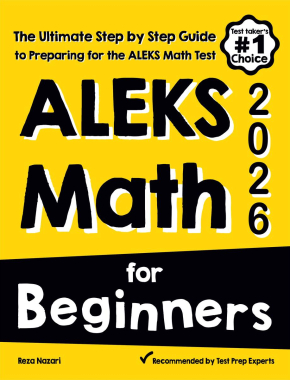
Our ALEKS Math for Beginners book is built specifically for the placement test.
How is the Prep & Learning Module different from a regular practice test?
It’s adaptive and personalized. ALEKS identifies the exact topics you missed (or didn’t know) and serves up short lessons + practice problems until you’ve mastered each one. Five hours in the module is roughly equivalent to 15–20 hours in a generic prep book.
Can I use scratch paper?
If you’re taking ALEKS in a proctored lab, yes. For at-home proctored ALEKS, the rules are stricter — usually you can use a whiteboard or scratch paper that you show the proctor before and after.
Does ALEKS expire?
Yes — most colleges accept ALEKS scores for 12 months. If you take a gap year, you may need to retake.
What if I score very high — like 90+?
A score above 90 typically places you straight into Calculus or Pre-Calculus. Some colleges grant elective credit for very high ALEKS scores. Always check your college’s placement chart.
What the ALEKS interface looks like
ALEKS doesn’t use multiple choice. You type your answer directly into an answer box, often with a small math-tool palette for fractions, square roots, exponents, and so on. There’s no penalty for using the palette — in fact, you have to use it for any answer that isn’t a plain integer.
Spend 10 minutes before your first attempt clicking through every button in the palette so you don’t lose time during the timed assessment figuring out how to type $\sqrt{2}$ or $\tfrac{3}{4}$.
Smart use of the calculator inside ALEKS
ALEKS opens its on-screen calculator only for certain problems — typically those involving long arithmetic, percent calculations, or logarithms. If the calculator icon doesn’t appear, mental math or pencil-and-paper computation is what’s expected.
Because ALEKS often gives you the calculator only on the hard questions, students who rely too heavily on it for easy steps end up running out of time. Get fast at signed arithmetic, fraction conversion, and order of operations without a calculator.
The single biggest score boost
If you have time for only one thing between attempts, do this: spend 5 dedicated hours in the Prep & Learning Module, focusing exclusively on the topics ALEKS flagged as your weakest. Students who do this consistently see 8–15-point gains — enough to leap an entire course placement.
What happens after the placement
Once your final score is in, your college’s advising office will route you to a math course. If you’re borderline between two courses, almost every college will let you start in the higher course; you can always drop down in the first week. Aim high.
The 4 ALEKS tiers most colleges use
While every school is different, the most common placement chart looks like this:
- 0–29: Pre-Algebra / Foundations of Math (often a non-credit course).
- 30–45: Beginning Algebra or Intermediate Algebra.
- 46–60: College Algebra (credit-bearing).
- 61–75: Pre-Calculus.
- 76–100: Calculus 1.
Moving up one tier can save a semester and ~$1,500–$3,000 in tuition. That’s why retaking ALEKS after focused prep is almost always worth it.
What ALEKS tests — the topic map
ALEKS covers roughly 314 topics in its “pie chart.” The big slices:
- Real numbers and arithmetic. Order of operations, integers, fractions, decimals, percents.
- Algebraic expressions. Combining like terms, distributing, polynomial operations.
- Linear equations and inequalities. Solving, graphing, slope, parallel/perpendicular.
- Word problems. Mixture, motion, work, age, percent.
- Polynomials and factoring. Factoring trinomials, difference of squares, special cases.
- Rational expressions. Simplifying, multiplying, dividing, adding/subtracting.
- Radicals and rational exponents. Simplifying, operating with radicals.
- Quadratics. Factoring, completing the square, quadratic formula, graphing parabolas.
- Functions. Notation, domain/range, composition, inverses.
- Exponential and logarithmic functions (for Pre-Calc placement).
- Trigonometry (for Calculus placement).
Your pie chart shows which slices you already own and which need work.
How long should you spend in the Prep & Learning Module?
Most colleges set a minimum hour requirement (often 3 hours) before you can retake. But more is better. Our data shows:
- 0–2 hours: Minimal score improvement (~3–5 points).
- 5–10 hours: Solid improvement (~8–12 points).
- 15+ hours: Major improvement (~15–25 points).
If you’re 10 points away from a critical threshold, schedule 15 dedicated hours of module work between attempts.
Final note
Extra study tips that move the needle
Most students don’t fail because the math is too hard — they fail because their practice habits are inefficient. Here are the habits that separate the students who improve fast from those who stall.
Practice with a timer. Untimed practice teaches you to eventually get the right answer; timed practice teaches you to get it in test conditions. Set a stopwatch every time you sit down. Aim for 90 seconds per question on most standardized tests.
Keep an error log. A simple spreadsheet with three columns — Problem, My answer, Correct answer, Why I missed it — is the single most powerful study tool ever invented. Review your error log weekly. The same mistakes show up again and again until you name them.
Mix topics every session. Doing 20 problems on the same topic feels productive, but spaced and interleaved practice — mixing topics — builds retrieval skills, which is what the test actually measures. Spend 70% of your time on mixed sets and only 30% on isolated drills.
Sleep on it. Memory consolidation happens during sleep. A 30-minute session the night before a quiz, followed by 7+ hours of sleep, beats a 3-hour cram session that ends at midnight. This is settled cognitive science.
Teach the topic out loud. If you can’t explain it, you don’t fully know it. Either record yourself, write a one-paragraph “how I’d teach this” explanation, or grab a friend to listen. Teaching exposes the gaps your problem sets hid.
When to ask for help
Spinning your wheels for more than 15 minutes on a single problem is a signal — not of failure, but of a missing piece of background. Stop, mark the problem, and either ask a teacher, post in our community, or watch a video on the relevant subtopic. Resuming after gaining the missing piece is much more efficient than guessing your way forward.
A quick self-assessment
Before you close this tab, answer these three questions honestly:
- What’s the one topic in this article you understood best?
- What’s the one topic that still feels fuzzy?
- What concrete next step (a worksheet, a practice test, a video) will you take in the next 48 hours?
Writing those answers down — even just in a notes app — has been shown to roughly double the chance you actually follow through. Treat the next 48 hours as a small, doable experiment, not a marathon. Your future test-day self will thank you.
ALEKS is not a measure of how smart you are. It’s a snapshot of what you currently remember. If you’re rusty after a summer or a few years off, the Prep & Learning Module is your secret weapon. Use it.
Related to This Article
More math articles
- FREE 7th Grade STAAR Math Practice Test
- How to Interpret Remainders of Division Two-digit Numbers By One-digit Numbers
- Top 10 4th Grade NYSE Math Practice Questions
- How to Solve Simple Interest Problems? (+FREE Worksheet!)
- The Ultimate AP Calculus BC Course
- 8th Grade MCAS Math FREE Sample Practice Questions
- Best Laptops for High School Students: 6 Things to Consider
- Free Grade 4 English Worksheets for Smarter Balanced Students
- Free Grade 8 English Worksheets for Maryland Students
- Word Problems of Comparing and Ordering Rational Numbers


What people say about "ALEKS Math Placement Test: What to Expect (and How to Pass) - Effortless Math: We Help Students Learn to LOVE Mathematics"?
No one replied yet.